
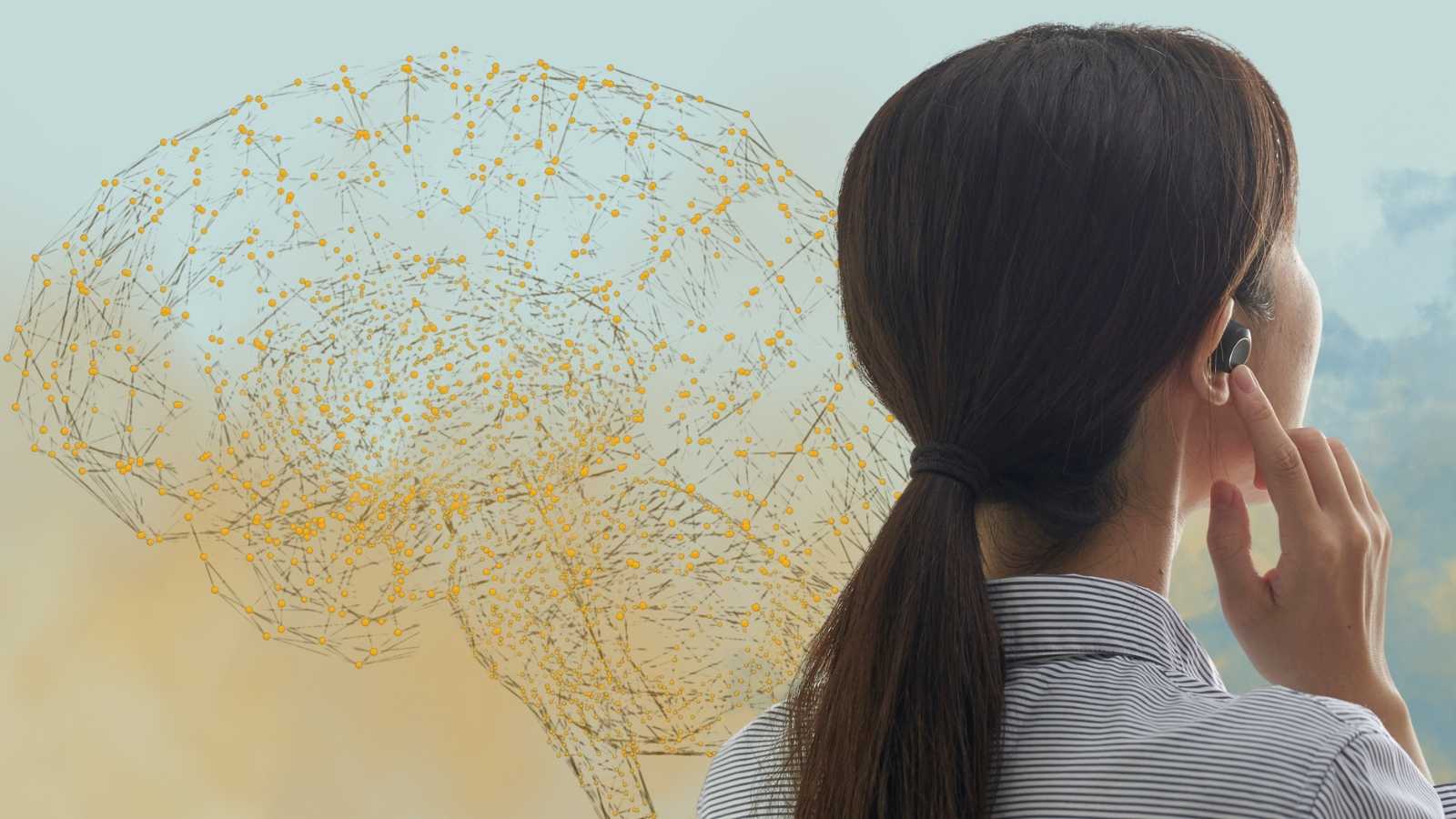
A new generation of tiny EEG devices sits inside or just around your ear. Here’s what they can measure, why they matter, and what they might soon do for you.
Written by Martina Berto.
WHAT IS EAR EEG?
Brain signals from your ear canal
Imagine a hearing aid that doesn’t just amplify sound — it also reads your mind. Not in a science-fiction sense, but in a very literal, electrochemical one: it detects the faint electrical signals your brain produces every moment of every day.
This is the promise of ear-based EEG — electroencephalography recorded not from a web of electrodes on your scalp, but from small sensors placed in or around the ear. Two main forms exist:
In-ear EEG
Electrodes are embedded directly into a custom earpiece. Essentially, a sophisticated earbud that sits inside the ear canal. The electrodes make contact with the skin lining the canal, recording brain electrical activity from the outside of the skull, just millimetres from the temporal lobe of the brain. The concept was first demonstrated in 2011 and since then has been validated in hundreds of peer-reviewed studies.
Around-ear EEG (periauricular EEG)
Rather than entering the canal, electrodes are arranged in a flexible array worn around the outer ear — think of a soft, C-shaped clip that wraps behind the ear. The best-known commercial form is the cEEGrid, used extensively in research labs. Because these electrodes sit closer to the scalp surface without the constraints of the ear canal, they can record from a slightly wider area while still being far more discreet than a traditional EEG cap.
Both approaches benefit from the same fundamental insight: the ear sits in an acoustically isolated, mechanically stable position on the skull, close to the auditory and temporal regions of the brain. This makes it an unusually good location for a wearable neural sensor, especially one you might wear all day without anyone noticing.
HOW DOES IT COMPARE?
Smaller signals, bigger convenience
To understand ear EEG, it helps to understand what conventional scalp EEG is doing. A standard clinical EEG system places 19 to 64 (or even 256) wet electrodes across your entire head, requires conductive gel, takes trained technicians 20–30 minutes to set up, and leaves you tethered to an amplifier. It is exquisitely sensitive — but completely impractical for everyday life.
Ear-based EEG sits at the opposite end of this spectrum. The signals are weaker — roughly 2 to 10 times smaller in amplitude than scalp recordings — and spatial coverage is limited. But what it sacrifices in raw signal strength, it more than compensates for in every other dimension that matters for daily use.
| Feature | Scalp EEG | Around-ear EEG | In-ear EEG |
|---|---|---|---|
| Electrodes | 19–256 | 9–20 per ear | 2–6 per ear |
| Signal amplitude | 10–100 µV | Moderate | 1–10 µV |
| Setup time | 20–45 min + gel | ~5 min | <2 min |
| Comfort (long-term) | Low | Good | High |
| Concealability | None | Moderate | Near-invisible |
| Best suited for | Clinical diagnosis, research | Wearable research, monitoring | Daily-life monitoring, hearables |
A recent head-to-head study recorded scalp, around-ear, and in-ear EEG simultaneously in the same participants, allowing a direct comparison. Using a standard algorithm to decode which of two speakers a listener was paying attention to, the results illustrated the trade-off clearly:
Auditory attention decoding accuracy
60-second decision windows · Geirnaert et al., Scientific Reports, 2025
All three setups showed significant performance above chance. Adding just 3 scalp electrodes to in-ear EEG brings accuracy close to full scalp-EEG level.
Importantly, adding just three well-placed scalp electrodes to an in-ear setup brought performance close to full scalp EEG levels, suggesting that the future may be hybrid sensor networks rather than any single modality alone.
One more key difference: in-ear devices typically use dry electrodes, no gel needed. No studies have shown how they compared with dry-elecrodes scalp EEG like BrainAccess. Dry EEG trades a small amount of signal quality for enormous gains in convenience. Studies confirm that dry electrodes, including in-ear ones, start with higher electrical impedance but stabilise significantly within the first hour of wear, as natural moisture improves skin contact.
WHAT CAN WE MEASURE?
What ear EEG can actually detect
Despite recording from a small patch of scalp near the ear, ear-based EEG is capable of capturing a surprisingly rich range of brain signals — particularly those generated by temporal and frontal regions, which happen to be involved in many of the mental processes we care about most.
Brain signals detectable with ear EEG
Alpha waves
Relaxation, eyes-closed rest, mindfulness states
Theta waves
Drowsiness, memory encoding, light meditation
Sleep spindles & slow waves
N2 and deep (N3) sleep stage signatures
Auditory evoked potentials
Brain responses to sounds, clicks, speech onset
P300 response
Target detection signal; used in BCI paradigms
Steady-state responses
ASSR and SSVEP — frequency-tagging paradigms
Neural speech tracking
Cortical entrainment to attended speech rhythm
Attentional focus
Which speaker or stimulus the listener is focused on
Motor imagery
Imagined hand or tongue movement for BCI control
Sleep and relaxation
One of the most robust demonstrations of in-ear EEG is sleep monitoring. Multiple studies have shown that ear-worn devices can detect the distinct brainwave signatures of light sleep (N1, N2), deep sleep (N3), and REM sleep with accuracy comparable to laboratory polysomnography. Alpha waves, the hallmark of wakeful relaxation, are detected in around 80% of users. In a study of 30 participants, in-ear EEG correlated significantly with scalp signals across all sleep stages. Noticeably, consumers-level devices for these application already exist in the market.
Focus and mental workload
Changes in frontal alpha power and theta activity are well-established markers of sustained attention and cognitive load. Ear electrodes positioned near the frontal-temporal boundary can capture these shifts, making it possible to track how hard you’re concentrating or to detect the early onset of mental fatigue.
Auditory attention and speech tracking
Perhaps the most scientifically striking capability is neural speech tracking: the brain’s auditory cortex subtly synchronizes its electrical oscillations with the rhythm of speech it is attending to. Ear EEG can detect this entrainment, revealing which voice in a noisy room a person is focusing on. This is the core mechanism behind next-generation hearing aids that can literally steer amplification toward the speaker you’re listening to.
Motor imagery
Research has demonstrated that movement-related brain signals (including imagined hand and tongue movements) can be decoded from around-ear EEG. This opens doors to hands-free control systems that require no physical movement at all.
Wellbeing markers
Frontal asymmetry in alpha-band activity is associated with emotional states and stress. While ear EEG’s limited spatial resolution makes this more challenging than with full scalp coverage, frontal temporal electrode placements still capture enough signal to contribute meaningfully to mental wellbeing monitoring — particularly when fused with other physiological signals such as heart rate or skin conductance.
APPLICATIONS
What could you actually do with this?
The applications of ear-based EEG span from deeply clinical to delightfully playful. What unites them is a simple enabling condition: a brain-monitoring device that people are actually willing to wear — in bed, on the commute, at the gym, all day.
🌙
Sleep Tracking
Automatic, objective staging of sleep cycles from the comfort of a familiar earpiece without a sleep lab visit. Already validated in multiple clinical studies.
🎧
Smart Hearing Aids
Devices that detect which speaker you’re paying attention to and automatically focus amplification there. A paradigm shift for the 430 million people worldwide with hearing loss.
💡
Home & Device Control
Imagine switching off a light, skipping a track, or answering a call using nothing but attention or a mental command. BCI paradigms like P300 and motor imagery work in ear EEG.
🎮
Neurogaming & BCI
In-ear EEG can serve as a discreet, portable input channel for brain-computer interface games and applications. No headset required. This will also facilitate integration with VR headset.
🧘🏻
Wellness & Mindfulness
Real-time feedback on relaxation and focus states built into the earbuds you’re already wearing during a meditation session or a stressful workday.
🧠
Neuroadaptive Technology
Software and devices that adapt to your cognitive state in real time, adjusting music tempo, notification volume, or workflow tools based on how focused or fatigued you are.
🚗
Fatigue & Drowsiness Monitoring
Detecting microsleeps or dangerous drowsiness in drivers, pilots, or shift workers with continuous, unobtrusive monitoring that doesn’t interfere with the task.
🏥
Long-term Neurological Monitoring
Out-of-clinic EEG monitoring for epilepsy, early signs of Alzheimer’s, or Parkinson’s disease. Weeks of continuous data, collected at home without clinical staff.
Integration into everyday earphones
Perhaps the most commercially exciting trajectory is the integration of EEG sensors into mainstream consumer earphones. Several companies are already exploring this direction. The billions of earbuds worn globally every day represent a ready-made distribution platform for the world’s largest passive brain-monitoring network, one that users would wear not because they need a medical device, but simply because they want to listen to music.
The convergence is natural: modern wireless earbuds already contain microphones, accelerometers, touch sensors, and sophisticated digital signal processors. Adding a small number of EEG electrodes to the earpiece architecture is, in principle, a straightforward hardware addition. The challenge lies in the signal processing and the algorithms that make the data meaningful.
WHERE WE ARE HEADED
A small device with a very large horizon
Ear-based EEG is still a young field. There are genuine limitations to acknowledge: signal quality is lower than scalp EEG, spatial resolution is constrained, and individual differences in ear anatomy mean that one size doesn’t always fit all. Dry electrode impedance can vary. Motion artifacts from jaw movements remain a real challenge. Participant-independent models, algorithms trained on one person and applied to another, work less reliably from the ear than from the scalp.
But the trajectory is clear. Algorithms are getting better, especially with machine learning. Electrode materials are improving. Device design is becoming more sophisticated, and increasingly personalized. And the research base once sparse is now expanding rapidly, with new datasets, new paradigms, and new clinical validations appearing every year.
The fundamental physics won’t change: the brain is inside the skull, the ear is outside it, and distance matters for signal amplitude. But for the vast class of applications that don’t need to resolve activity from every corner of the cortex, such as monitoring your sleep, detecting your attentional focus, tracking fatigue, enabling simple hands-free control, ear EEG is already good enough, and it’s getting better.
At BrainAccess, we’re paying close attention
We’ve built compact EEG hardware — the MINI, MIDI, and HALO headsets — designed for researchers, developers, and the applications of tomorrow. Ear-based EEG represents an exciting frontier we are actively exploring: its potential to bring brain monitoring into everyday life aligns perfectly with why we do what we do.
We’re curious: would you wear EEG in your earphones? What would you want it to do for you? We’d love to hear your thoughts! Reach out, or follow our updates as we keep pushing the boundary of what compact EEG can do.
References
Debener, S., Emkes, R., De Vos, M., & Bleichner, M. (2015). Unobtrusive ambulatory EEG using a smartphone and flexible printed electrodes around the ear. Scientific reports, 5(1), 16743.
Geirnaert S., Kappel S.L., & Kidmose P. (2025). A direct comparison of simultaneously recorded scalp, around-ear and in-ear EEG for neural selective auditory attention decoding to speech. Scientific Reports, 15, 41655.
Moumane H. et al. (2024). Signal quality evaluation of an in-ear EEG device in comparison to a conventional cap system. Frontiers in Neuroscience, 18, 1441897.
Mihai A.S. et al. (2025). The Next Frontier in Brain Monitoring: A Comprehensive Look at In-Ear EEG Electrodes and Their Applications. Sensors, 25, 3321.

Martina Berto, PhD
Research Engineer & Neuroscientist @ Neurotechnology.
Martina Berto, PhD
Research Engineer & Neuroscientist @ Neurotechnology.