
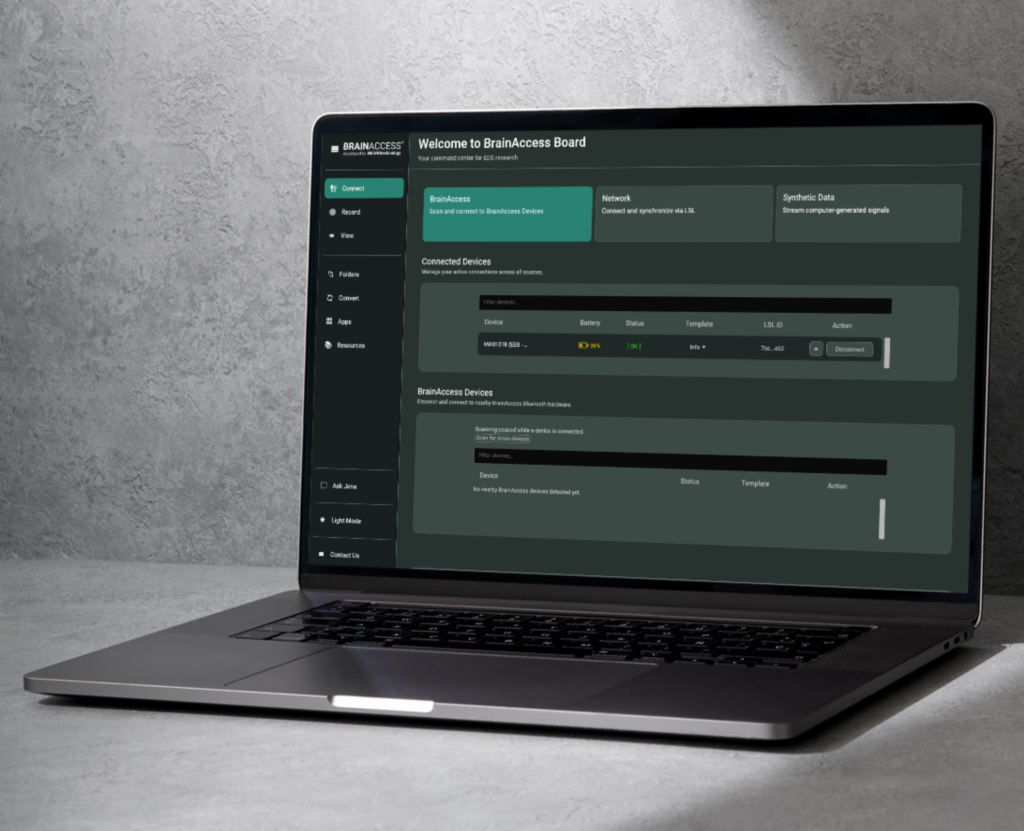
Welcome to BrainAccess Board
your command center for EEG research
This introductory tutorial demonstrates how to connect and stream data from BrainAccess devices using BrainAccess Board software.
With BrainAccess Board you can record signal from one or multiple devices, inspect the signal in the viewer, explore the main data folders, convert your .db data to different formats, check your data quality with Jena, the integrated AI chatbot, and more.
Installation
Download the BrainAccess Board software from the Download Centre.
Unpack the .zip folder and install on your computer.
General Interface
The new BrainAccess Board interface is designed to give you more control over your data, devices, recordings, and analysis workflow.
The main functionalities are available from the sidebar:
- Connect
Discover and connect to nearby BrainAccess Bluetooth hardware. Multiple devices can be connected at the same time. - Record
Capture a new recording session from connected signal sources. - View
Visualize incoming signals in real time. - Folders
Quickly access local application directories, including templates, logs, and recorded data. - Convert
Batch-convert BrainAccess DB and BDF recordings into analysis-ready formats. - Apps
Open external Python plugins. Users can also extend the system by adding their own custom apps. - Resources
Access links to manuals, documentation, tutorials, and downloads. - Ask Jena
Use BrainAccess Jena, the integrated chatbot, to ask questions about Board settings, connected device status, and signal quality.
Connect
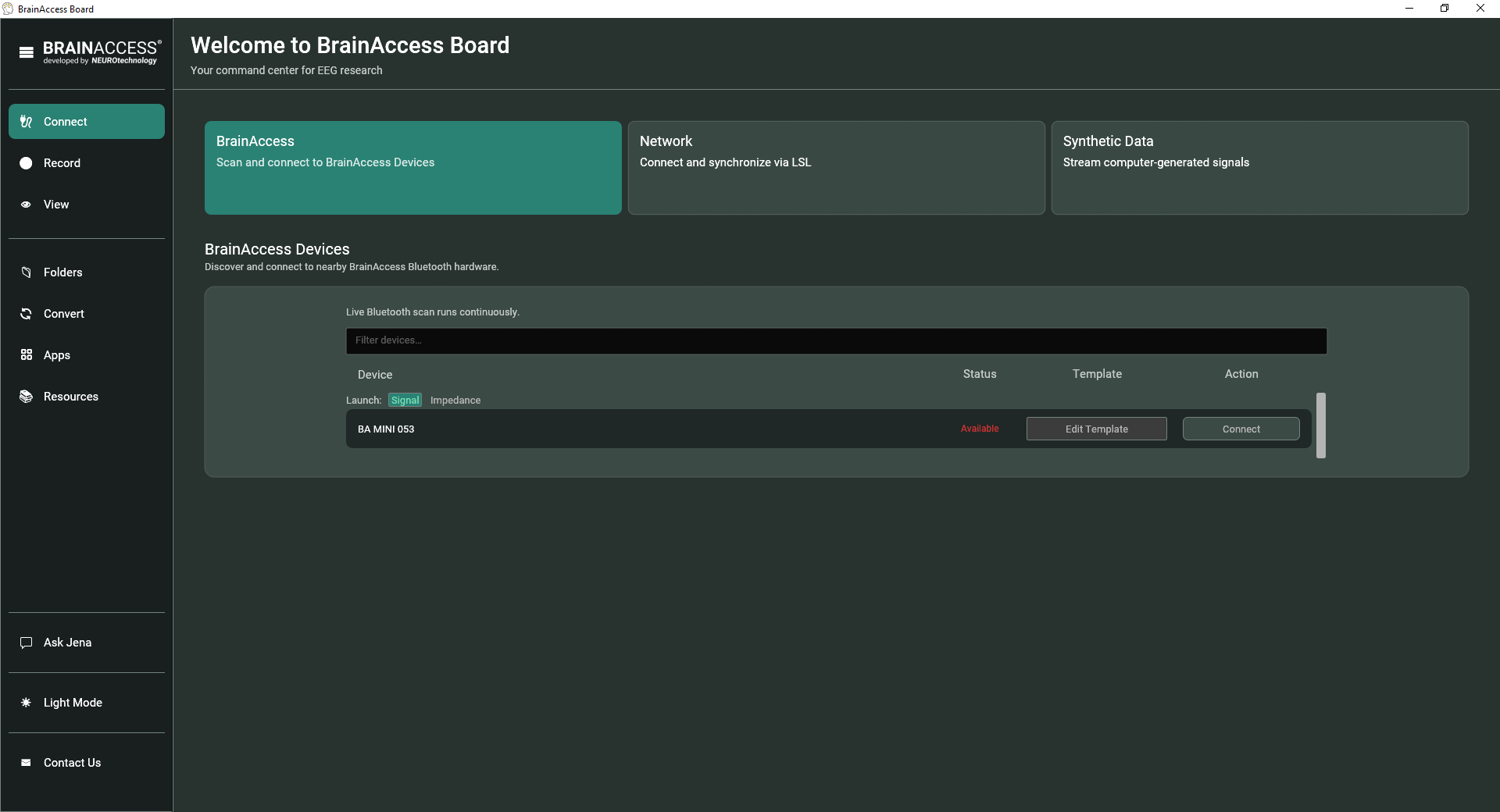
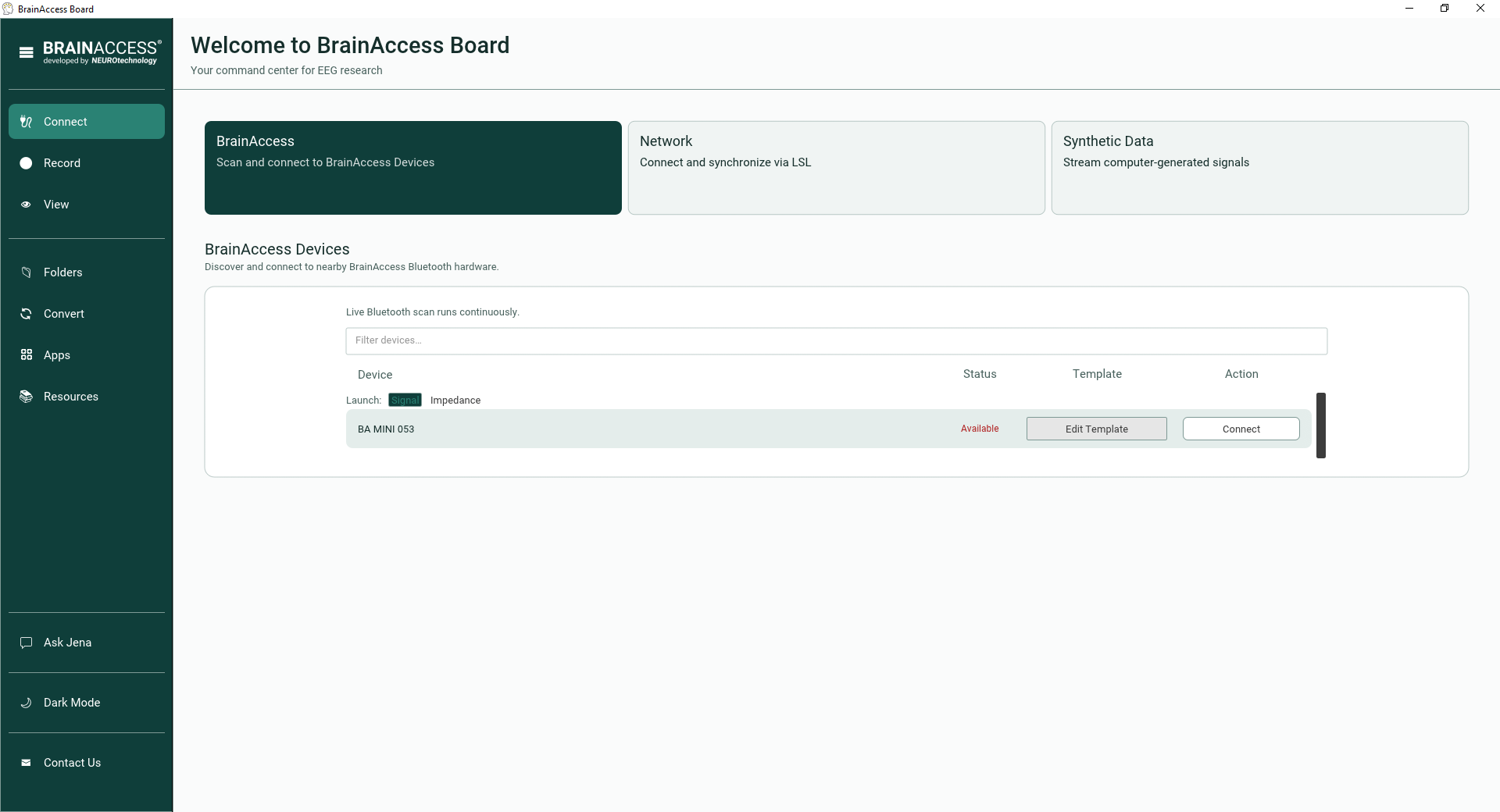
The Connect page allows you to discover, connect, and manage signal sources. It contains three main modules:
- BrainAccess: Scan for and connect to BrainAccess Bluetooth devices.
- Network: Connect to external streams using Lab Streaming Layer, or LSL.
- Synthetic Data: Generate computer-based synthetic EEG signals for testing and development.
BrainAccess Devices
The BrainAccess module continuously scans for nearby Bluetooth devices until at least one device is connected.
When a device is detected, it appears in the table under
BrainAccess Devices –> Device.
There are two connection modes:
- Signal: Connect to the device for signal recording.
- Impedance: Connect in impedance mode to check electrode impedance and signal quality before recording.
The device table includes the following information:
| Column | Description |
|---|---|
| Device | Name of the detected device. |
| Status | Current connection status. A red status indicates that the device is disconnected. |
| Edit Template | Select or edit the channel template used for the device. |
| Action | Click “Connect” to connect to the selected device. |
If several devices are detected, use the Filter device field to type part of the device name and quickly find the one you want.
After a device is connected, it is moved to the Connected Devices table. This section allows you to manage all active connections across available sources.
The connected device table includes additional information:
| Column | Description |
|---|---|
| Battery | Shows the current battery level as a percentage. |
| Status | Shows the updated connection status. A connected device should appear as green or OK. |
| Template | Displays template information, including an overview and raw JSON view. |
| LSL ID | Shows the Lab Streaming Layer identifier for the connected stream. |
| Viewer | Click the eye icon to open the signal viewer in a detached window. |
| Action | Click “Disconnect” to end the connection. |
Network
The Network module detects available Lab Streaming Layer, or LSL, streams on your local network.
Use this module to connect to external devices or data streams and synchronize them using the same clock. This is useful when combining BrainAccess recordings with other devices or software that also support LSL.
Synthetic Data
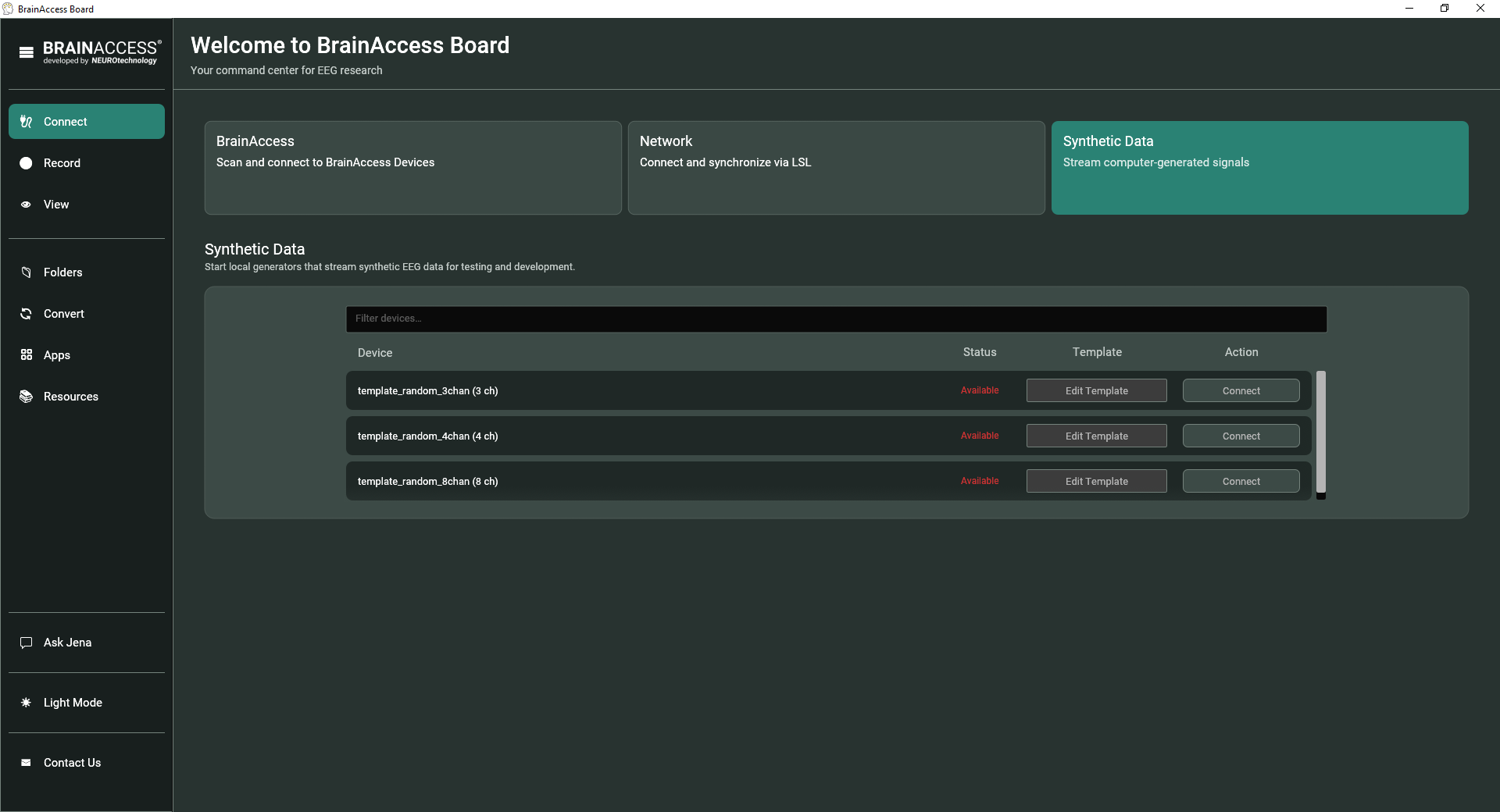
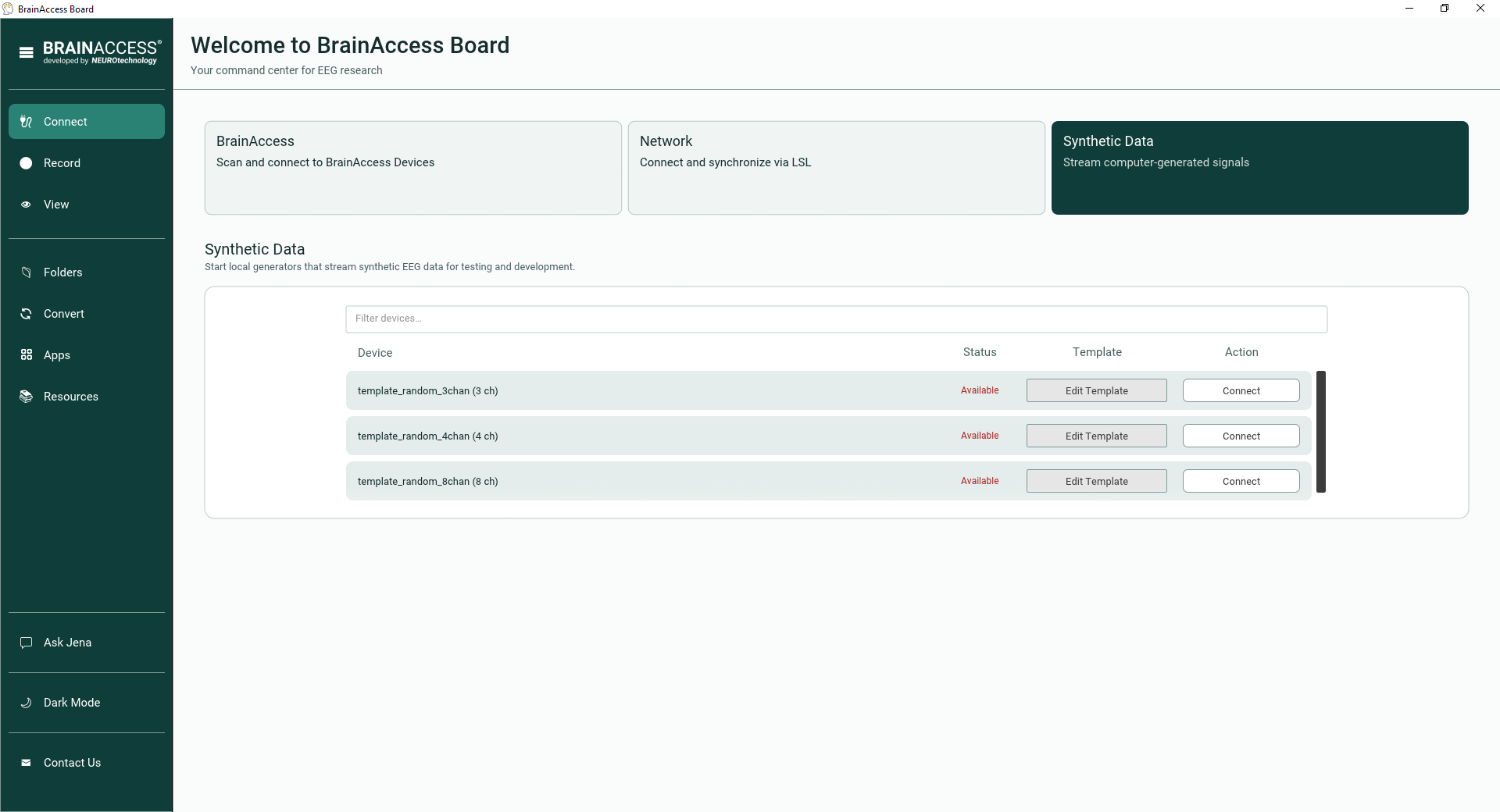
The Synthetic Data module allows you to start local generators that stream synthetic EEG-like signals.
Synthetic data is useful for:
- Testing Board functionalities without physical hardware.
- Becoming familiar with the interface.
- Simulating specific events or signal patterns.
- Developing and testing analysis pipelines.
Three predefined generator options are available:
- 3 channels
- 4 channels
- 8 channels
For each synthetic generator, you can use Edit Template to customize:
- Channel locations.
- Signal function, such as sine, cosine, or random noise.
- Main frequency, for example 4 Hz.
- Signal amplitude.
- Signal phase.
The synthetic data table uses the same options as the BrainAccess device table. Once connected, a synthetic generator appears together with the connected devices and behaves like a regular signal source. Its signal can be viewed in the same way as EEG data.
Record
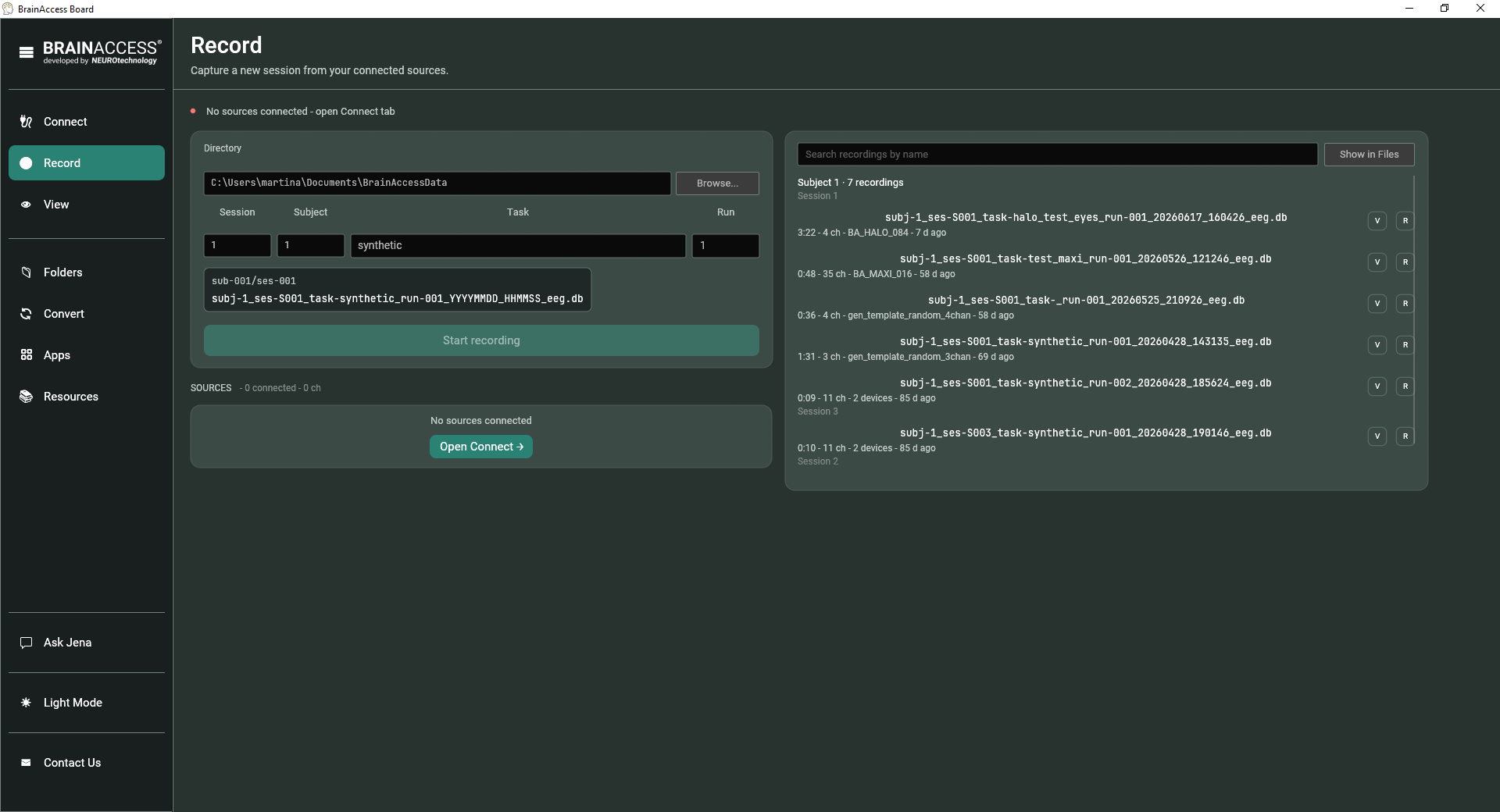
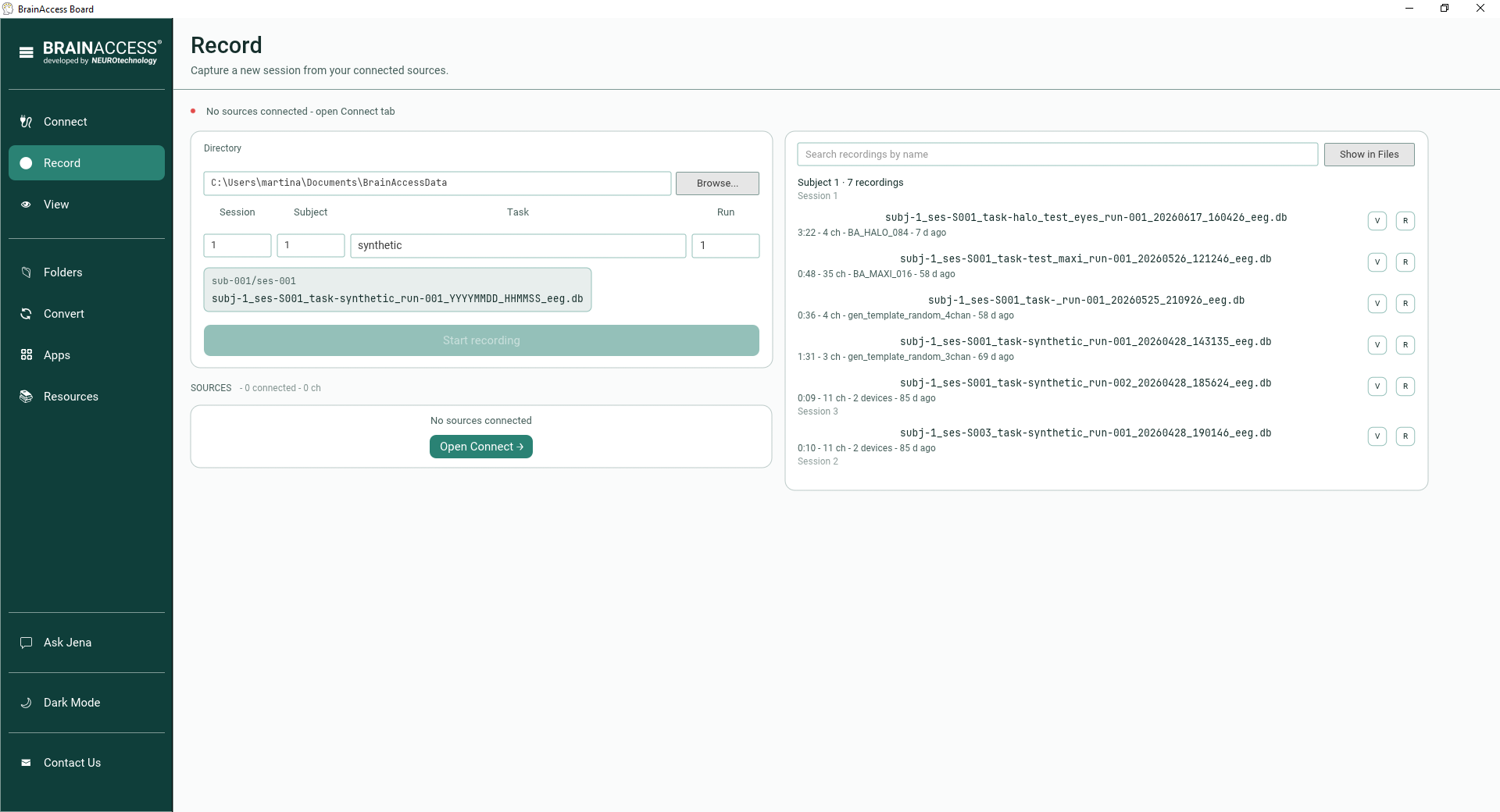
The Record page is used to capture a new session from the connected signal sources and to access recordings that are already saved in the selected directory.
The page is divided into two main areas:
- The recording setup area on the left.
- The recordings list on the right.
Recording Setup
At the top of the page, BrainAccess Board shows how many sources are currently available for recording. For example:
1 source ready – idle
This means that one signal source is connected and ready, but recording has not started yet.
Under the recording form, the Sources section shows the connected sources. For example:
Sources – 1 connected – 4 ch
Each connected source is listed with its name, signal type, number of channels, sampling rate, and current streaming status.
Selecting the Save Directory
Before starting a recording, select the directory where the file should be saved.
The Directory field shows the current save location. To choose a different folder, click Browse… and select the desired directory.
The recordings shown on the right side of the page are also loaded from this selected directory.
Naming the Recording
Recordings are named using a BIDS-style format.
The recording name is generated from the fields in the recording form:
| Field | Description |
|---|---|
| Session | Session number or session identifier. |
| Subject | Subject number or subject identifier. |
| Task | Name of the task or condition being recorded. |
| Run | Run number for repeated recordings of the same task. |
As you fill in these fields, BrainAccess Board automatically generates the output filename.
The filename follows this structure:
subj-[subject]_ses-S[session]_task-[task]_run-[run]_YYYYMMDD_HHMMSS_eeg.db
The date and time are automatically added to every filename. This ensures that recordings are never overwritten, even if the same subject, session, task, and run values are used again.
Starting a Recording
Once at least one source is connected and the recording details are set, click Start recording.
The recording will begin using the connected sources and will be saved in the selected directory.
During recording, make sure that all required sources are connected and streaming correctly.
Sources
The Sources section shows the devices or streams that are currently connected and available for recording.
For each source, the page displays information such as:
- Source name.
- Signal type.
- Number of channels.
- Sampling rate.
- Streaming status.
For example, a synthetic data source may appear as:
Synthetic Data (SYN)
EEG · 3 ch · 250 Hz
Streaming
Recordings List
The right side of the page shows the recordings already available in the selected directory.
You can use the search bar to find recordings by name.
Each recording entry includes information such as:
- Filename.
- Recording duration.
- Number of channels.
- Template or device information.
- When the recording was created.
Viewing a Previous Recording
Each recording has a 🅅 button.
Click 🅅 to open the selected recording in the signal viewer. This allows you to inspect the recorded signal.
Reusing Recording Settings
Each recording also has an 🅁 button.
Click 🅁 to copy the recording settings from that file into the recording form. This is useful when you want to record the same subject, session, task, or run again.
For example, you can use this option when repeating a recording for the same subject or replacing a previous attempt.
View
The View page allows you to inspect data from the connected BrainAccess device.
What you see on this page depends on how the device was connected:
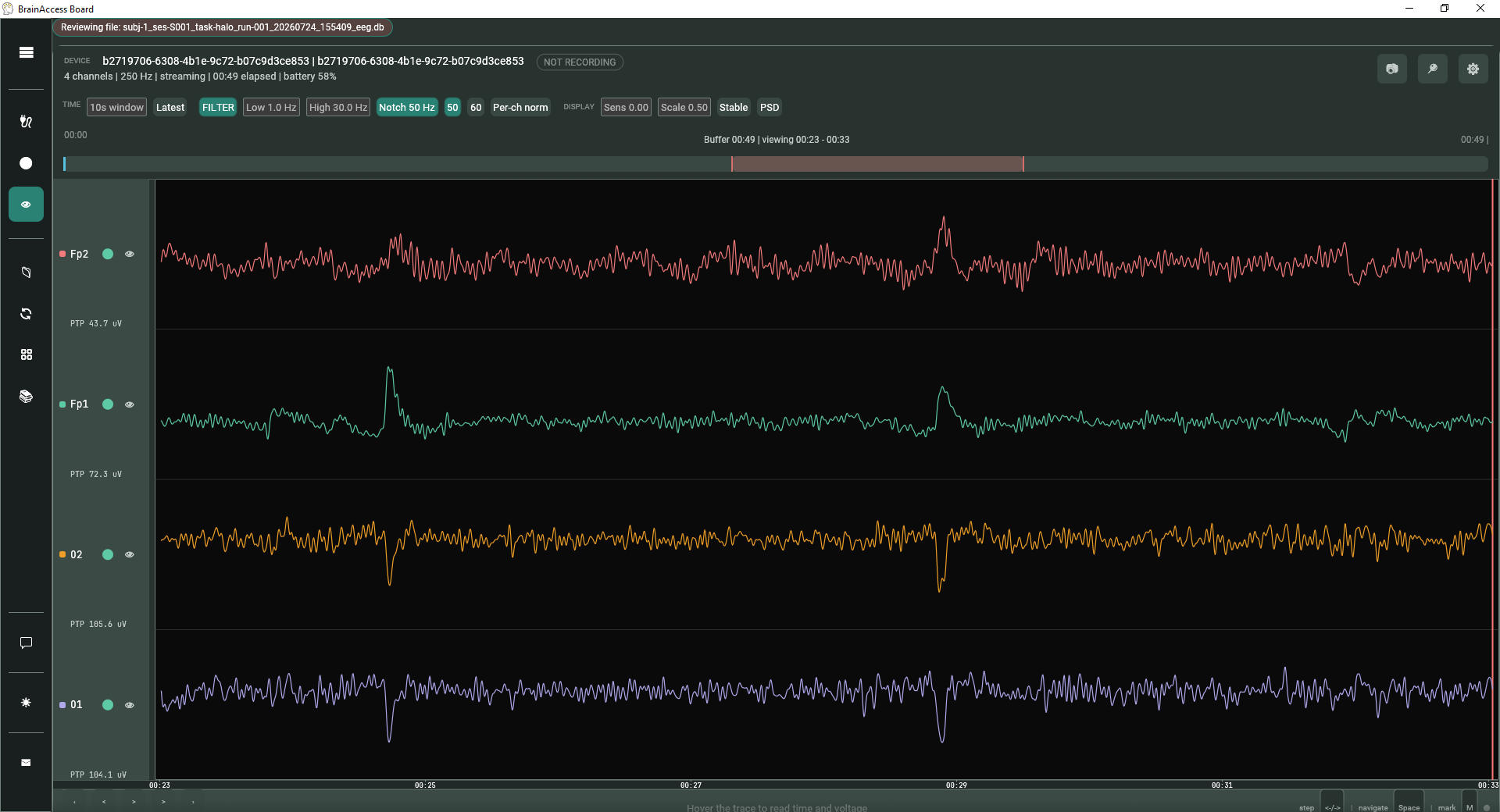
- If the device was connected in Signal mode, the View page opens the Signal Viewer, where you can inspect the EEG signal in real time.
- If the device was connected in Impedance mode, the View page opens the Impedance Viewer, where you can check electrode contact quality before recording.
Use Signal mode when you want to monitor or record EEG data. Use Impedance mode before recording to verify that the electrodes have good contact with the skin.
After checking impedance, disconnect the device and reconnect it in Signal mode before starting a recording.
Signal Mode
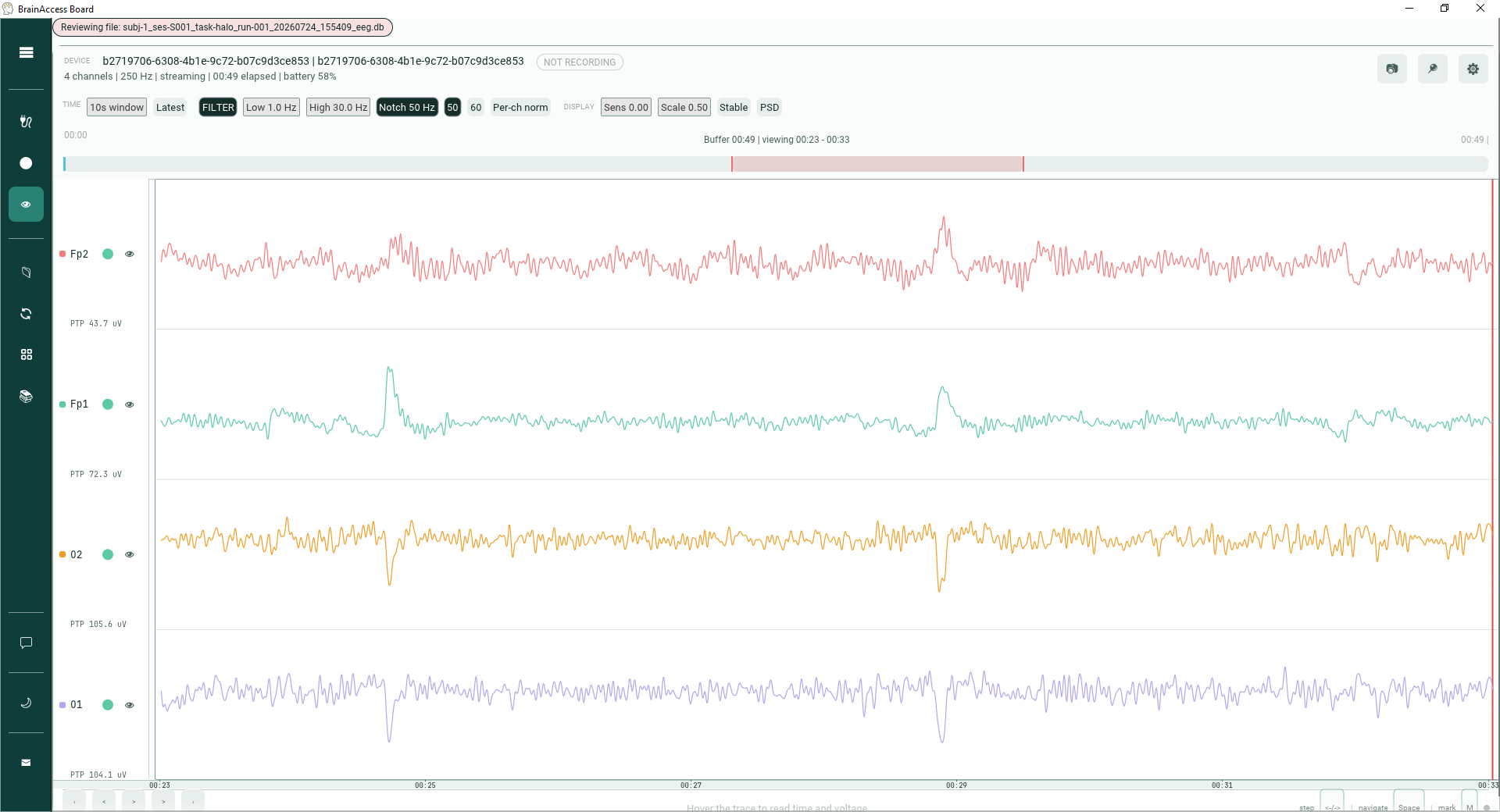
The Signal Viewer allows you to visually inspect your signal in real time. You can use it to check the incoming data stream, monitor signal quality, and verify that the connected sources are working correctly.
You can also use it to replay previously recorded data.
The way the signal is displayed can be customized, including the visual layout and main viewer settings.
For a complete explanation of the Signal Viewer settings and options, see the dedicated page:
Impedance mode
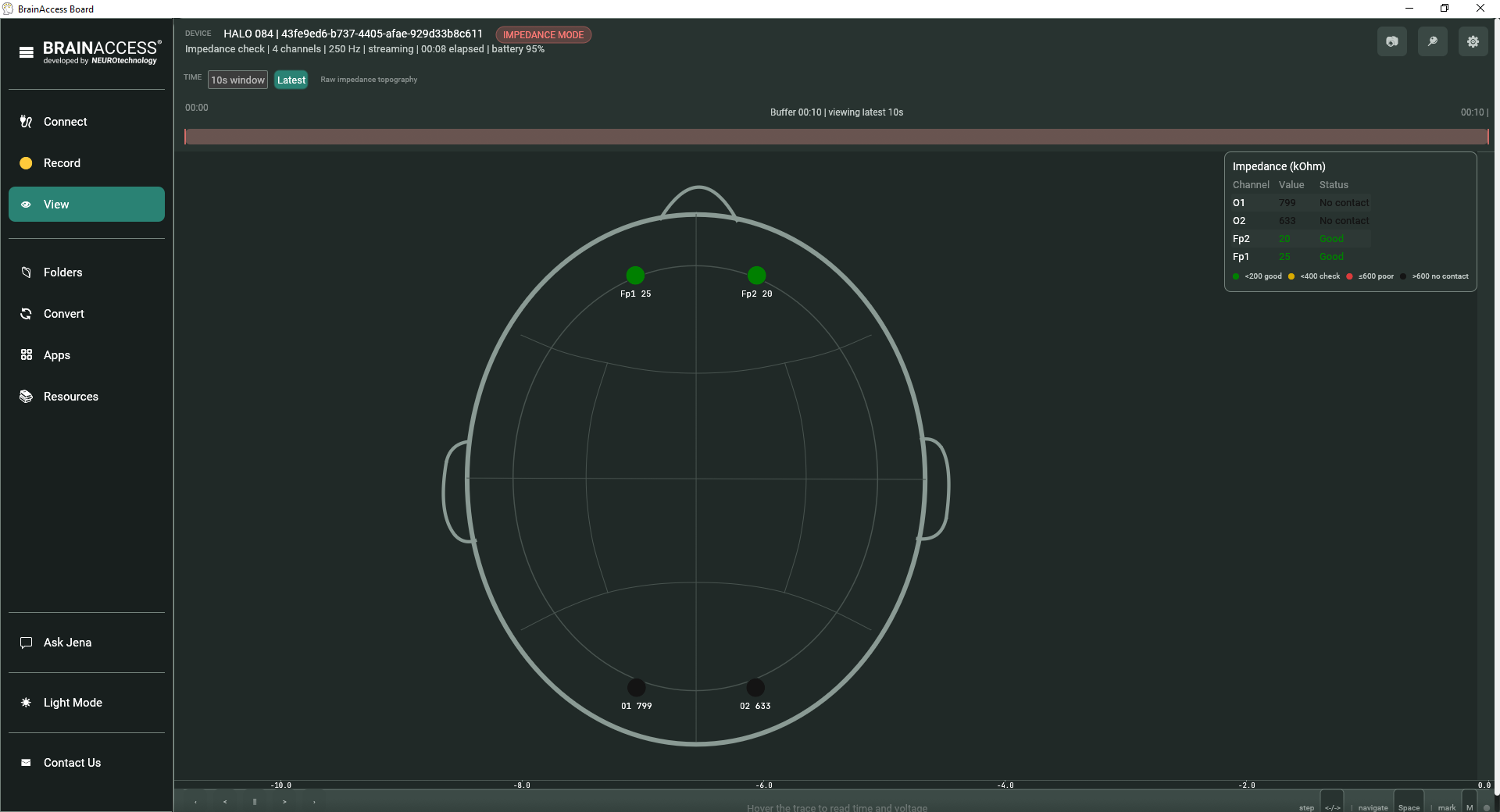
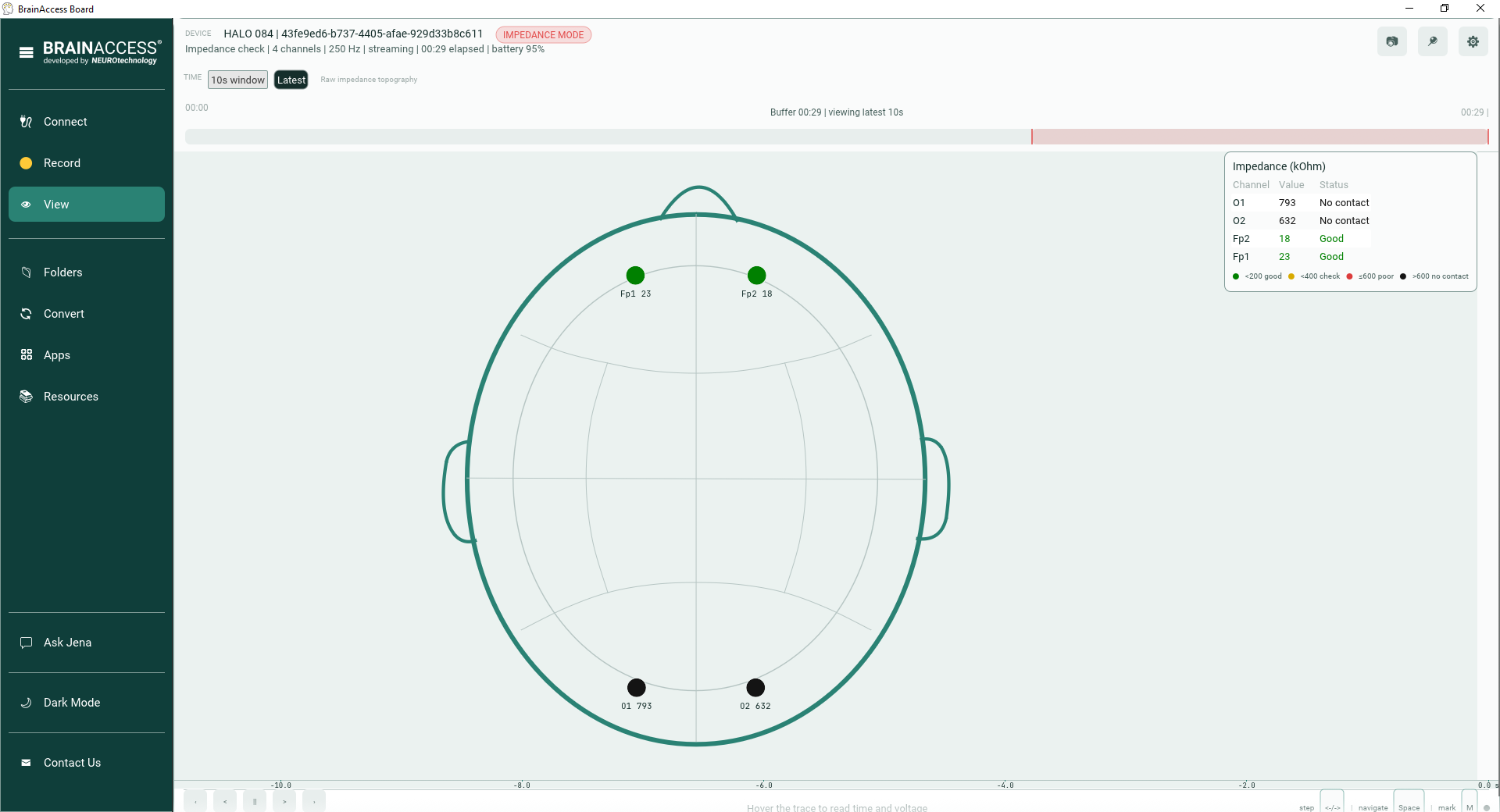
Impedance mode is used to check the quality of the electrode contact before recording.
Impedance describes how easily the EEG signal can pass between the electrode and the skin. Lower impedance usually indicates better contact and better signal quality, while high impedance may indicate poor contact, dry electrodes, or that the electrode needs to be adjusted.
To view impedance values, first connect the BrainAccess device in Impedance mode from the Connect page. Then open the View page from the sidebar.
The impedance screen shows a head map with the available electrode channels and their impedance values. A table on the side lists each channel, its measured value, and its current status. The color indicators help you quickly identify whether each electrode has good contact, poor contact, or no contact.
Folders
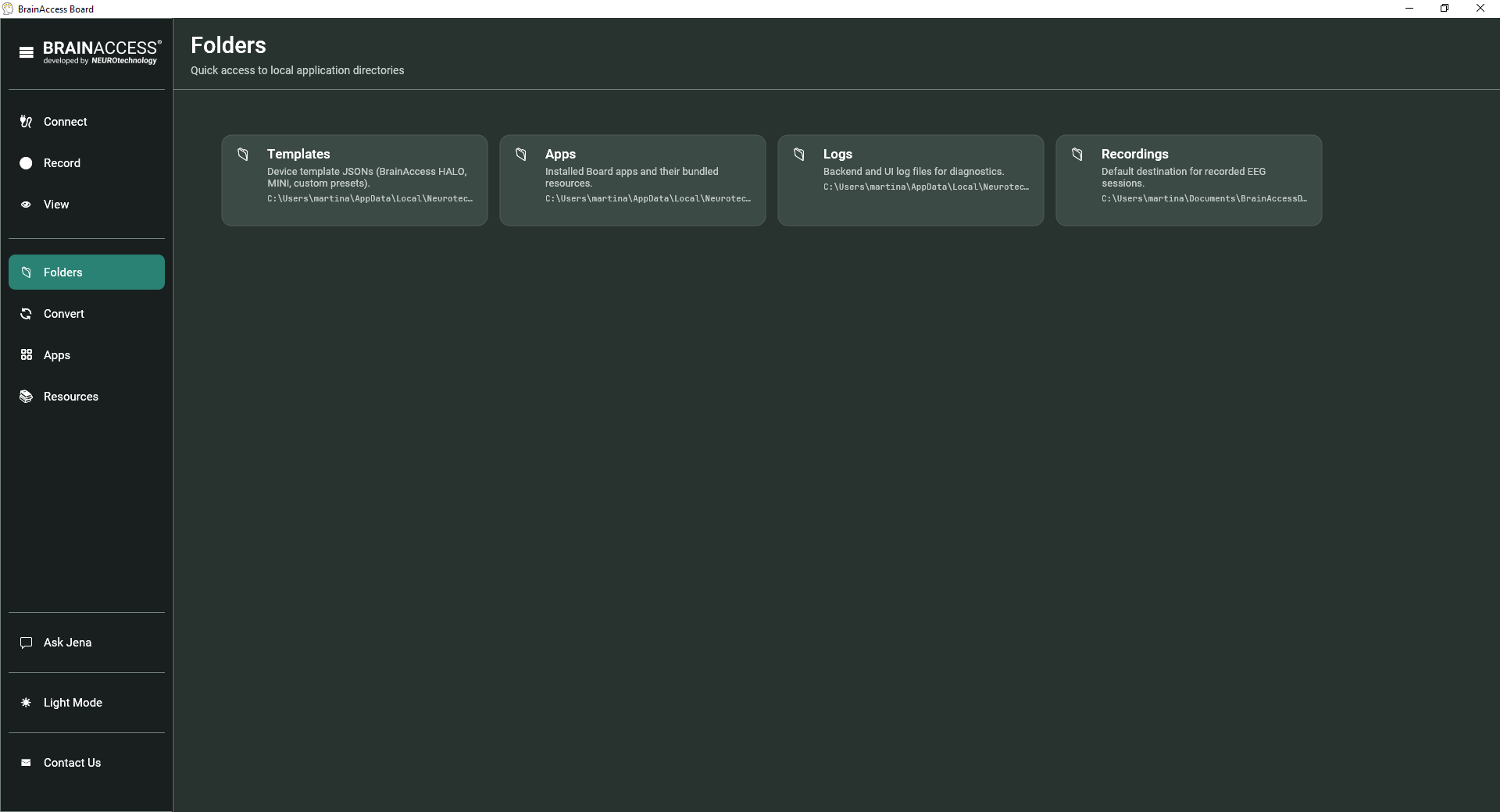
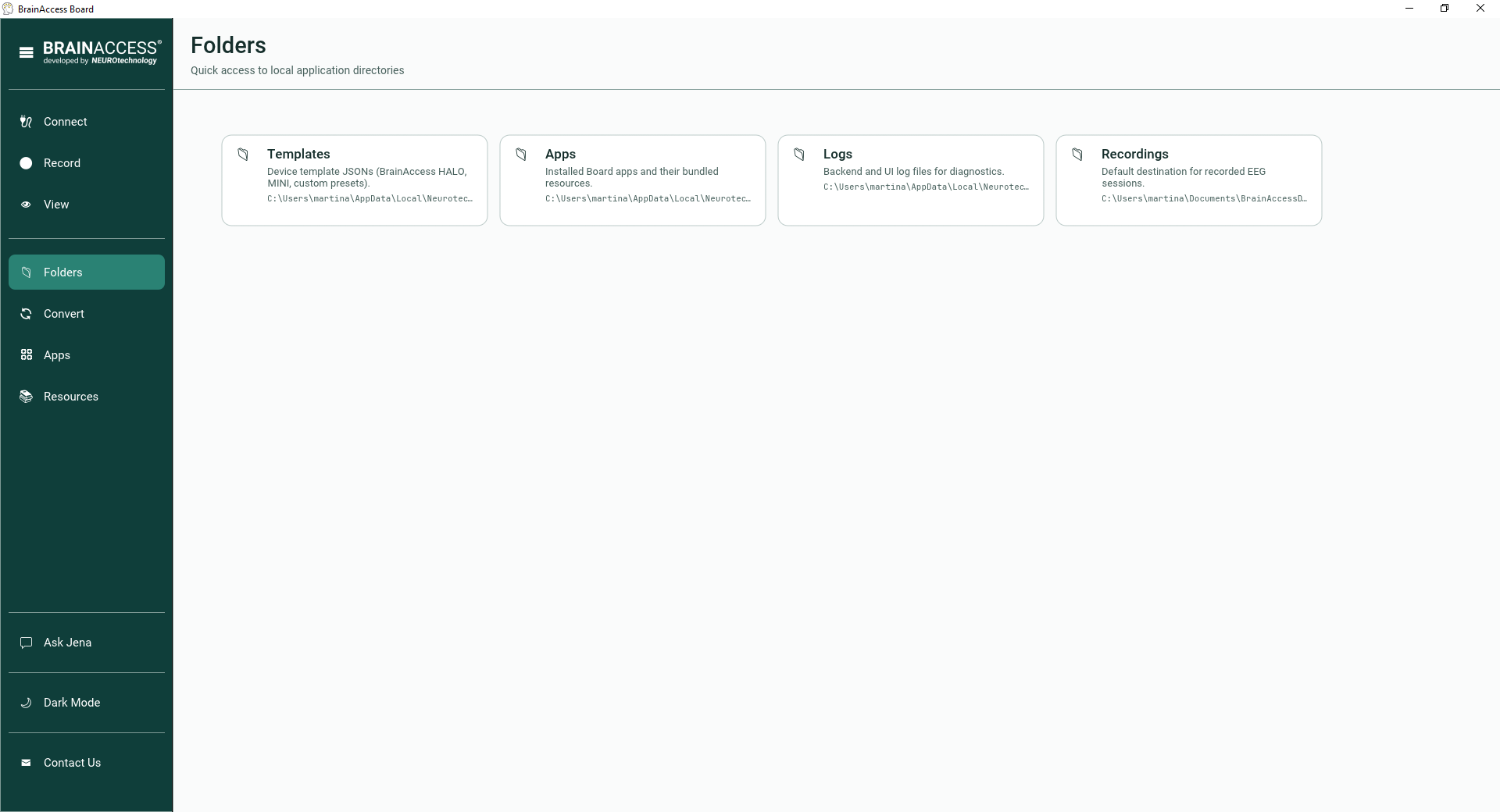
The Folders page provides quick access to useful local BrainAccess Board directories.
From this page, you can open folders for:
- Templates: Default and custom template JSON files.
- Apps: Installed Board apps and bundled resources. User can save custom apps here as well.
- Logs: Backend and user interface log files for diagnostics.
- Recordings: The default folder where recorded EEG sessions are saved.
Clicking a folder card opens the corresponding directory on your computer.
Convert
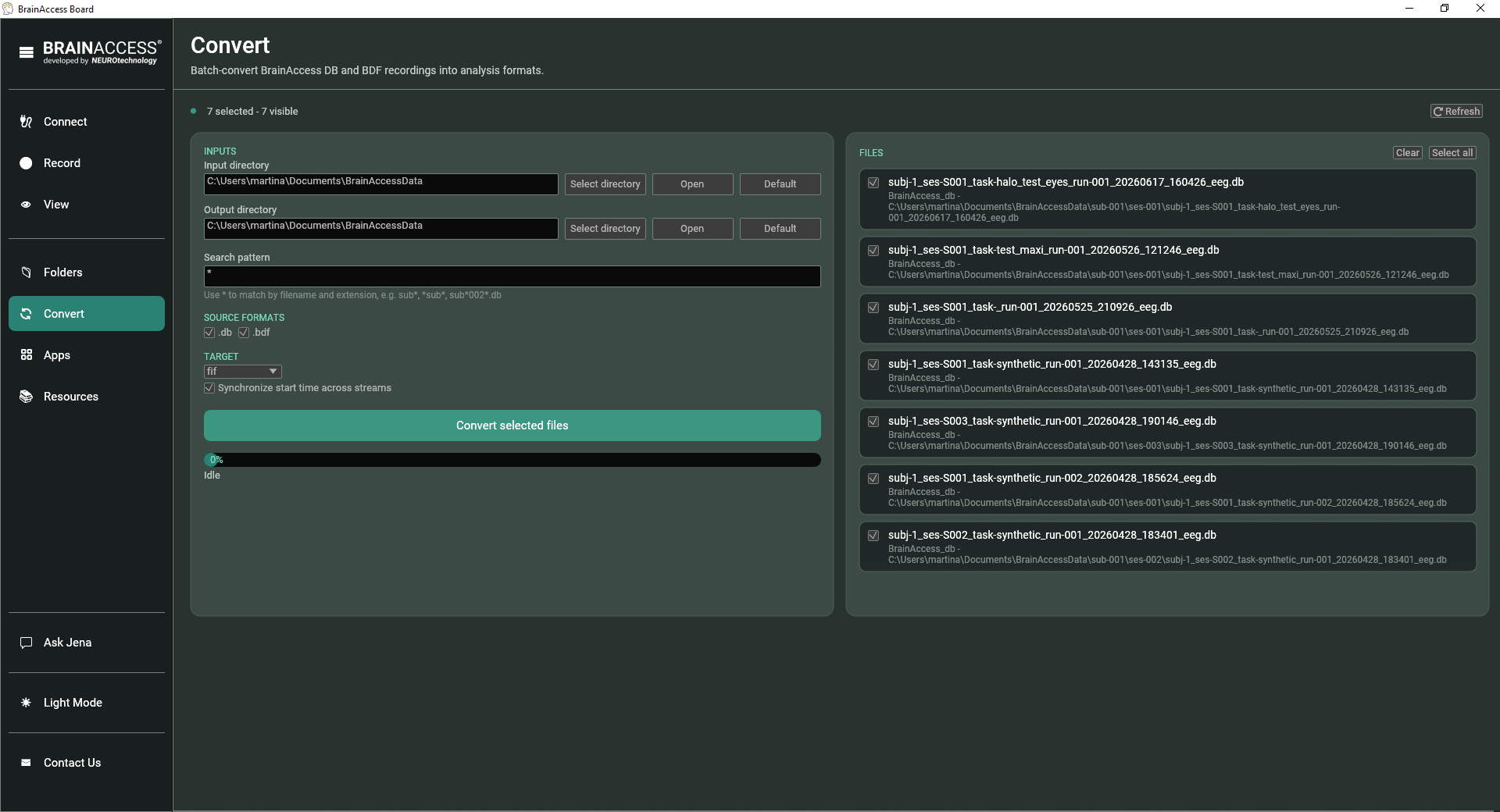
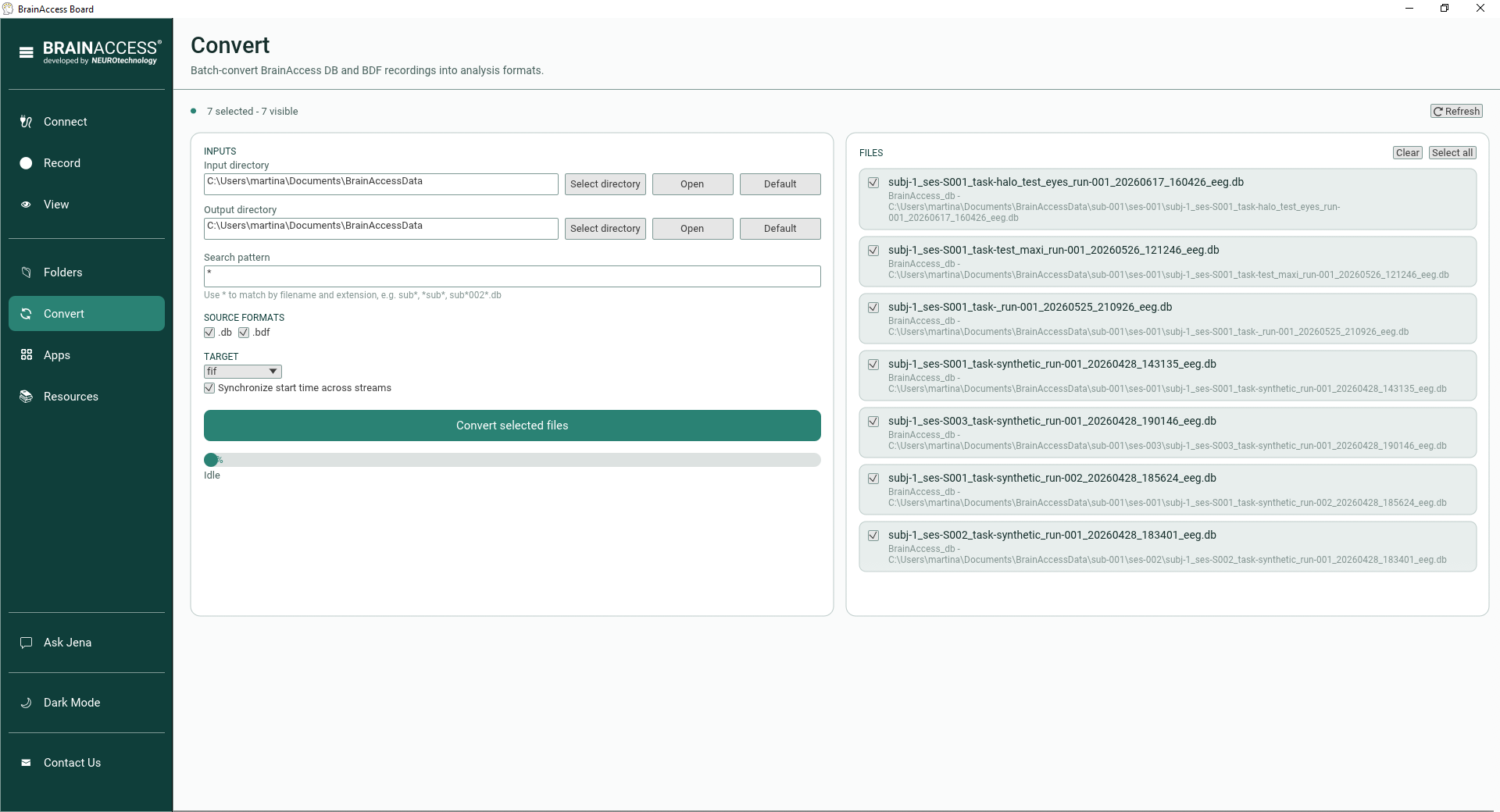
The Convert page allows you to batch-convert BrainAccess recordings into analysis-ready formats.
On the left side, select the input directory where your recordings are stored and the output directory where the converted files should be saved. The files found in the input directory are shown on the right side, ordered by date with the newest files first.
You can use the Search pattern field to filter files by name or pattern.
Source Format
Use Source Formats to choose which type of recording files should be shown:
- .db: recordings created with BrainAccess Board on the computer.
- .bdf: recordings created with the BrainAccess Mobile app.
Target Format
Use Target to select the output format you want to convert to. Available options include:
- BDF
- CSV
- FIF
- SET
For example, you can convert .db recordings into .fif, .csv, .set, or .bdf files for further analysis.
Selecting Files
The right side of the page shows all matching files in the selected input directory. Use the checkboxes to select which files should be converted. You can also use Select all or Clear to quickly manage the selection.
Synchronize Start Time Across Streams
Enable Synchronize start time across streams when working with recordings from multiple devices or participants, such as hyperscanning or multimodal recordings.
When enabled, BrainAccess Board aligns all selected streams to a common start time by cropping the beginning of the recordings so they start at the same wall-clock moment.
Click Convert selected files to start the conversion.
Apps
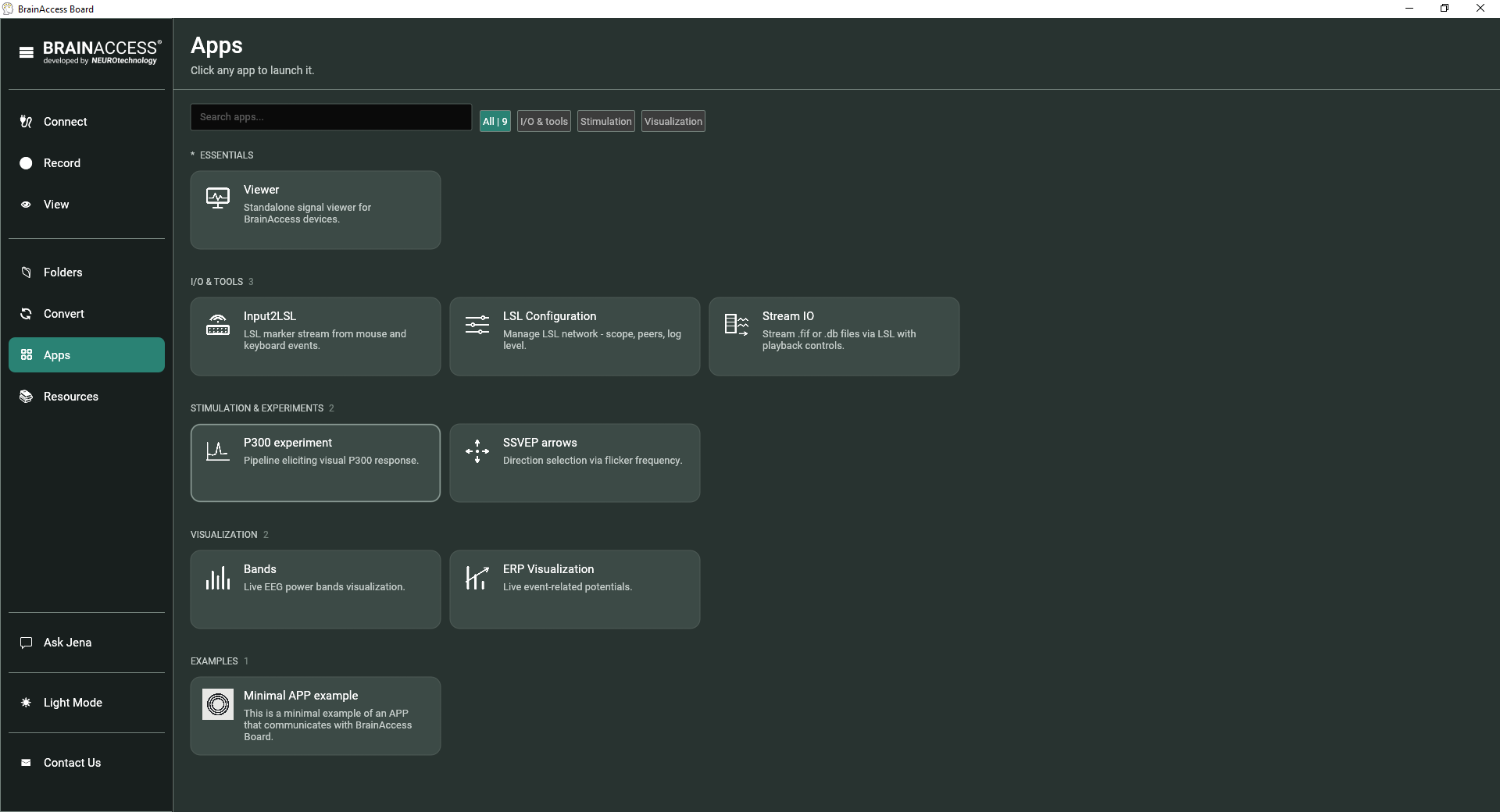
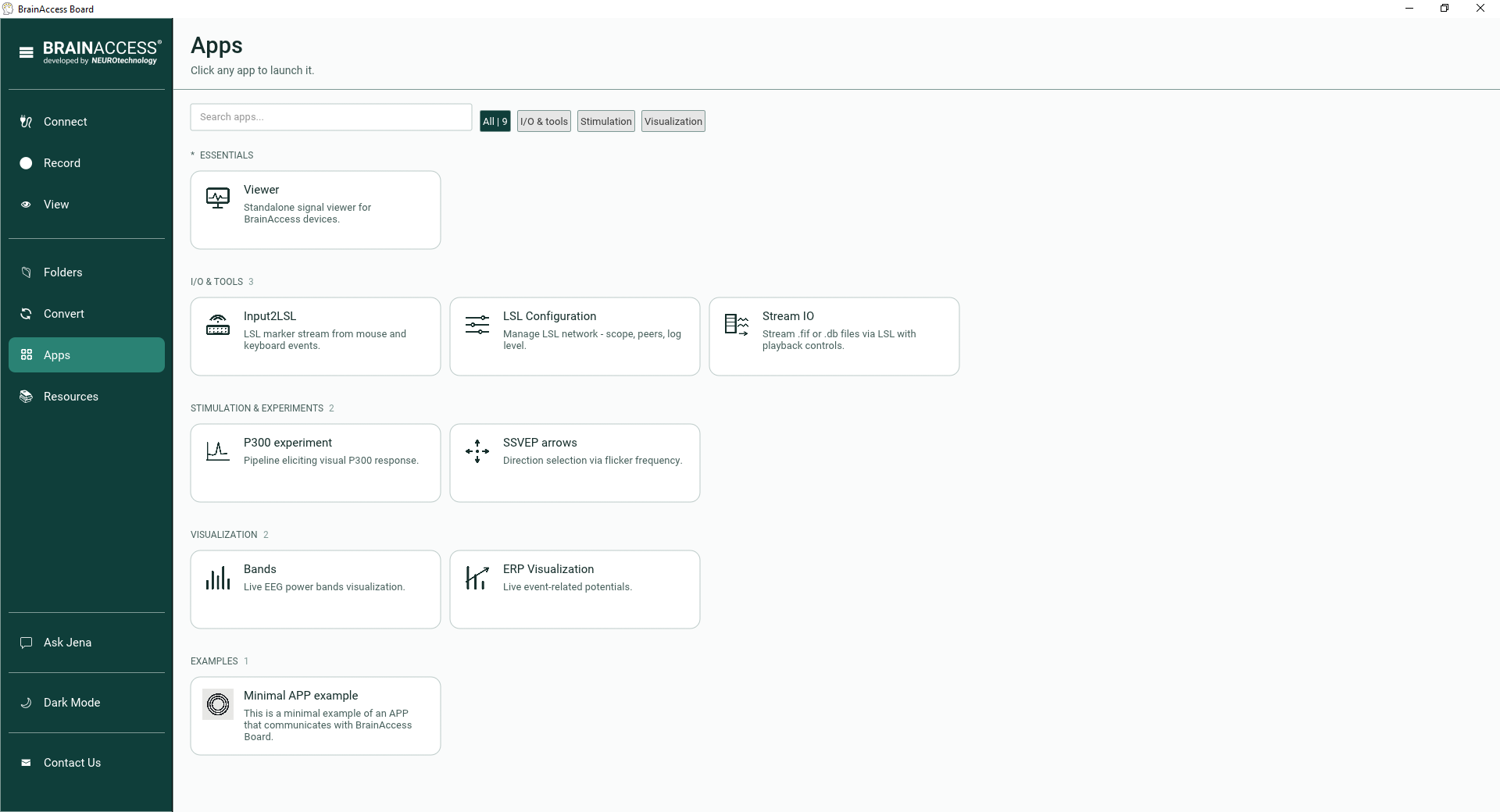
The Apps page provides access to additional BrainAccess Board apps and plugins.
These apps are Python-based tools that can extend the functionality of BrainAccess Board. Most apps open as browser-based interfaces.
Some apps are included for compatibility with previous workflows, such as the Python-based Viewer. This provides similar functionality to the main View, but runs as separate Python app.
Apps are organized into categories such as:
- Essentials
- I/O & Tools
- Stimulation & Experiments
- Visualization
- Examples
Overall, apps include tools for LSL configuration, stream input/output, stimulation experiments, EEG power band visualization, and ERP visualization.
The Minimal APP example is provided as a development example for the BrainAccess Board platform. It demonstrates how an app can interact with the BrainAccess Board database by reading data from the Board database and printing it to the screen.
The source code is available in the app folder, so users can inspect it, learn from it, and use it as a template to create their own custom plugins that communicate with BrainAccess Board.
Resources
The Resources page provides quick access to useful BrainAccess links and online materials.
From this page, users can open links to:
- Manuals and user guides.
- Product documentation.
- Tutorials.
- BrainAccess blog posts.
- The BrainAccess shop.
- SDK and API downloads.
- SDK and API documentation.
Use this page whenever you need to access official BrainAccess materials, download development tools, or find additional support and learning resources.
Ask Jena
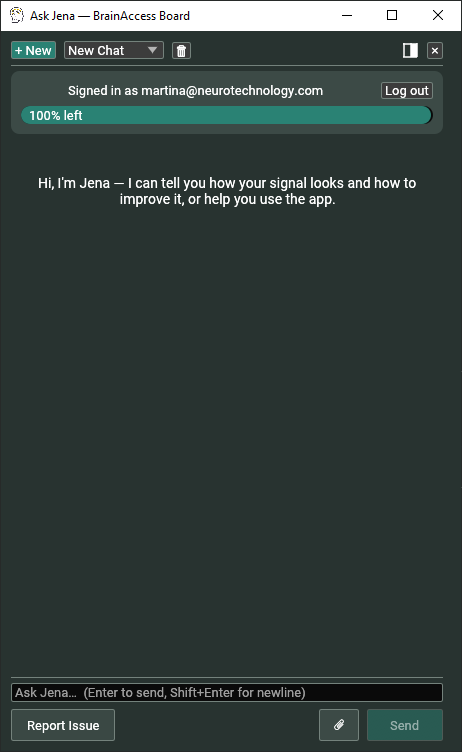
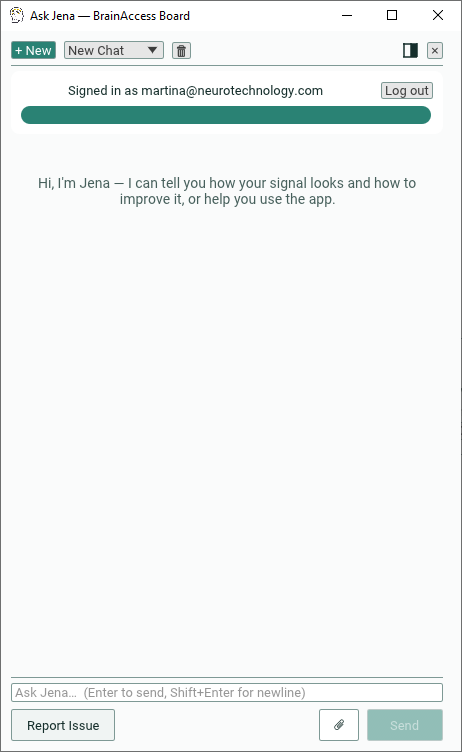
Ask Jena gives access to Jena AI, the integrated assistant for BrainAccess Board.
Jena can answer questions about Board settings, connected device status, signal quality, and general usage of the interface. It is designed to help users understand what is happening during setup, recording, and signal inspection.
For a complete explanation of Jena AI, including available features and example questions, see the dedicated page:
Additional Settings
The sidebar also includes quick access to additional options.
Light / Dark Mode
Use Light Mode or Dark Mode to switch the BrainAccess Board interface between light and dark visual themes.
Contact Us
Use Contact Us to open the BrainAccess contact page. From there, users can submit a request by filling in the contact form.
Keyboards Shortcuts
BrainAccess Board can be driven from the keyboard. Most shortcuts are suppressed while a text field or other widget has focus , so typing a digit into an input never switches tabs. The two Ctrl+…+D combos below are the exception — they use a three-key combo on purpose and stay active even while typing.
Navigation
Switch the active screen. Active only when no input field is focused.
| Shortcut | Action |
|---|---|
| Ctrl+1 | Connect |
| Ctrl+2 | Record |
| Ctrl+3 | View |
| Ctrl+4 | Folders |
| Ctrl+5 | Convert |
| Ctrl+6 | Apps |
| Ctrl+7 | Resources |
| Ctrl+B | Toggle the sidebar between expanded and collapsed |
Global
Always active, including while typing.
| Shortcut | Action |
|---|---|
| Ctrl+Shift+D | Toggle dark / light theme |
| Ctrl+Alt+D | Toggle the diagnostics panel (state dump with copy-to-clipboard) |
Resources
| Shortcut | Action |
|---|---|
| Esc | Clear the search query |
For additional information or help troubleshooting, please contact: [email protected]