
Your heart races, your palms sweat, you freeze or you run. But what is your brain doing while all that happens, and can a machine learn to spot it?
Halloween is this week and it is the one night a year we go looking for fear on purpose. Haunted houses, horror films, a friend jumping out from behind a door…
For neuroscientists, fear is more than a seasonal thrill: it is one of the brain’s oldest survival tools, and a surprisingly tricky thing to measure.
In this spooky-season post, we look at two pieces of research.
- The first is a recent review of how EEG and artificial intelligence are being used to detect fear.
- The second is an experiment in which people wearing mobile EEG walked through a real, physical cave while a two-metre werewolf came at them in virtual reality. The results were not quite what the textbooks predicted.
Fear: the brain’s built-in alarm
When we face a threat, the brain switches on circuits that get the body ready to respond: to fight, to flee, or to freeze.
That is why fear is often described as a mental alarm that protects us [1] . Much of the classic research on fear used brain scanners such as fMRI.
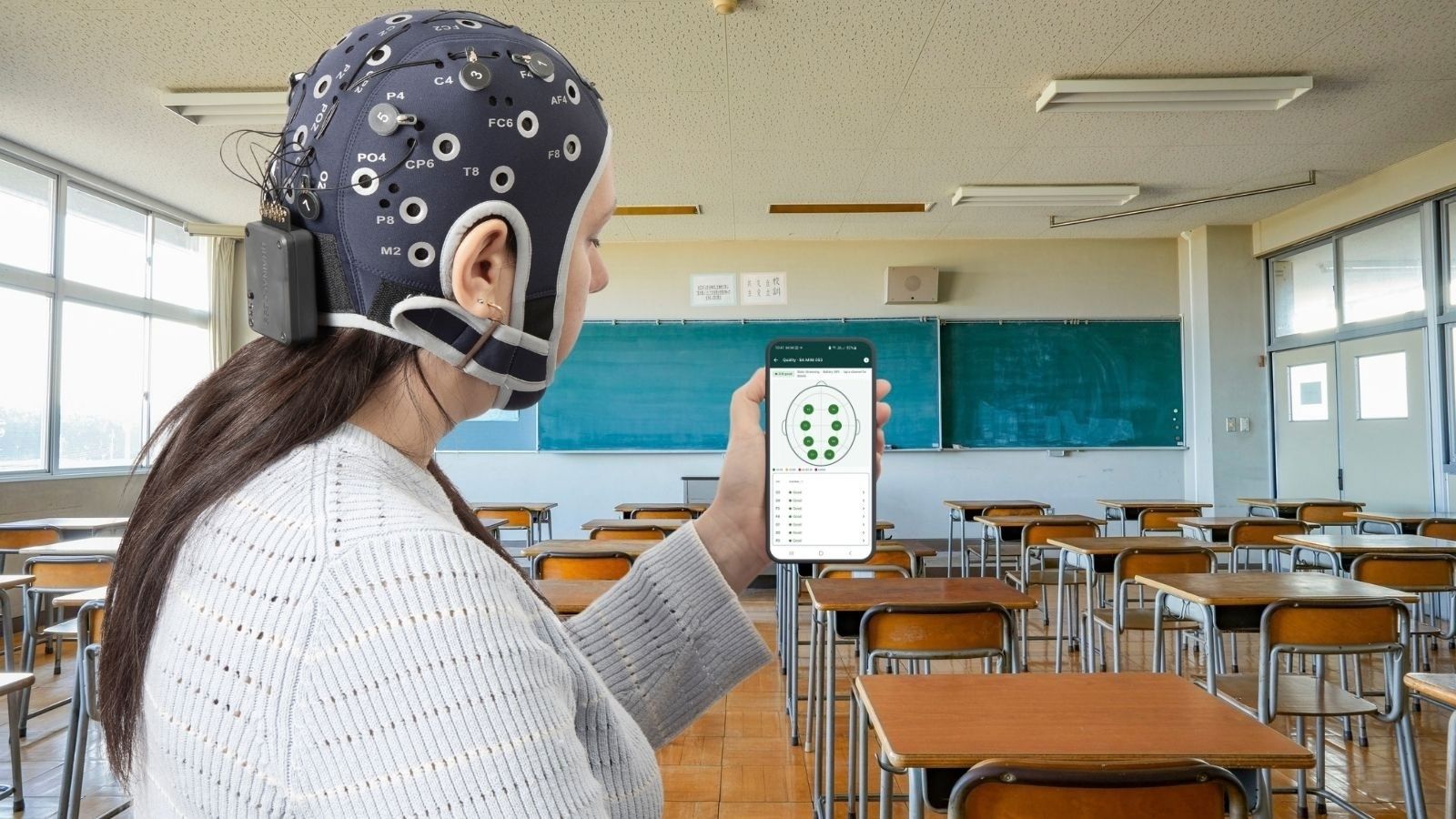
EEG, which records the brain’s electrical activity through sensors on the scalp, has a few big advantages here: it is fast enough to follow changes from moment to moment, it is relatively affordable, and, increasingly, it is portable [1].
1. Can a computer read fear from brainwaves?
That is the question a team of researchers from Mexico set out to answer in a systematic review published in Brain Sciences in 2025 [1]. They searched the scientific literature for studies that used EEG together with AI or machine learning to detect fear specifically.
Only 11 studies made the final cut, which tells you something on its own: while emotions like happiness, sadness and anger have been studied a lot, fear detection with EEG is still an emerging field.
Even so, a few patterns came through clearly.
Fear has a frequency signature
Brain activity measured with EEG is often split into frequency bands, a bit like separating the bass, mid and treble in a song. Across the reviewed studies, fear tended to show up as:
BETA
↑
More activity. Linked to alertness, active processing and getting ready to move.
GAMMA
↑
More activity, especially when fear is intense. Linked to attention and pulling sensory information together.
ALPHA
↓
More activity. Linked to alertness, active processing and getting ready to move.
Location matters: front and sides of the head
Sensors placed over the frontal and temporal regions (roughly your forehead and the areas above your ears) were the most sensitive to fear-related activity. That fits with what we know about the brain’s fear network, which involves frontal areas that evaluate threats and deeper temporal structures such as the amygdala. It also has a practical upside: if you know where to look, you may not need a full cap of electrodes to pick up the signal.
The algorithms are getting good, at least in the lab
The most common tools were machine learning models such as Support Vector Machines, Decision Trees and neural networks. Some of the results are striking. In one study, a Decision Tree classified five levels of fear in people landing a plane in a flight simulator with about 93% accuracy. Another used a compact, portable 8-channel EEG system and horror video clips, and reached around 88% accuracy when the model was trained on each person individually, and around 80% across people. Even a single-sensor headband was able to pick up fear-related changes in fast brain activity while people watched scary videos.
Realistic scares work better than short clips
One of the more interesting conclusions concerns the scare itself. Immersive, longer and interactive experiences, like games and simulators, produced clearer and more stable fear responses than brief clips or static pictures. Fear needs a bit of time and context to build up, just like in a good horror film.
2. Into the cave: a werewolf, a sheep and a mobile EEG
One of the main limitation of the studies discussed above is that they ask people to sit still and respond by pressing a button. But that is not how fear works. Nobody presses a key when a monster appears; they back away, they hide, or they run for the exit.
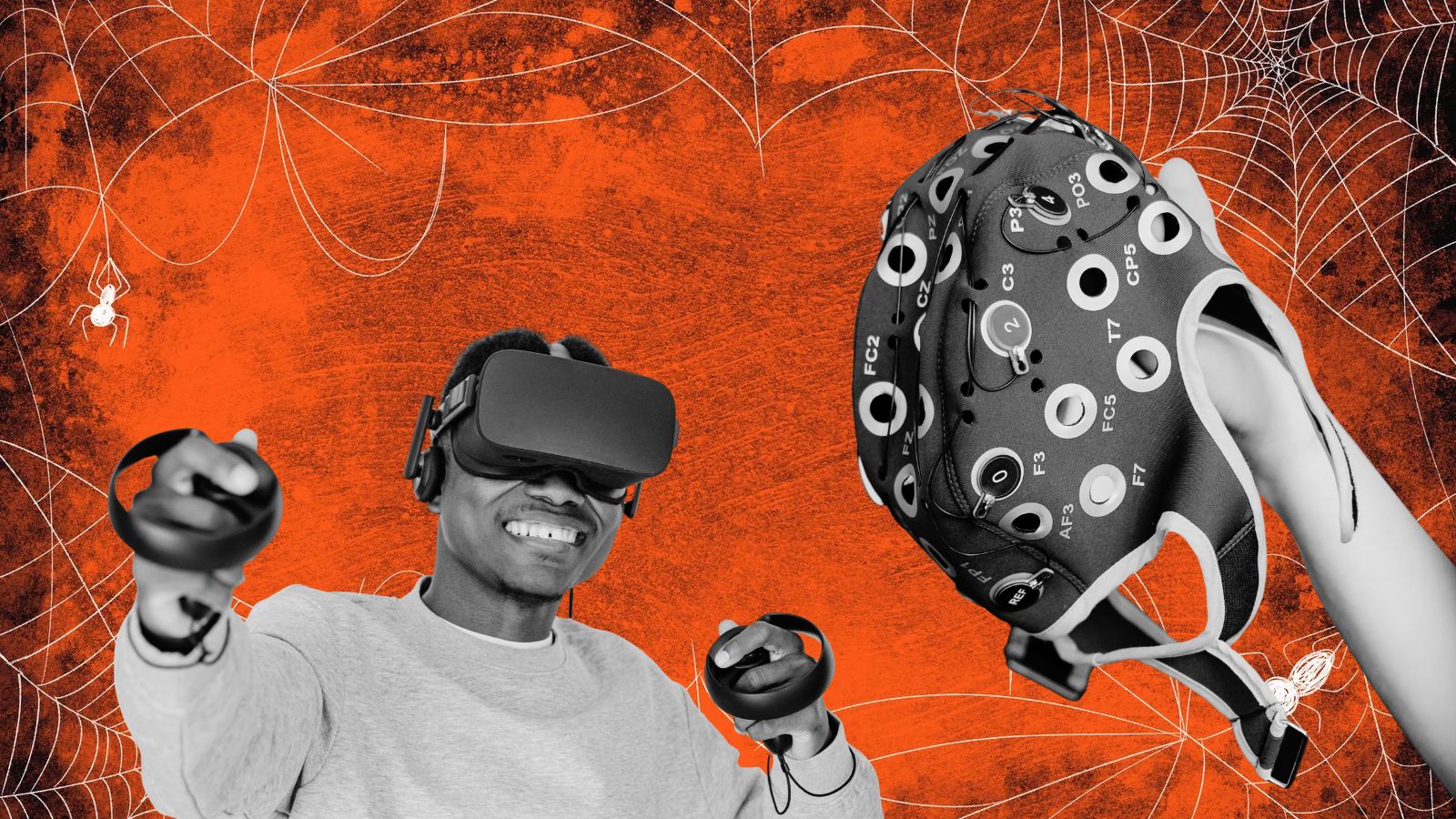
The gap between the lab and real life, is exactly where this next study comes in. A research team at Osnabrück University in Germany wanted to study fear the way it actually happens: with the whole body [2]. To do so, they combined a virtual reality (VR) headset with EEG and behavioral measures to measure fear in a more naturalistic way.
The setup
The researchers built a cave in virtual reality, and then built a physical copy of it in their lab. Walls, rocks and tree trunks were recreated with papier-mâché, hanging ivy with jute ropes, and a body on the cave floor with a life-size puppet. So when participants reached out and touched a wall in VR, they felt a real wall. They walked through the cave on their own feet, wearing a wireless VR headset and a wireless mobile EEG system, and holding a controller that worked as a flashlight.
Participants were randomly sent into one of two versions of the same cave, spooky (negative) or neutral.
Neither group knew what was waiting for them. In the end, data from 81 participants were analysed.
🐺
The spooky cave
Near the entrance lay weapons and bodies. Further in came the sound of crying and a mutilated corpse they had to step around. Then a two-metre werewolf striding towards them. The only way to the exit was to walk towards the werewolf and turn just in front of it.
🐑
The neutral cave
The neutral cave had exactly the same layout, but the corpse was a tree trunk, the crying was wind, and the werewolf was… a sheep, calmly bleating and eating grass.
Nothing to worry about and Walking out the cave was easier.
The scares were real
People in the spooky cave reported much more negative feelings and wanted to leave far more than those in the neutral cave. And it showed in how they moved. They slowed down, peeked around corners, gasped, and wrapped their arms around themselves.
Five people stopped the experiment altogether, four of them at the first sight of the werewolf. Three participants later reported having nightmares that night.
When the werewolf appeared, two very different strategies emerged.
- Some participants hesitated: they stopped or even hid behind a wall.
- Others hastened: they sped straight towards it to get past as quickly as possible. In the sheep cave, people simply strolled on.
The plot twist in the brainwaves
From the EEG perspective, the researchers focused on a well-known EEG measure called frontal alpha asymmetry. It compares alpha activity over the left and right sides of the forehead. Because alpha tends to drop where the brain is more active, the balance between the two sides is used as a window into motivation. The classic textbook idea: relatively more left-side activity goes with approaching things, and relatively more right-side activity goes with withdrawing from them.
So the prediction was simple. The people who rushed towards the werewolf should show an “approach” pattern, and the people who hid should show a “withdraw” pattern.
However, for most of the walk through the cave, the groups could not be told apart by this measure at all, despite their very different feelings and behavior. The groups differed in only two of the seven sections of the cave. And while walking towards the werewolf, the pattern ran the opposite way to the prediction: the hesitating group leaned towards the “approach” side and the hastening group towards the “withdraw” side.
Models built from people pressing buttons in a lab may not fully predict how brains behave when bodies are free to hide, run and react.
The authors offer some possible explanations.
- The hesitators’ pattern might reflect the effort of controlling their fear enough to finally walk past the monster;
- the hasteners’ pattern might reflect an escape that just happened to point forwards.
They also point out that movement and wearing a VR headset are unlikely to explain the results, based on earlier work showing mobile EEG can record good-quality data during walking. Their main conclusion is more fundamental: a single, simple EEG marker may not capture the full complexity of real-world fear.
What this means for taking fear research out of the lab
The first piece of evidence described here—the review—shows that EEG and AI can pick up fear-related brain activity, and that more realistic experiences produce stronger, clearer signals. The second—the cave study—shows what happens when you push realism further: people react with genuine, full-body fear, and some of our lab-based assumptions start to wobble. Neither result is a reason to give up on EEG.
Both are reasons to measure the brain where real behavior happens.
This is exactly the kind of research where portable, wireless EEG like BrainAccess shines. When participants can move freely through a space, rather than sitting still in front of a screen, we get much closer to studying fear as it really is, monsters and all.
If you are planning a spooky experiment with BrainAccess, here’s our advice
🔍 Always measure the brainwaves together with behavior
In the cave study, the most important finding only made sense because the researchers filmed what people did. Recording movement, timing and self-reports alongside EEG turns a puzzling signal into an interpretable one. All BrainAccess devices come with motion sensors as well as an SDK to process this data type. Something to keep in mind and integrate in your analysis pipeline.
⚙️ Synchronise everything
The cave researchers sent position markers from the VR software into the EEG recording, so they knew exactly where each participant was when the werewolf appeared. Tools such as Lab Streaming Layer—integrated in BrainAccess Board—make it possible to line up EEG with VR, video and other sensors.
💡 Treat fear with care
Both papers stress ethics. Immersive scares can be intense enough to make people quit, cry or have nightmares. Clear consent, an easy way to stop at any time, and a proper debrief afterwards are not optional extras.
Happy Halloween from the BrainAccess team 🎃
Are you planning a study on emotions or real-world behavior with EEG and VR? We’d love to hear about it.
Your project could feature in a future post — no werewolves required.
References
- Serna, B., Salazar, R., Alonso-Silverio, G. A., Baltazar, R., Ventura-Molina, E., & Alarcón-Paredes, A. (2025). Fear detection using electroencephalogram and artificial intelligence: A systematic review. Brain Sciences, 15(8), 815. https://doi.org/10.3390/brainsci15080815
- Kisker, J., Lange, L., Flinkenflügel, K., Kaup, M., Labersweiler, N., Tetenborg, F., Ott, P., Gundler, C., Gruber, T., Osinsky, R., & Schöne, B. (2021). Authentic fear responses in virtual reality: A mobile EEG study on affective, behavioral and electrophysiological correlates of fear. Frontiers in Virtual Reality, 2, 716318. https://doi.org/10.3389/frvir.2021.716318