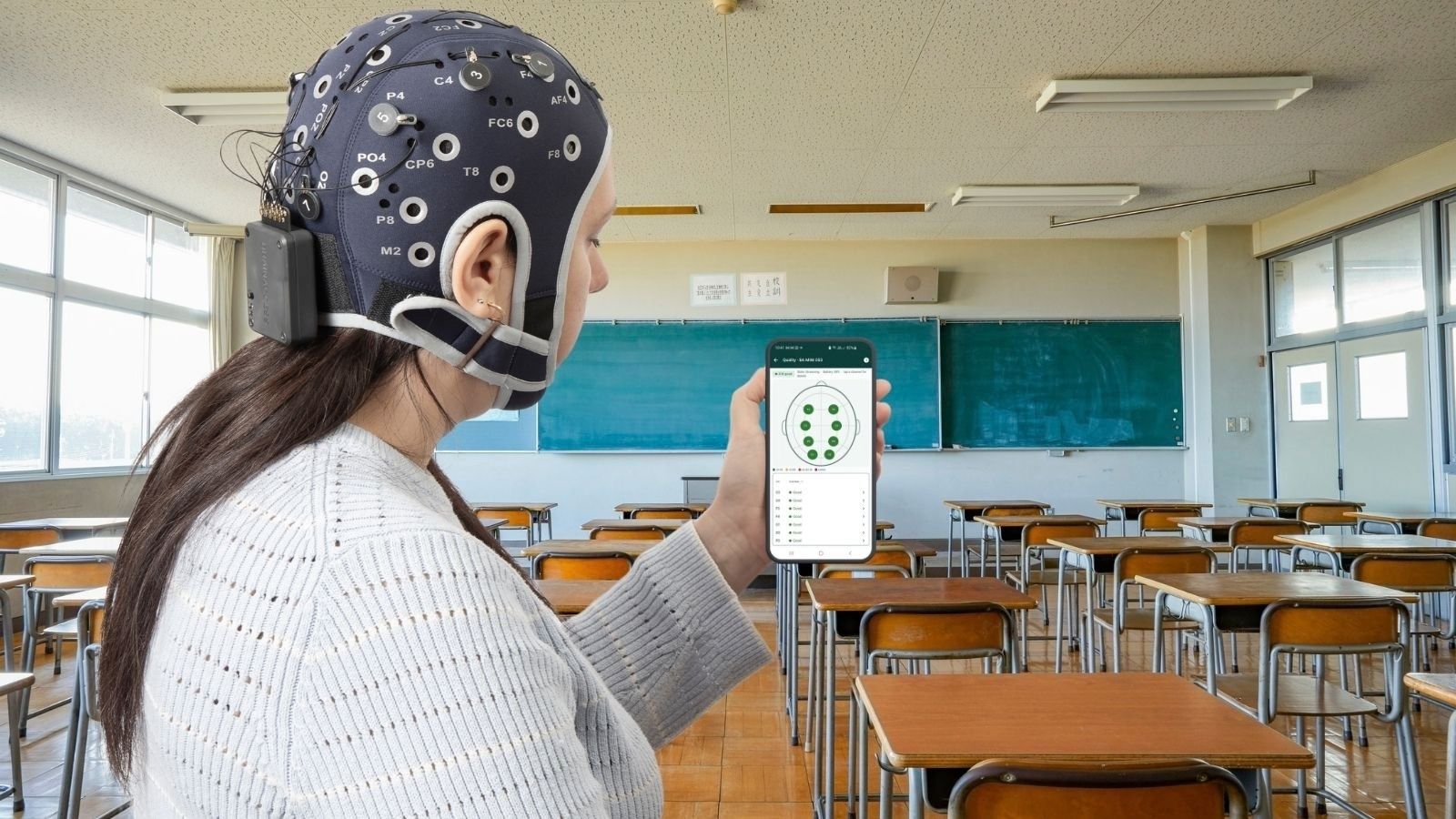

In this article, we explore five EEG research areas where portability matters: mental workload and fatigue, relaxation in natural environments, sleep at home, social interaction through hyperscanning, and engagement in the classroom. Each comes with an example research question, a sample setup and one practical point to plan for.
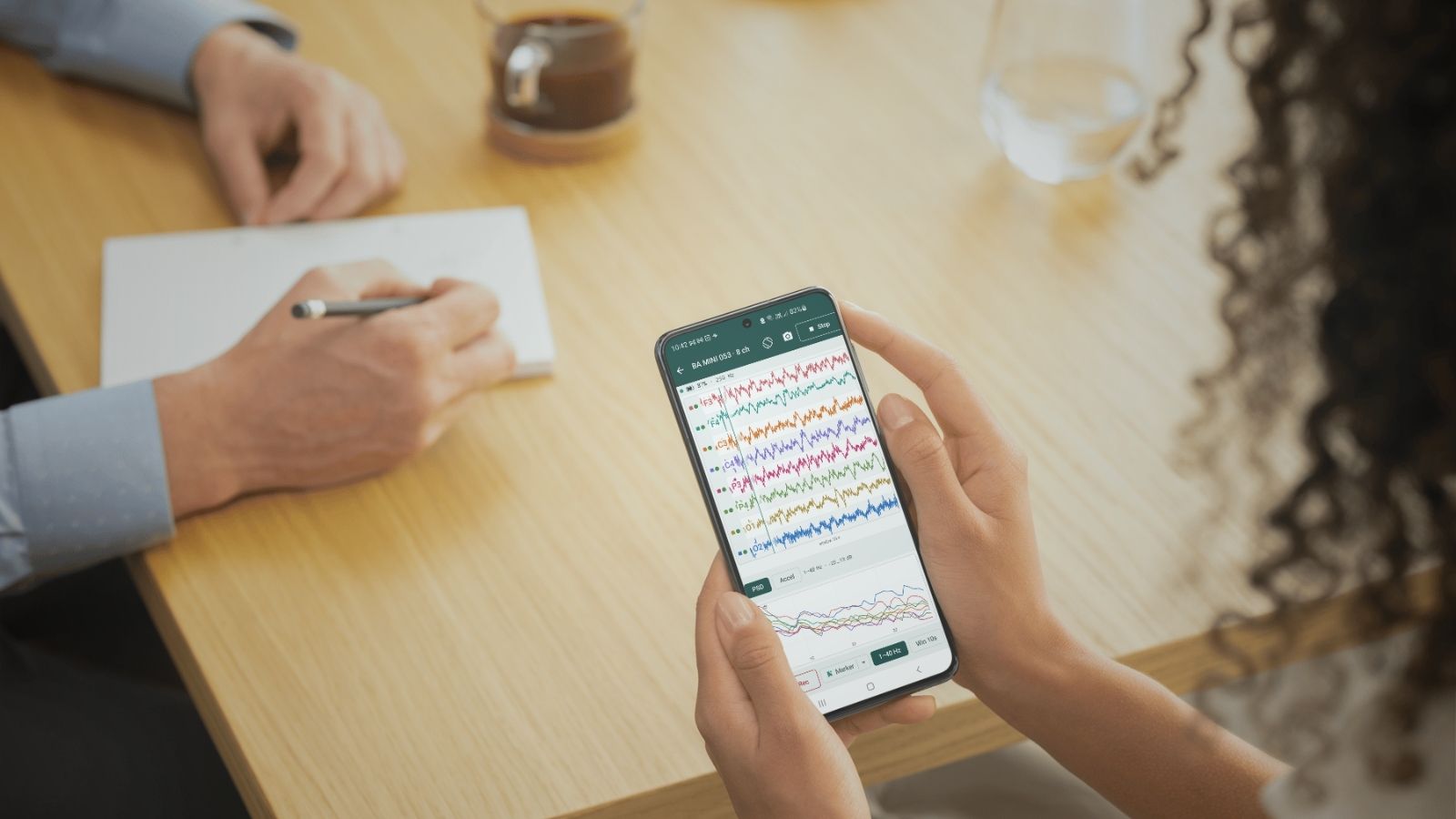
The brain doesn’t stop working when it leaves the lab, and now your recordings don’t have to either. With the release of BrainAccess Mobile, you can connect to BrainAccess devices, view signals in real time, and record EEG straight from your phone or tablet.
That opens the door to studies that are hard to run at a desk: a commute, a walk in the park, a night at home, a conversation, a classroom. Researchers have already shown that wireless EEG can capture usable data even while participants walk outdoors [1].
Below are 5 research directions that become far more practical with a portable setup. For each, we outline a question worth asking, a sample setup, and one thing to plan for before you head out.
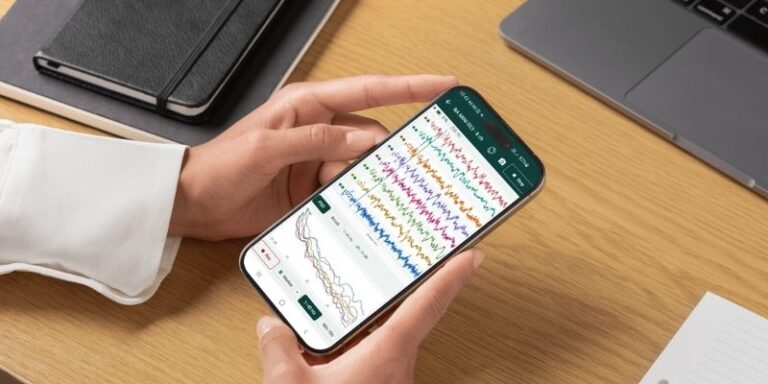

① Mental workload and fatigue
Lab tasks are tidy by design. Real work is not: it comes with interruptions, noise, time pressure and long stretches of repetition. Mobile EEG lets you study how brain activity changes across the tasks people actually do.
🔍 Research question
How do EEG measures associated with workload and fatigue, such as changes in frontal theta or parietal alpha power [2], evolve over a full work shift compared with a short lab task?
⚙️ Example setup
A participant wears a BrainAccess device during a two-hour block of routine office or control-room work. BrainAccess Mobile handles the connection and recording, and the researcher checks signal quality on screen before starting. On a separate log or event markers from the interactive viewer, the participant annotates task switches, breaks and self-reported fatigue ratings every 20 minutes, so EEG segments can be compared against what was happening at the time.
💡 Our advice
Be aware of movement artifacts. Typing, talking, head turns and jaw clenching all leave traces in the signal. Ask participants to stay seated for key measurement windows, keep a timestamped activity log, and plan artifact handling into your analysis pipeline rather than treating it as an afterthought.
② Relaxation and natural environments
There is a growing body of work on how green and blue spaces affect wellbeing. Much of it relies on questionnaires or on showing nature photos and videos indoors. Early mobile EEG work has already compared walks through urban and green spaces [3]. Portable EEG makes it possible to record in the environment itself.
🔍 Research question
Do EEG measures differ when participants rest in a park versus a comparable indoor room, and do those differences line up with their self-reported relaxation?
⚙️ Example setup
Each participant completes two sessions in counterbalanced order: 10 minutes of seated rest in a quiet office and 10 minutes on a bench in a nearby park. The same BrainAccess device and BrainAccess Mobile recording settings are used in both locations, with eyes-open and eyes-closed baselines at the start of each session. Short questionnaires before and after each session provide the subjective comparison.
💡 Our advice
Be aware of the environment. Outdoors brings wind, temperature changes, passing people and electrical noise from nearby equipment. Note weather, time of day and any disturbances for every session, and keep the protocol (posture, duration, instructions) identical across conditions so the setting is the main thing that changes.
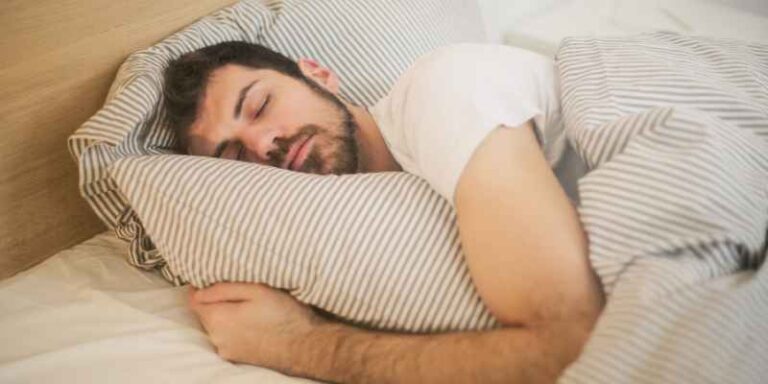
③ Sleep research
Sleep labs offer full polysomnography, but they also put people in an unfamiliar bed, often for just one night. A compact EEG setup makes it easier to record across several nights in the participant’s own home. Validation studies of reduced-montage, dry-electrode headbands suggest this approach can capture usable sleep EEG [4].
🔍 Research question
How does sleep EEG at home vary from night to night, and how does it relate to daytime factors such as caffeine, exercise or evening screen use?
⚙️ Example setup
Participants take home a BrainAccess device and a phone or tablet with BrainAccess Mobile installed. After a short training session, they put on the device at bedtime, confirm the connection and start the recording themselves. A brief morning diary captures bedtime, wake time and sleep quality ratings. Researchers then analyse the recordings offline, for example by scoring them or computing spectral measures, using their own validated methods.
💡 Our advice
Be aware of the recording duration. A full night means seven to nine hours of continuous data. Before the study, run a test night to confirm battery life on both the device and the mobile device, available storage, and how the app behaves if the screen locks. Ask participants to keep the phone charging overnight and close to the bed.
④ Social interaction: hyperscanning
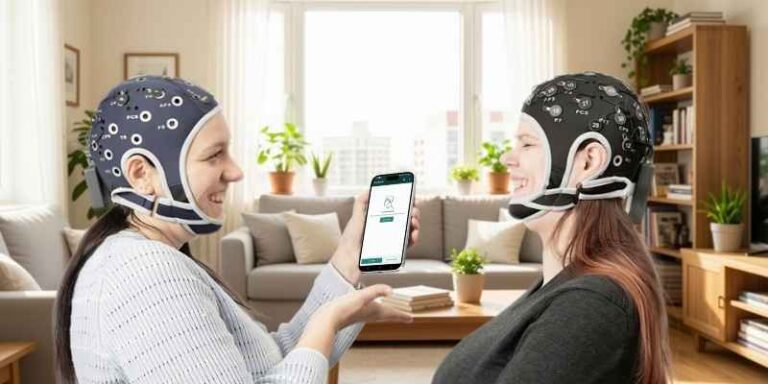
Hyperscanning means recording EEG from two or more people at the same time while they interact. It’s a way to study coordination, turn-taking and shared attention as they happen, rather than one brain at a time. EEG is currently the most widely used method for hyperscanning [5].
🔍 Research question
Is inter-brain synchrony between two people higher during a cooperative task than during a competitive one, or when they work side by side without interacting?
⚙️ Example setup
Two participants each wear a BrainAccess device while they play a cooperative puzzle game, then a competitive version, then solve tasks independently. Each headset is recorded through BrainAccess Mobile, and the session is video-recorded so behaviour such as eye contact and speech can be coded later. Researchers compute synchrony measures offline from the paired recordings.
💡 Our advice
Be aware of time alignment. Synchrony analysis is only as good as the timing between recordings. Plan how you will align the data streams, for example with shared event markers, a common start signal visible on video, or a synchronisation step at the beginning and end of each session. Test the alignment before collecting real data.
⑤ Learning and education
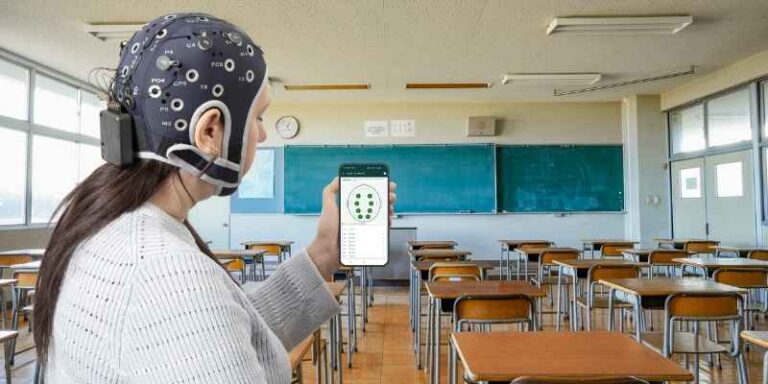
Classrooms, lecture halls and workshops are where learning actually happens, yet they are rarely where EEG data is collected. One notable exception recorded 12 high school students with portable EEG across a semester and found that brain-to-brain synchrony in the class tracked student engagement [6]. A portable setup lets researchers bring measurement into these settings with minimal disruption.
🔍 Research question
How do EEG measures that researchers associate with attention and engagement vary across different parts of a lesson, such as a lecture segment, a hands-on activity and a group discussion?
⚙️ Example setup
A small group of student volunteers wears BrainAccess devices during a 45-minute lesson. The teacher or a researcher adds event markers or notes the start of each lesson phase, and short quizzes or engagement ratings are collected at the end. EEG segments from each phase are compared offline against the behavioural and self-report data.
💡 Our advice
Be aware of ethics and the classroom setting. Recording in schools requires clear consent, and for minors, consent from parents or guardians plus the student’s own assent. Keep the setup quick to apply and comfortable to wear so it doesn’t become the most interesting thing in the room, and make it easy for any participant to stop at any time.
Taking your research out of the lab
These five directions share a common thread: the questions are richest where people actually live, work, rest and learn. BrainAccess Mobile gives you the tools to get there, so you can connect, check your signal and record wherever your study takes place. What you measure, how you analyse it and what it means remain in the hands of the researcher.
💬 We’d love to hear what you’re planning!
If you’re designing a study with BrainAccess Mobile, get in touch and tell us about it. Your project could be featured in a future post!
References
[1] Debener, S., Minow, F., Emkes, R., Gandras, K., & de Vos, M. (2012). How about taking a low-cost, small, and wireless EEG for a walk? Psychophysiology, 49(11), 1617–1621. https://doi.org/10.1111/j.1469-8986.2012.01471.x
[2] Borghini, G., Astolfi, L., Vecchiato, G., Mattia, D., & Babiloni, F. (2014). Measuring neurophysiological signals in aircraft pilots and car drivers for the assessment of mental workload, fatigue and drowsiness. Neuroscience & Biobehavioral Reviews, 44, 58–75. https://doi.org/10.1016/j.neubiorev.2012.10.003
[3] Aspinall, P., Mavros, P., Coyne, R., & Roe, J. (2015). The urban brain: Analysing outdoor physical activity with mobile EEG. British Journal of Sports Medicine, 49(4), 272–276. https://doi.org/10.1136/bjsports-2012-091877
[4] Arnal, P. J., Thorey, V., Debellemaniere, E., Ballard, M. E., Bou Hernandez, A., Guillot, A., Jourde, H., Harris, M., Guillard, M., Van Beers, P., Chennaoui, M., & Sauvet, F. (2020). The Dreem Headband compared to polysomnography for electroencephalographic signal acquisition and sleep staging. Sleep, 43(11), zsaa097. https://doi.org/10.1093/sleep/zsaa097
[5] Czeszumski, A., Eustergerling, S., Lang, A., Menrath, D., Gerstenberger, M., Schuberth, S., Schreiber, F., Rendon, Z. Z., & König, P. (2020). Hyperscanning: A valid method to study neural inter-brain underpinnings of social interaction. Frontiers in Human Neuroscience, 14, 39. https://doi.org/10.3389/fnhum.2020.00039
[6] Dikker, S., Wan, L., Davidesco, I., Kaggen, L., Oostrik, M., McClintock, J., Rowland, J., Michalareas, G., Van Bavel, J. J., Ding, M., & Poeppel, D. (2017). Brain-to-brain synchrony tracks real-world dynamic group interactions in the classroom. Current Biology, 27(9), 1375–1380. https://doi.org/10.1016/j.cub.2017.04.002