
A recent Nature Human Behaviour study (Wang et al., 2025) did something refreshingly concrete: it compared divergent creativity in humans vs large language models (LLMs) at scale, using a standardized task and algorithmic scoring. The headline was nuanced: humans are slightly more creative on average, but the biggest gap shows up at the extreme. In other words, humans have a much “fatter” right tail (exceptional creativity), while LLM outputs are more uniform and repetitive.
For scientists and brain enthusiasts, this result immediately sparks curiosity:
If exceptional creativity is about variance (not just average performance), what does the brain do differently when creativity is really happening?
Turns out Electroencephalography (EEG) is one of the best tools we have to answer this question, because creativity is not a single state, it unfolds over seconds, with rapid shifts in attention, control, and connectivity that EEG can map.
Below is a practical, EEG-grounded way to think about creativity and how it may connect to what we’re learning about LLMs.
What is creativity, and how can we measure it?
In psychology and neuroscience, creativity is often studied through two classic (and complementary) abilities:
Divergent thinking: generating many original ideas, alternatives, or uses.
Remote association and insight: linking distant concepts and suddenly seeing a new connection (those “aha” moments).
High-level creativity usually needs both, but EEG research suggests they’re related, not identical, and their neural “signatures” can look different depending on which process a task emphasizes.
1. Divergent thinking: the internal search mode (alpha)
During divergent thinking tasks, higher creative demands are often associated with increased alpha power (~8–13 Hz), frequently over frontal and parietal regions. More creative individuals may also sustain these alpha changes longer.
Importantly, alpha is not a creativity biomarker on its own. It is better understood as an indicator of a brain state that supports creative search: less driven by incoming sensory input, more driven by internal simulation. When external interference is reduced, the brain can more freely recombine memories, concepts, and associations.
2. Insight: timing matters (alpha → gamma)
For remote association and insight, it’s not just which frequency band is present, but how activity evolves over time. Many studies describe a pattern like:
a preparatory alpha increase, followed by
a brief gamma burst (>30 Hz)
This late gamma component is often interpreted as rapid integration/binding: the moment the solution “clicks.”
Control and selection: pruning ideas (theta)
Creativity is not only free exploration and sudden insight. Both modes require control: screening, refining, and choosing which ideas are worth pursuing.
That’s where theta (~4–8 Hz) often appears. Theta activity, especially frontal theta and theta connectivity, is frequently linked to cognitive control and long-range coordination between brain regions. In creativity tasks, theta-related patterns may reflect how control is applied while generating ideas, evaluating them, or switching strategies.
A useful EEG-informed picture
From this perspective, creativity emerges from a dynamic balance that EEG can track with high temporal precision:
Alpha: shielding attention from distraction and supporting internal exploration
Theta: steering, regulating, evaluating, and coordinating the search
Gamma: brief integration bursts around insight (“aha” moments)
So, divergent thinking often leans more on alpha-supported internal exploration, while insight often looks like alpha before the click and a short gamma signature at realization, with theta reflecting regulation and coordination around these shifts.
How EEG helps explain differences in LLM creativity
Creativity is not a steady-state trait in the brain. Even within a single idea-generation trial, alpha can rise and fall as attention turns inward, theta can ramp up during evaluation and selection, and gamma can appear briefly during integration. In other words, creative thinking often involves state shifts. Exploration, constraint, pruning, and restructuring, each unfolding over seconds. That dynamic cycle matters when we compare human creativity to LLMs, which can generate novelty but don’t necessarily implement the same internally regulated, time-varying search process.
A key takeaway from the Nature Human Behaviour paper isn’t just that “humans are slightly better” at idea generation. It’s that the distribution looks different: humans produce more outliers (more rare, exceptional ideas) while LLM outputs are typically more consistent and cluster closer to the middle.
That gap suggests something important: exceptional creativity is not simply “more randomness.” It’s controlled variability, exploring unusual combinations while keeping the result coherent, relevant, and useful. This is where LLMs often struggle. You can increase variation by raising temperature (or sampling more broadly), but push it too far and the output becomes noisy or loses meaning. LLMs can produce variability; keeping variability meaningful is the hard part.
EEG offers a natural hypothesis for why humans may excel here. Humans don’t remain in one creative mode. The brain appears to shift states during creative work: turning inward to explore, then re-engaging control to steer and prune, sometimes culminating in a brief, coherent reorganization that feels like insight. Those shifts are exactly what EEG is suited to capture, because they happen on sub-second to multi-second timescales.
In summary
LLMs can generate many ideas, but many are similar because the system tends toward stable, average patterns.
Humans also generate plenty of average ideas, but when exceptional creativity happens, it may reflect the brain’s ability to modulate between internal exploration and constraint, producing variability without collapsing coherence.
Taken together with the EEG literature, the human advantage over LLMs at the extremes may come from the brain’s capacity to regulate the search in real time while controlling and preserving meaningful connections.
Conclusion: creativity is a fluctuating process
Creativity isn’t a fixed property you either have or don’t have. It’s a dynamic process: attention turns inward, control loosens and re-tightens, remote associations emerge, and occasionally a solution snaps into place.
LLMs can imitate parts of this in output space and are excellent fast idea generators. But the human brain seems especially strong at controlled variability—novelty without losing meaning—which may explain why the largest human advantage appears in the outliers, not the average.
EEG doesn’t reduce creativity to “alpha” or “gamma”. What it reveals is more interesting and more actionable: creativity has a rhythm that evolves in time.
If this hypothesis is true, it would have direct implications for where LLM research could go next. If exceptional human creativity comes from state-dependent control (loosening constraints to explore, then tightening them to evaluate and integrate), then better “creative” models may need something closer to a dynamic controller, not just a different sampling temperature.
Concretely, this points toward architectures and inference strategies that:
- Switch modes over time (explore → critique → restructure),
- Use explicit meta-control signals (uncertainty, novelty, goal alignment),
- Optimize for the tails of the distribution (rare high-quality outliers) rather than only average performance.
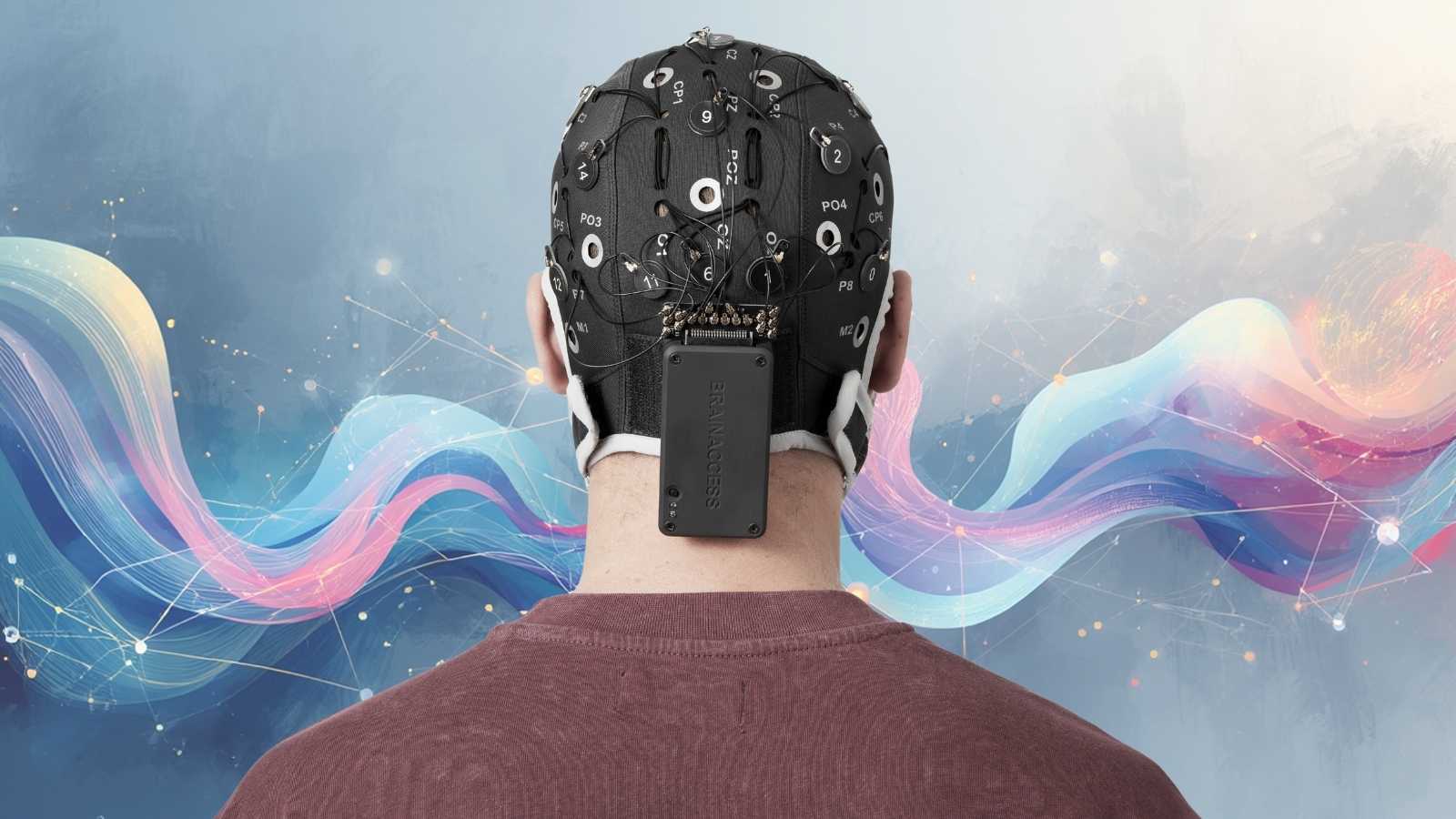
For researchers, brain enthusiasts, and BrainAccess clients, this is a practical reminder that EEG can make otherwise invisible dynamics measurable. It lets you track when the brain shifts between exploration, evaluation, and integration, processes that are hard to infer from behavior alone. That means better experiments and products: clearer hypotheses, more targeted metrics, and evaluation frameworks that reflect the process (not just the final answer), so you can refine paradigms, compare conditions, and interpret outcomes with much more precision.
Reference
Wang, D., Huang, D., Shen, H., & Uzzi, B. (2025). A large-scale comparison of divergent creativity in humans and large language models. Nature Human Behaviour, 1-10.
Stevens Jr, C. E., & Zabelina, D. L. (2019). Creativity comes in waves: an EEG-focused exploration of the creative brain. Current Opinion in Behavioral Sciences, 27, 154-162.