Heroes of the Brain 2025 - The Neurohackathon sponsored by BrainAccess - BrainAccess

Heroes of the Brain 2025 – The Neurohackathon sponsored by BrainAccess

Martina Berto Avatar

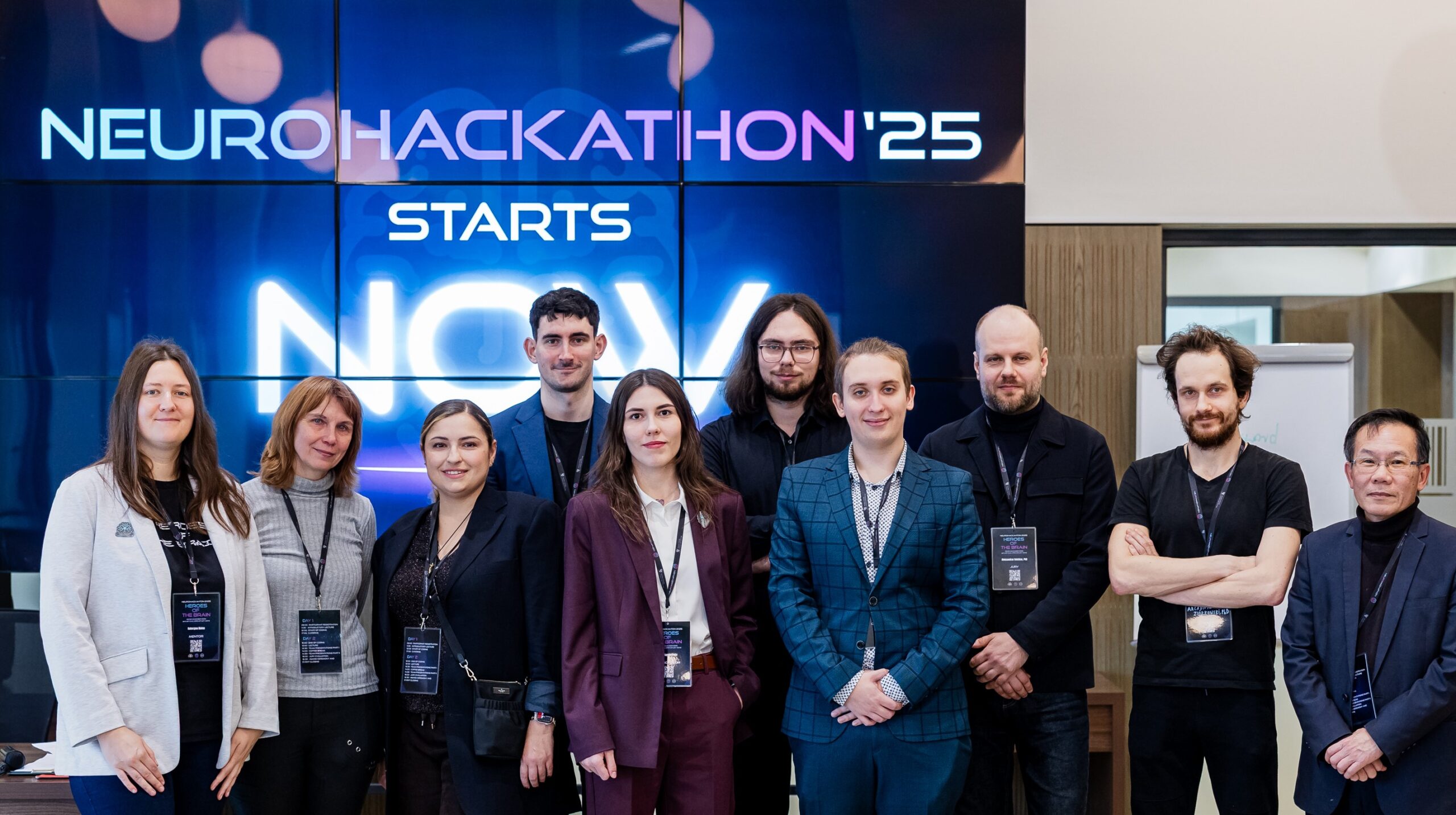
Last weekend (November 29-30), we had the pleasure of sponsoring and participating in Heroes of the Brain 2025, a 24-hour neurohackathon organized by KN Neuron at the Wrocław University of Science and Technology in Poland and dedicated to creativity, neuroscience, and real-world problem solving.


Using our BrainAccess MINI and HALO devices, participants worked intensively in teams to build innovative EEG-based applications in just one day!

This year, the hackathon featured two categories:

  •  Wellness (9 teams competed in this category)
  • Commerce (11 teams in this category)

Each team brought a unique vision of how brain-computer interfaces can change our daily lives, support well-being, and inspire new interactions between humans and technology.

The quality of submissions exceeded all expectations. All teams worked hard and presented outstanding projects. Below is a highlight of this year’s winners.

Wellness Category

1st Place. Real-Time Epilepsy Monitoring System

The team Brainstorm developed a portable EEG-based solution supported by BrainAccess devices aimed at detecting and recording epileptic seizures in real time. Their concept addresses a serious global health challenge affecting more than 50 million people worldwide, with around 25% of cases diagnosed in childhood.

The project comprises a night-time monitoring system for children, capable of alerting parents and improving diagnostic accuracy through continuous EEG analysis. The future roadmap includes multi-device data fusion, automatic emergency alerts, and expanding the system to other conditions such as sleep disorders meaningful project. 

An ambitious and inspiring project with great implications for health and prevention! 
Heroes of the Brain 2025 - The Neurohackathon sponsored by BrainAccess - BrainAccess

2nd Place. Real-Time Emotion Mapping

The runner-up, BrainGradient Team, used our BrainAccess MINI kit to create AuraCloud, a system for real-time EEG-based emotion detection and visualization.
Using the PAD emotional model (Pleasure-Arousal-Dominance), AuraCloud interprets EEG features and places users inside a 3D “emotion cube” to help identify and regulate their emotional state. Their solution includes:

  • Real-time monitoring of valence, arousal, and dominance

  • Visual mapping of emotional states

  • A slideshow-based neurofeedback system offering personalized emotional guidance

  • Clear applications in psychotherapy support, mental-health prophylaxis, and peak-performance training

A project with a vision: AI-based validation systems and long-term emotional trackers!
Heroes of the Brain 2025 - The Neurohackathon sponsored by BrainAccess - BrainAccess

Commerce Category

1st Place. Present.IT

Winners of the Commerce track, 4Sigma, built Present.IT, a modular system that uses EEG signal from our BrainAccess HALO headband to control digital presentations hands-free.


The project includes:

  • A Blink Detection Module

  • A Movement Detection Module

  • A Central Unit handling flags and system states

  • A Presentation Manager adjusting slides based on EEG events

  • An Indicator Module to communicate system status

Their modular diagram highlights how flexible and customizable the system is, from slide control to playlist navigation or even smart-home interactions.

A beautifully engineered concept with real commercial potential!
Heroes of the Brain 2025 - The Neurohackathon sponsored by BrainAccess - BrainAccess

2nd Place. Harmonizing With Your Mind

The Neuronauts team presented a charming and creative vision: turning EEG signals into sound and musical experiences in real time.
Using our BrainAccess Halo headband, their system converts brainwave patterns into MIDI parameters, enabling users to “play” music with their mind. Perfect for science centers, classrooms, or creative installations.

The project highlights:

  • Real-time sound generation driven by brain markers

  • Dynamic calibration and PSD-based mapping

  • A playful, intuitive interface accessible to all ages

  • Future plans including multiplayer “brainwave orchestras” and gaming interactions

A wonderful demonstration of how BCI can be fun, artistic, and educational!
Heroes of the Brain 2025 - The Neurohackathon sponsored by BrainAccess - BrainAccess

Conclusion

All teams impressed us with their energy, ingenuity, and passion for neuroscience. The atmosphere during the hackathon was electric, full of curiosity, problem-solving, and the excitement of building something entirely new overnight!

At BrainAccess, our mission is to give people the tools to develop their ideas, explore neurotechnology hands-on, and make innovation in EEG affordable and accessible to everyone, from students to researchers, from artists to entrepreneurs.

Events like Heroes of the Brain reaffirm why we do what we do. We left inspired, motivated, and incredibly excited about the future these young innovators are building.

See you next year! 🚀🧠

Scroll through the gallery below to see BrainAccess devices in action during this year edition! 

To stay tuned on next edition:
MORE Posts
  • Can a VR Headset Make You a Better Footballer? A Study with BrainAccess MAXI Says Yes

    Can a VR Headset Make You a Better Footballer? A Study with BrainAccess MAXI Says Yes

    As football takes center stage with the World Cup 2026 underway, an interesting question emerges: how should the next generation of players train? A recent preprint from Turkish researchers found that young professional footballers who trained with VR outperformed those using traditional methods in balance, speed, and strength, with measurable neurological changes tracked via the…

  • A Guide to EEG Electrode Placement: The 10–20 System Explained

    A Guide to EEG Electrode Placement: The 10–20 System Explained

    If you are thinking about conducting EEG research, you may have come across the term International 10–20 System, often used when referring to electrode positions on an EEG cap. But what does it actually mean? In this article we provide a short overview and discuss why it still so important in EEG research today. Electroencephalography…

  • From Literature to Live Data: LLMs as Full-Cycle Research Companions

    From Literature to Live Data: LLMs as Full-Cycle Research Companions

    For decades, the challenge in neuroscience has not only been collecting brain data, it has been making sense of it. EEG signals are noisy, high-dimensional, and shaped by dozens of interacting variables. Interpreting them well has traditionally required years of specialist training. But a growing body of evidence suggests that large language models (LLMs) may…

  • When Sound Becomes Medicine: BrainAccess HALO in Music Therapy Research

    When Sound Becomes Medicine: BrainAccess HALO in Music Therapy Research

    Can lying on a vibrating table listening to carefully crafted audio actually change your brain? A team of Portuguese engineers built a system to find out and the results are surprisingly measurable. Sound therapy is one of those ideas that sits awkwardly between ancient wisdom and modern science. Cultures across history have used chanting, singing…