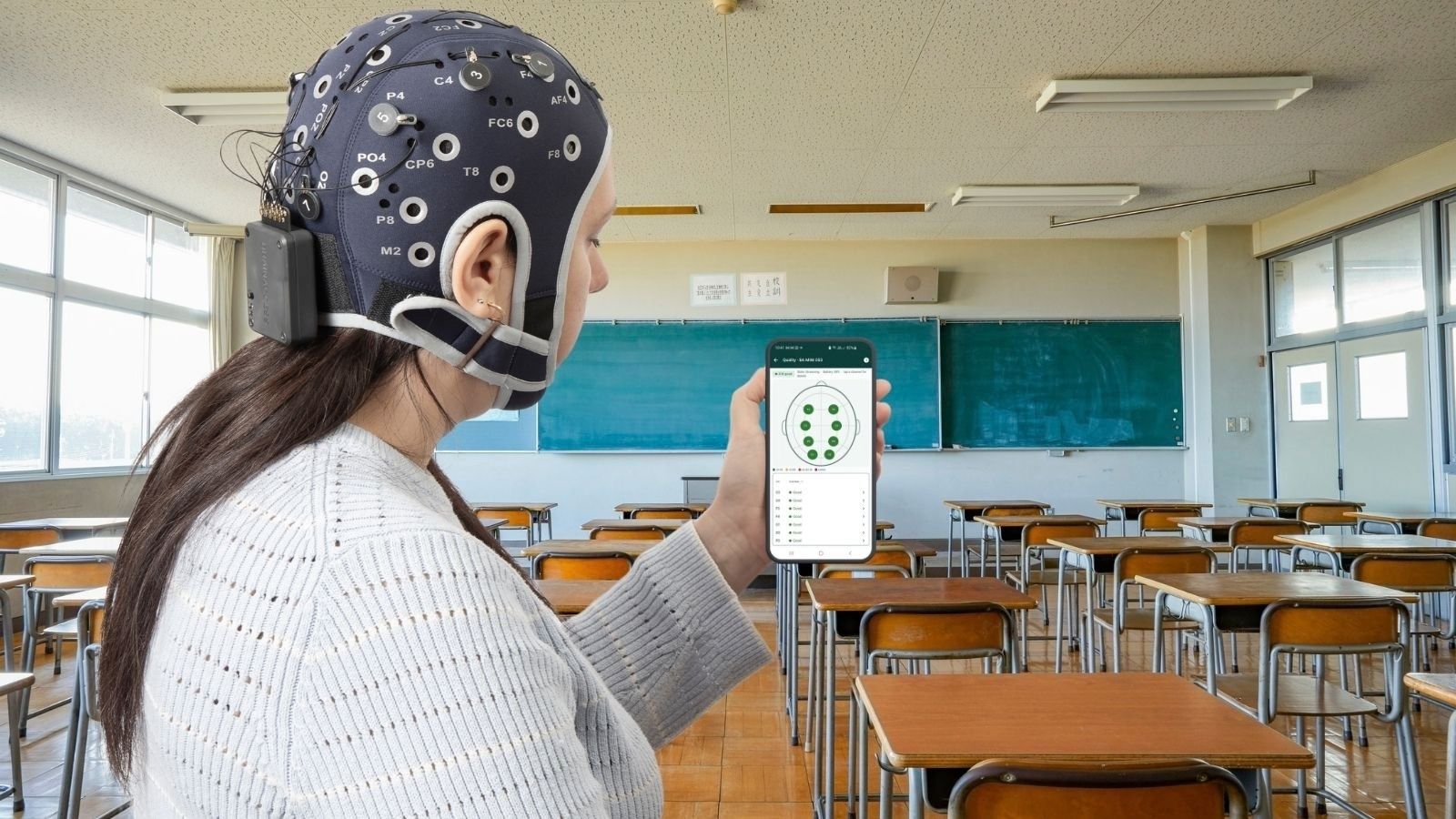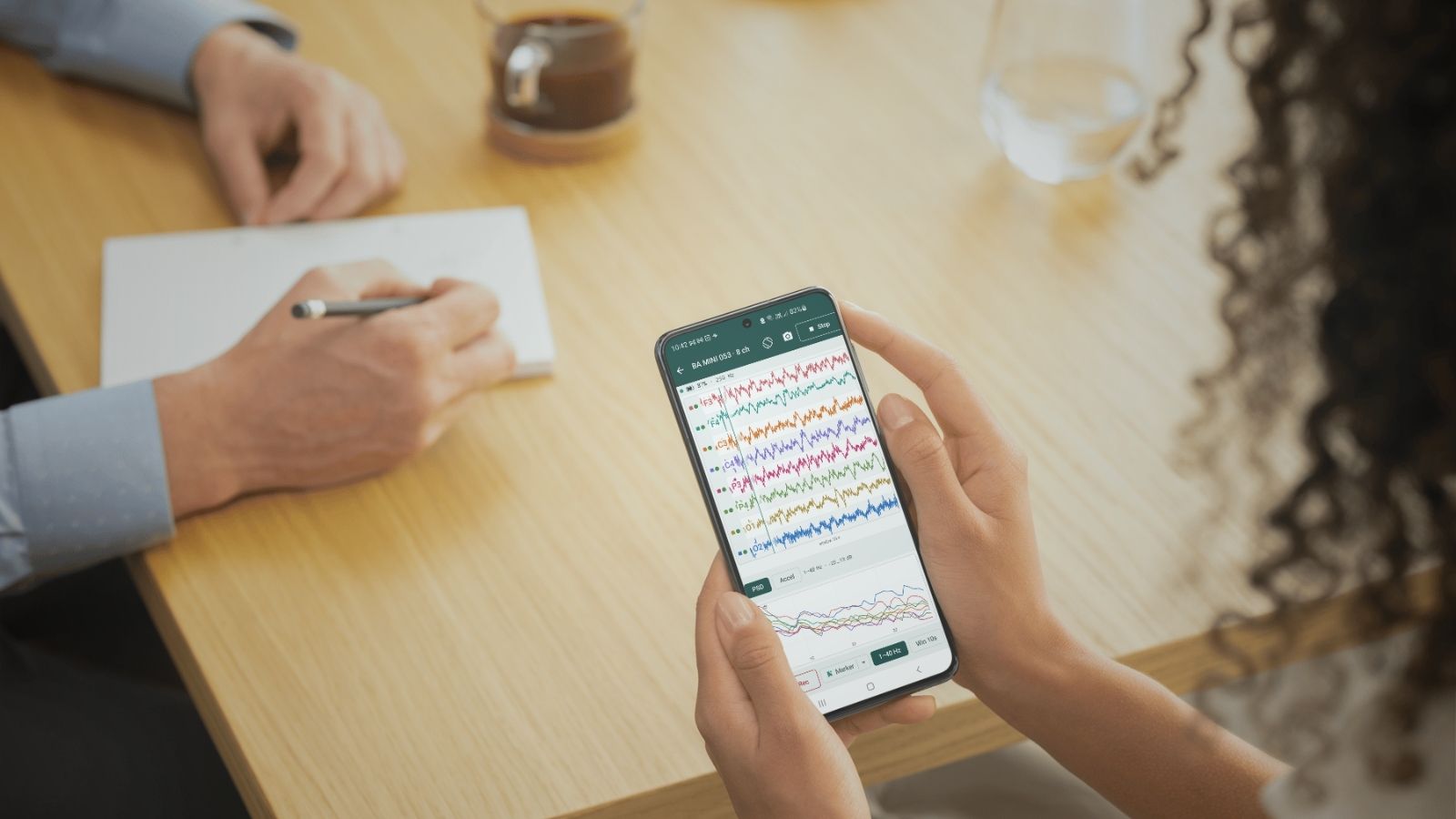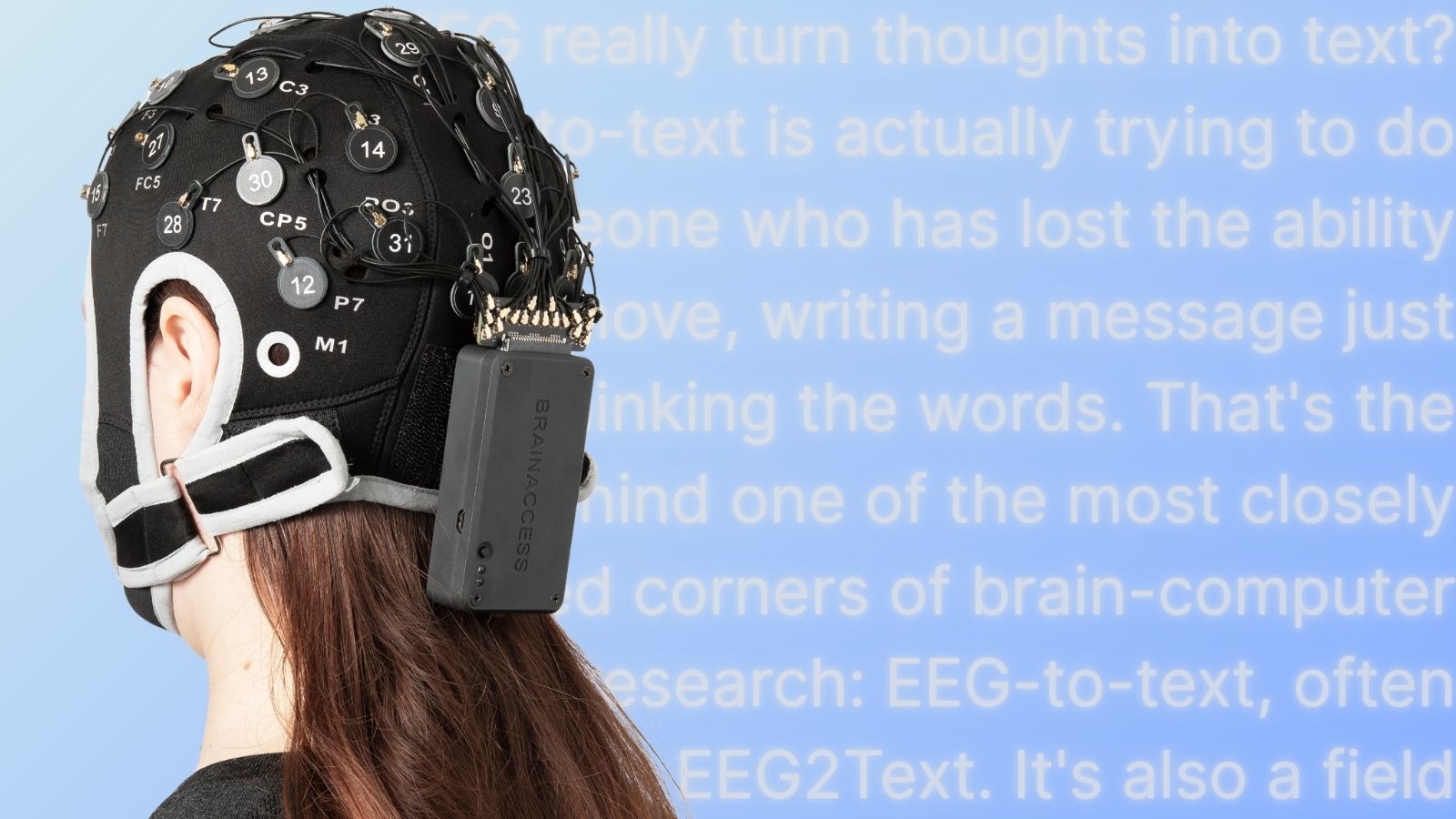
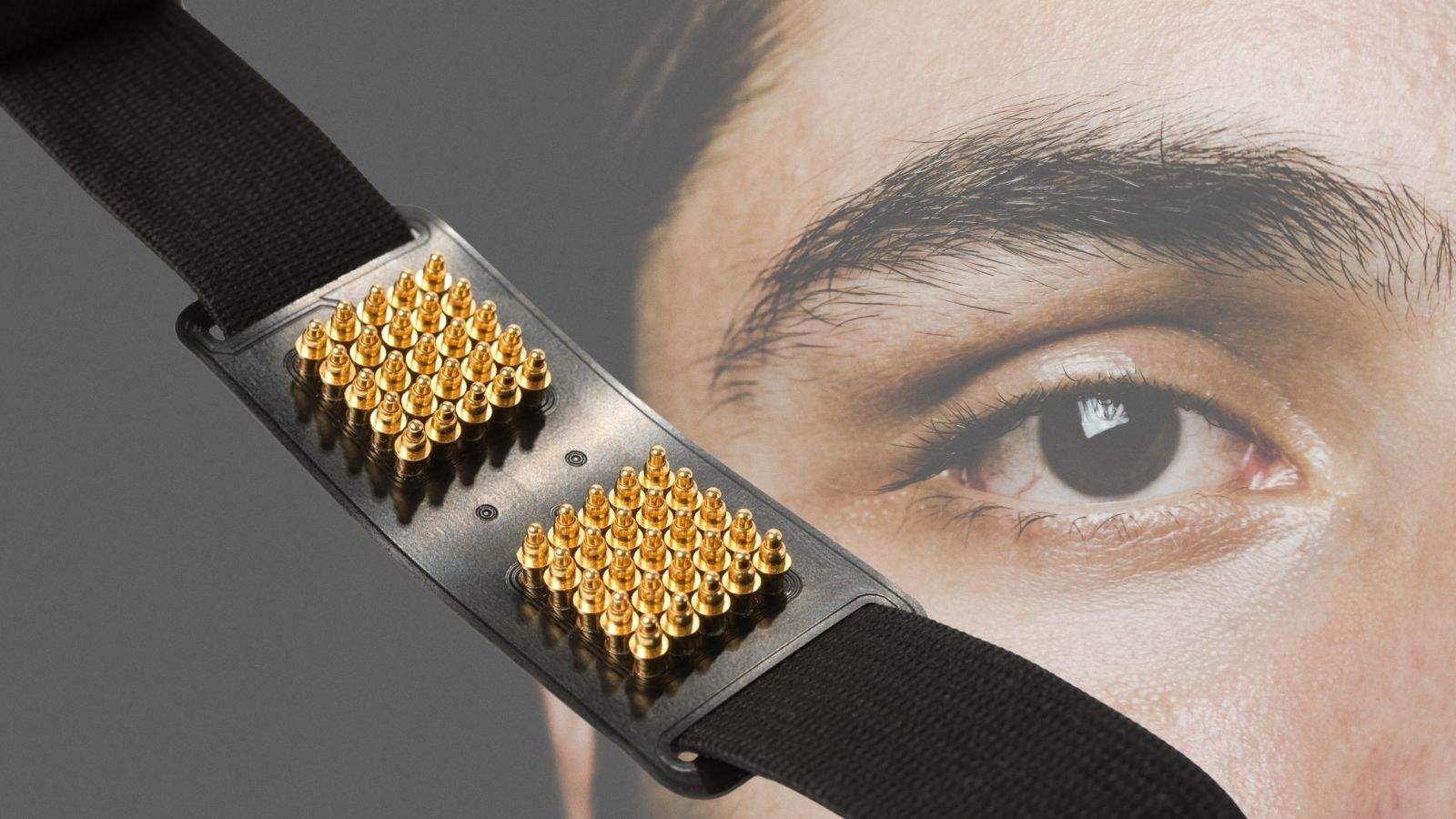

A new study puts the BrainAccess HALO to work decoding blinks and saccades from just two electrodes. Here’s how they built it, and what it found.
Researchers from Wroclaw University of Science and Technology, together with colleagues from Kazimierz Wielki University and Adam Mickiewicz University, set out to classify oculomotor activity — blinks, left saccades, right saccades, and a neutral state — using a BrainAccess HALO restricted to just its two occipital channels (O1, O2). Rather than relying on a single classifier, they trained an ensemble of one-dimensional CNNs as binary experts and combined them through stacked generalization, reaching 72.37% test accuracy on the 4-class problem (well above the roughly 50% ceiling any single end-to-end model managed on the same data).
But how did they get there?
THE SETUP
Data, preprocessing, and augmentation
Four healthy participants wore the HALO while a custom Python script built on the BrainAccess Board API streamed EEG at 250 Hz from O1 and O2. Each recording session captured four classes:
- Look Left
- Look Right
- Blink
- Neutral
Each class was segmented into fixed 2-second (500-sample) windows. The final dataset came out to 1,284 samples, split into 1,208 for training and 76 held out for testing.
4
Participants
250
Sampling rate (Hz)
2
Window length (s)
1284
Total samples
Raw filtered and z-scored/normalized. The team applied three data augmentation strategies during training:
- Gaussian noise injection (μ = 0, σ = 0.1) to simulate sensor noise
- Amplitude scaling drawn from U(0.8, 1.2) to mimic electrode-impedance variation
- Temporal shifting of up to ±30 samples (~120 ms) with zero-padding, to build in tolerance for small timing misalignments
An Isolation Forest was run on top of this to strip outlier windows before training began.
THE DEEP LEARNING APPROACH
Four architectures, one ensemble
Four stand-alone architectures were evaluated as baselines, chosen to span the main inductive biases used in time-series decoding:
- 1D-CNN — two temporal convolutional blocks (32/64 filters, kernel size 3), max-pooling, and two fully connected layers (128/64 units, dropout 0.5)
- EEGNet — depthwise separable convolutions with a temporal kernel of size 64
- LSTM — a 2-layer recurrent network, hidden size 64
- Transformer encoder — 2 layers, 4 attention heads, 64-dimensional embeddings
The CNN and EEGNet assume the useful signal is a short, localized waveform — a good match for the tens-of-milliseconds transients that characterize blinks and saccadic spikes. The LSTM instead assumes information is spread across longer temporal dependencies, and the Transformer imposes the weakest bias of the four, learning temporal relevance from data via self-attention — a flexibility that usually needs more than 1,208 training windows to pay off.
Given the low signal-to-noise ratio of a two-channel occipital montage, the team also trained the 1D-CNN as four binary one-vs-rest “experts” — Left, Right, Blink, and Neutral-vs-active — and combined their outputs two different ways:
- Heuristic voting — a confidence threshold (θ = 0.8) applied to each expert’s softmax output. Hard voting predicts a class only when it’s the sole candidate above threshold; soft voting picks the highest-confidence candidate whenever more than one clears the bar.
- Stacked generalization — the pretrained experts are frozen, and their penultimate-layer features plus logits are concatenated into a joint embedding fed to an MLP meta-classifier (one hidden layer, 64 units, ReLU) trained to resolve conflicts between experts into a final 4-class call.
Discover BrainAccess HALO
Explore our 4-channel fully portable Headband. Halo is a fully integrated system, with a free software included.

THE RESULTS
Decoding ocular events
On their own, the four end-to-end architectures topped out around 50% weighted accuracy, with the CNN-family models outperforming the recurrent and attention-based alternatives — matching what the architecture rationale predicted going in.
| Model | Accuracy | Precision | Recall | F1 |
|---|---|---|---|---|
| 1D-CNN | 0.50 | 0.51 | 0.50 | 0.49 |
| EEGNet | 0.50 | 0.50 | 0.50 | 0.50 |
| Transformer | 0.42 | 0.45 | 0.42 | 0.43 |
The binary experts told a more interesting story. Experts trained to full convergence (“strong”) scored much better individually than early-stopped (“weak”) experts — for Blink, 84.21% accuracy versus 34.21%. And yet, once aggregated, the weak experts consistently produced the stronger ensemble. Stacking with the MLP meta-classifier beat both voting schemes in every configuration tested, and dropping a dedicated Neutral expert from the stack improved things further — landing on 72.37% accuracy with weak base learners as the best result overall, despite those same experts performing worst individually.
| Aggregation strategy | Strong learners | Weak learners |
|---|---|---|
| Voting (soft) | 10.53% | 55.26% |
| Voting (hard) | 19.74% | 32.89% |
| Stacking MLP (w/ Neutral) | 51.32% | 63.16% |
| Stacking MLP (w/o Neutral) | 55.26% | 72.37% |
The best configuration — stacked weak learners, no dedicated Neutral expert — showed balanced performance across all four classes, with Blink and Neutral as particular strengths and Left/Right discrimination the hardest to call, consistent with known difficulties in fine-grained oculomotor discrimination from noisy EEG.
0.74
Blink F1
0.69
Left F1
0.68
Right F1
0.81
Neutral F1
Why it’s cool for BrainAccess
Turning a compact, two-channel EEG headset into a hands-free eye-movement detector is exactly the kind of result we love to see. We’re continuing to explore a HALO-based eye tracker ourselves as part of our upcoming EOG suite (stay tuned — 2027).
It’s genuinely exciting to see our clients and the wider research community independently landing on the same idea!
Read a related post:
Can Your EEG Read Your Eyes?
Eye tracking usually requires a dedicated device. A growing body of research suggests that EEG alone — even from a…
Reference
Kusnierz, J., Malek, R., Soltysiak, S., Pelc, M., Kawala-Sterniuk, A., & Gorzelanczyk, E. J. (2026, June). Preliminary Study on Leveraging Ensemble Convolutional Neural Networks for Robust Eye Movement Pattern Recognition via EEG Systems. In 2026 Progress in Applied Electrical Engineering (PAEE) (pp. 1-5). IEEE. doi: 10.1109/PAEE71887.2026.11660679