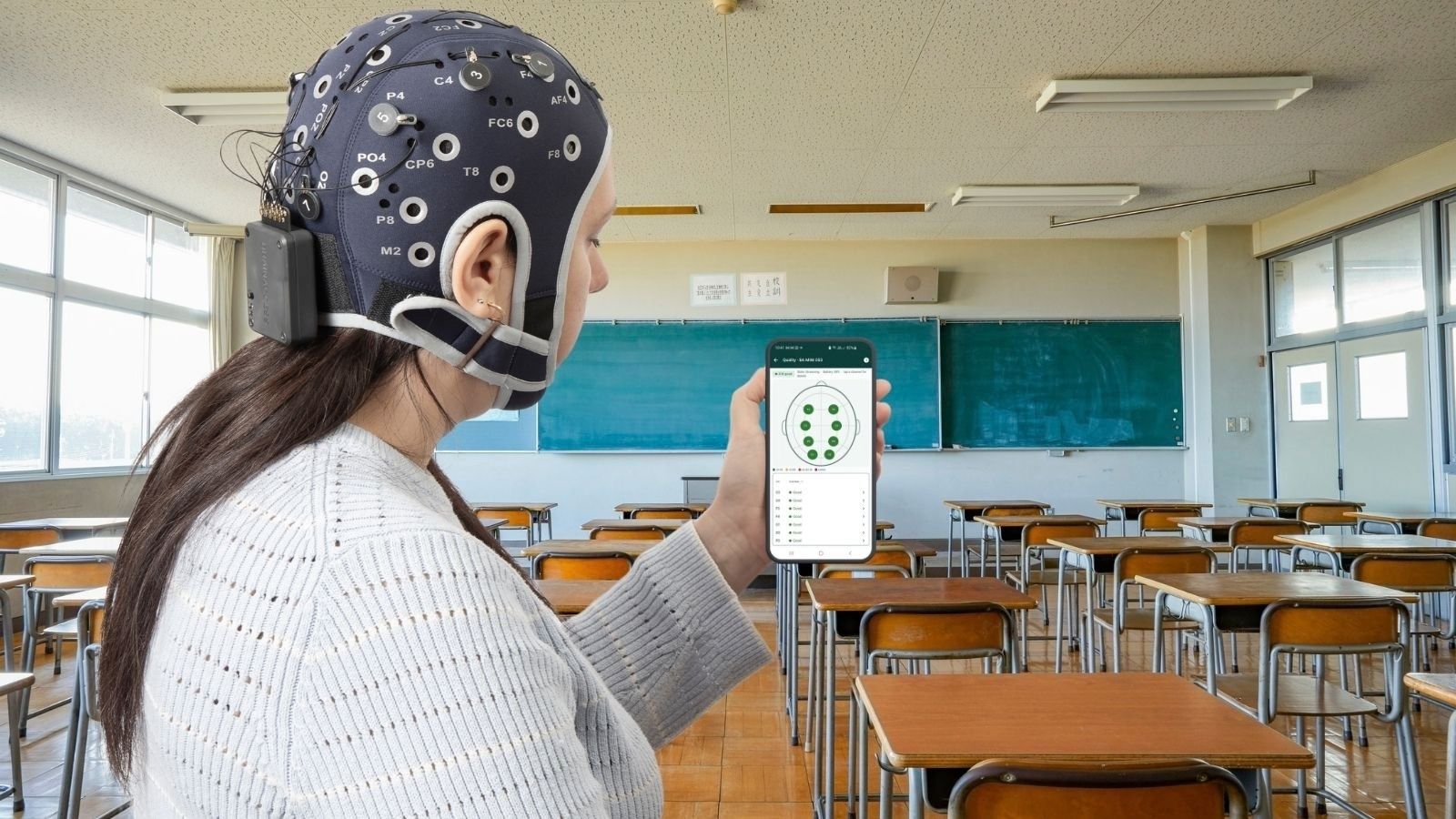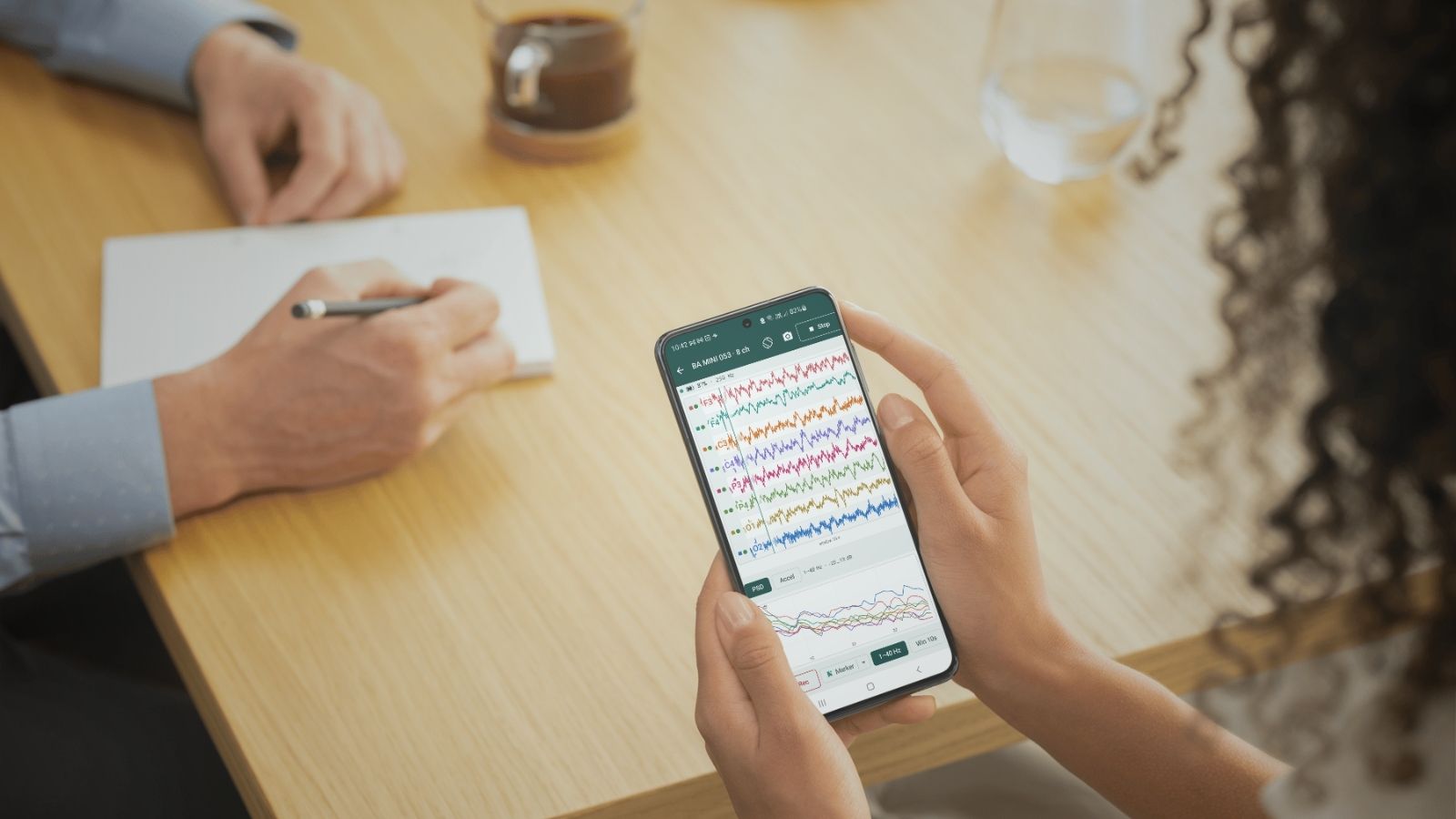

The BrainAccess team has been testing a new BrainAccess Mobile App for hyperscanning applications. The app enables connecting BrainAccess EEG devices to mobile devices such as phones and tablets and re-streaming data to the local network. Therefore, this provides a convenient and cost effective way for setting up hyperscanning experiments. This becomes particularly crucial when the number of devices and participants increases. Coupled with the BrainAccess Board software, Neurotechnology can now offer large-scale hyperscanning solutions.
BrainAccess Mobile App official release is planned for December 2024 on Android devices and support for iOS devices will follow next year.
Please read below for the details on the hyperscanning experiment involving 5 participants and a video stimulus.
Hyperscanning Experiment
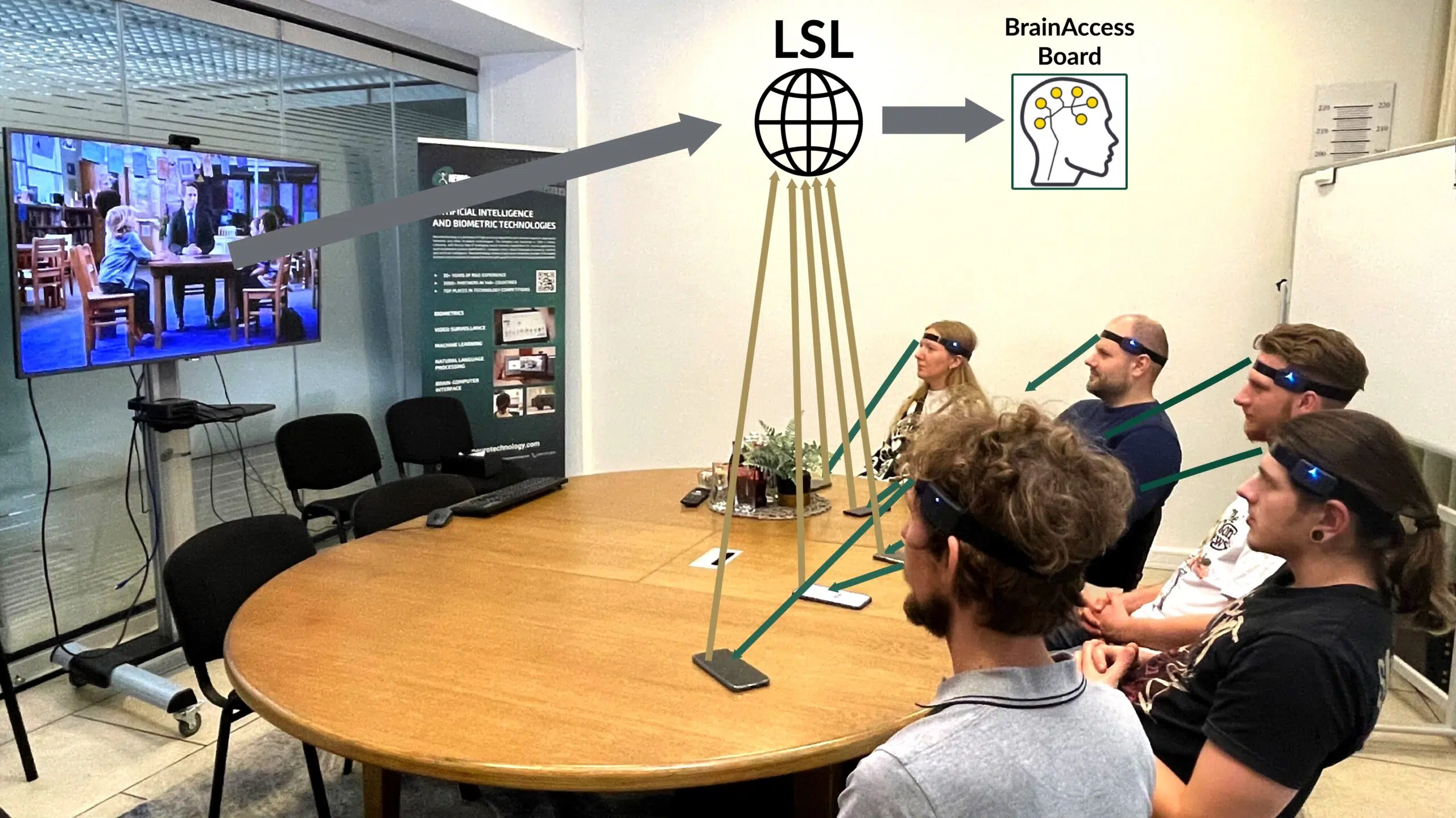
A group of five participants wore the BrainAccess Halo devices, portable dry-contact EEG headsets. Each participant had an Android phone with BrainAccess mobile app installed and used it to connect to their HALO device via Bluetooth. The app collected data from the devices and re-streamed data to the local network using WiFi connection. Participants were watching a number of commercial ads presented on a TV screen, annotations on each frame change in the video were sent to the local network as well. The BrainAccess Board software running on a PC was used to collect all the streams from HALO devices together with frame annotations and save the data for a later processing and analysis.
Both BrainAccess Mobile App and BrainAccess Board use Lab streaming layer (LSL) for data synchronization ensuring that all the streams are in sync with each other. Read more on LSL capabilities and use cases.
PsychoPy was used for video content presentation which is a useful tool for presenting image or video stimuli and ensuring accurate timing and annotations.
Read below for some potential applications of hyperscanning.
Applications
Hyperscanning has numerous application possibilities:
- Neuromarketing: The BrainAccess system can optimize marketing campaigns by assessing consumer reactions to advertisements and identifying the most effective branding elements.
- Social Interaction Research: This technology enables a deeper understanding of how human brains interact during social exchanges.
- Clinical Research: The BrainAccess system can be employed to study various neurological disorders and evaluate the efficacy of different therapeutic interventions.
If you have a project related to neuroscience, or are looking for an all-in-one system for your EEG research, do not hesitate to contact us. Our team of dedicated specialists will examine every individual case and provide an offer that best suits your requirements.