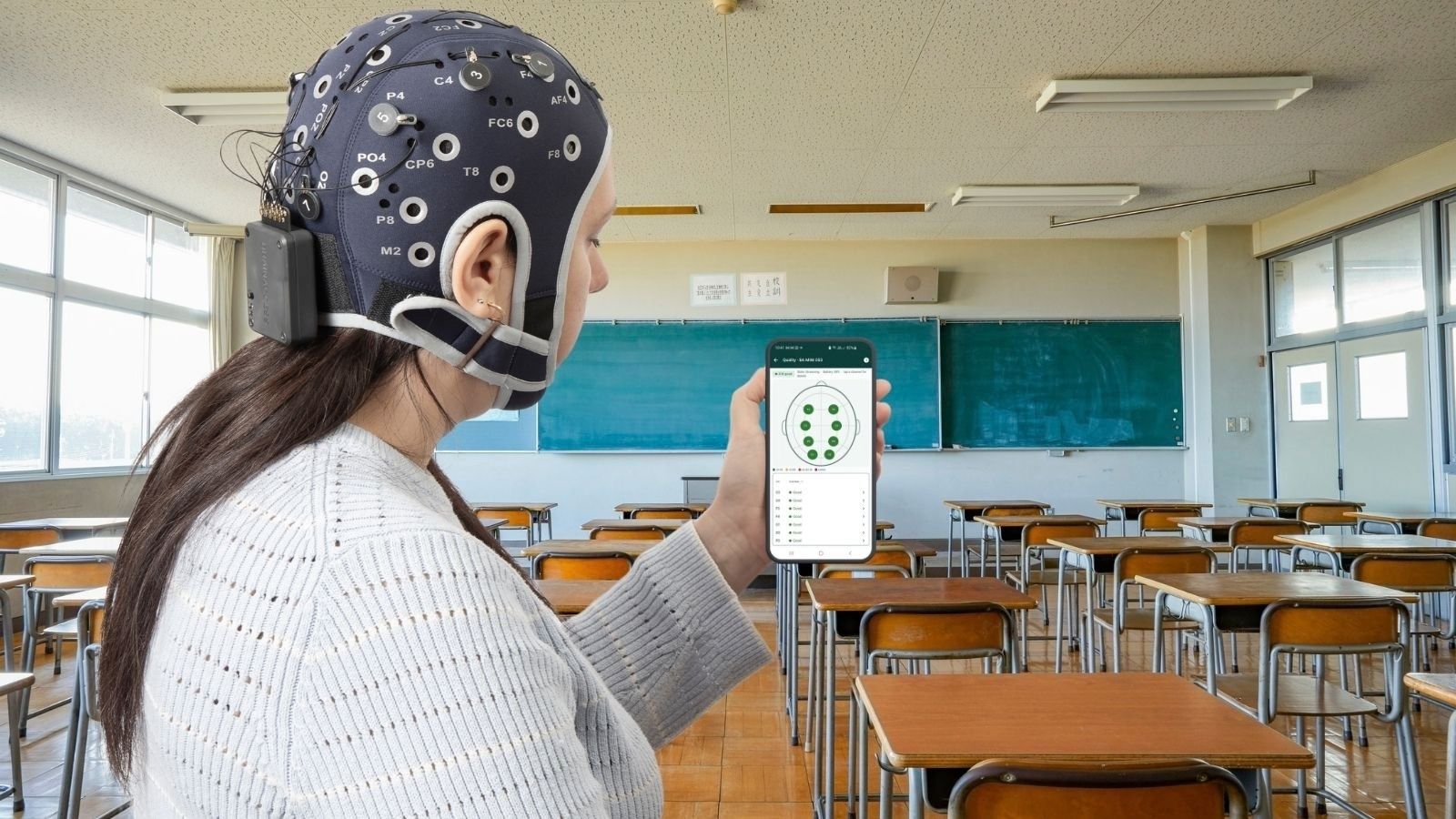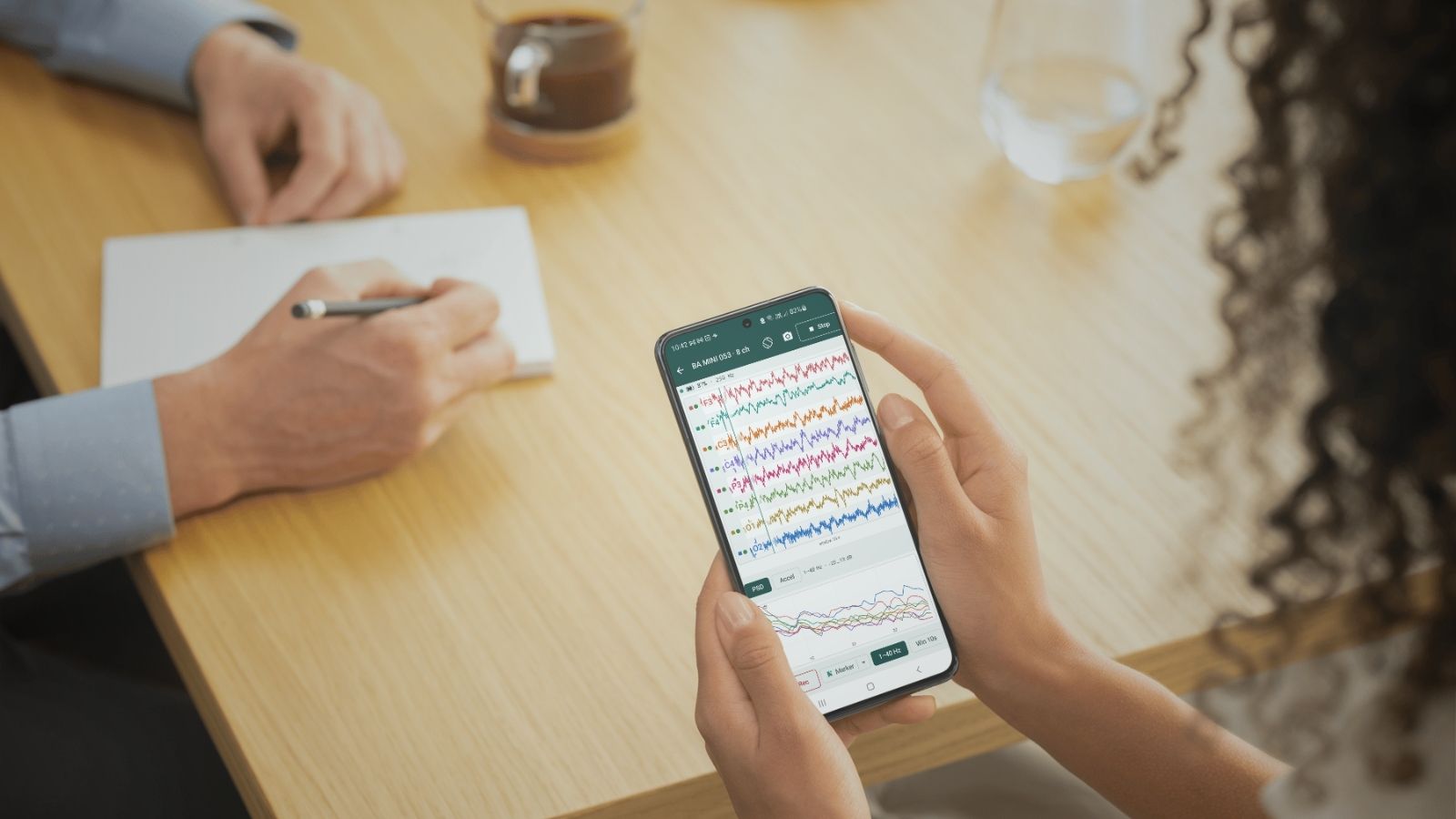

BrainAccess makes four wireless, dry-electrode EEG systems, and the right one for you comes down almost entirely to channel count — 4, 8, 16, or 32 — and what you actually need to measure with it. This guide walks through what each device is, how portable and comfortable it is, and which real projects it’s built for: wellness monitoring, BCI prototyping, neuromarketing, or full-coverage neuroscience research.
All four BrainAccess devices share the same DNA. Every one of them uses dry contact electrodes, so there’s no gel or paste to prep or clean up. Every one of them is fully wireless, streaming over Bluetooth to the free BrainAccess software on your laptop, tablet, or phone. Every one of them is battery-powered and genuinely portable: lab, living room, classroom, or out in the field.
Where they differ is in how they’re built.
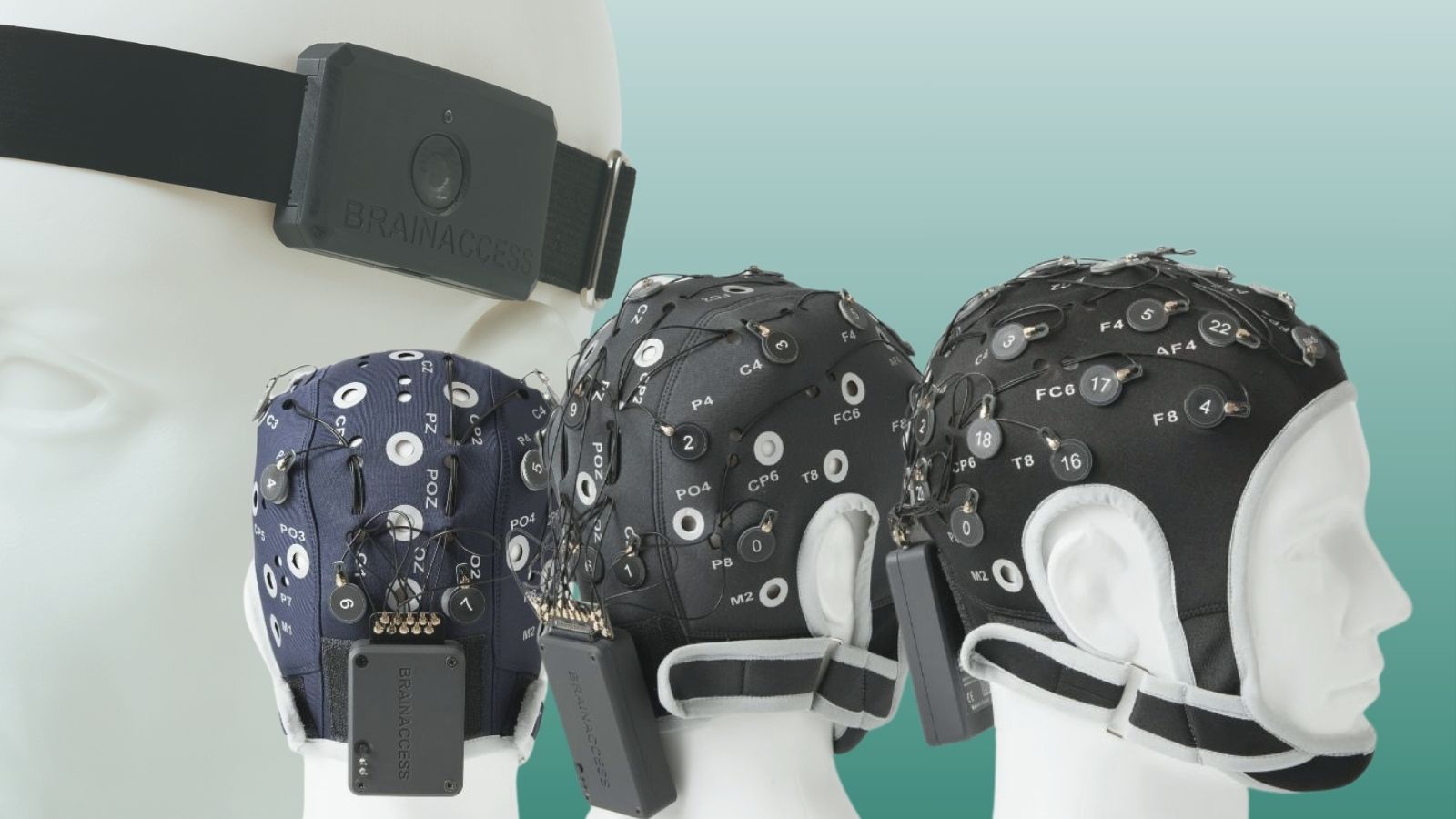
- HALO is the odd one out: a single, fully integrated headband, with electrodes, amplifier, and battery all molded into one flexible strap. Put it on and you’re recording in under a minute.
- MINI, MIDI, and MAXI, on the other hand, are modular kits: a separate wireless amplifier that attaches onto an EEG cap fitted with 8, 16, or 32 electrodes. Same recording principles, different physical form, and a very different amount of brain activity visible at once.
Each of these devices can be an excellent choice based on your needs, current application, and level of experience; but choosing which device will work best for you can be confusing: is a 4-channel headband enough for your neurofeedback app, or too little? Do you actually need 32 channels for your BCI prototype, or is that expensive overkill? Is MIDI just a smaller MAXI, or its own thing entirely?
This guide cuts through that by focusing on the specifications that drives the decision and actually matter day to day: comfort, portability, setup time, battery life, and, most importantly, what kinds of questions each device can and can’t answer.
DEVICE 01
HALO Headband
The one you forget you’re wearing.
Portability: 5/5 ⭐
Coverage:2/5 ⭐
Comfort: 5/5 ⭐
Beginner Friendly: 5/5 ⭐
4 ch + reference
Integrated headband
~7 h battery
~2 h full charge

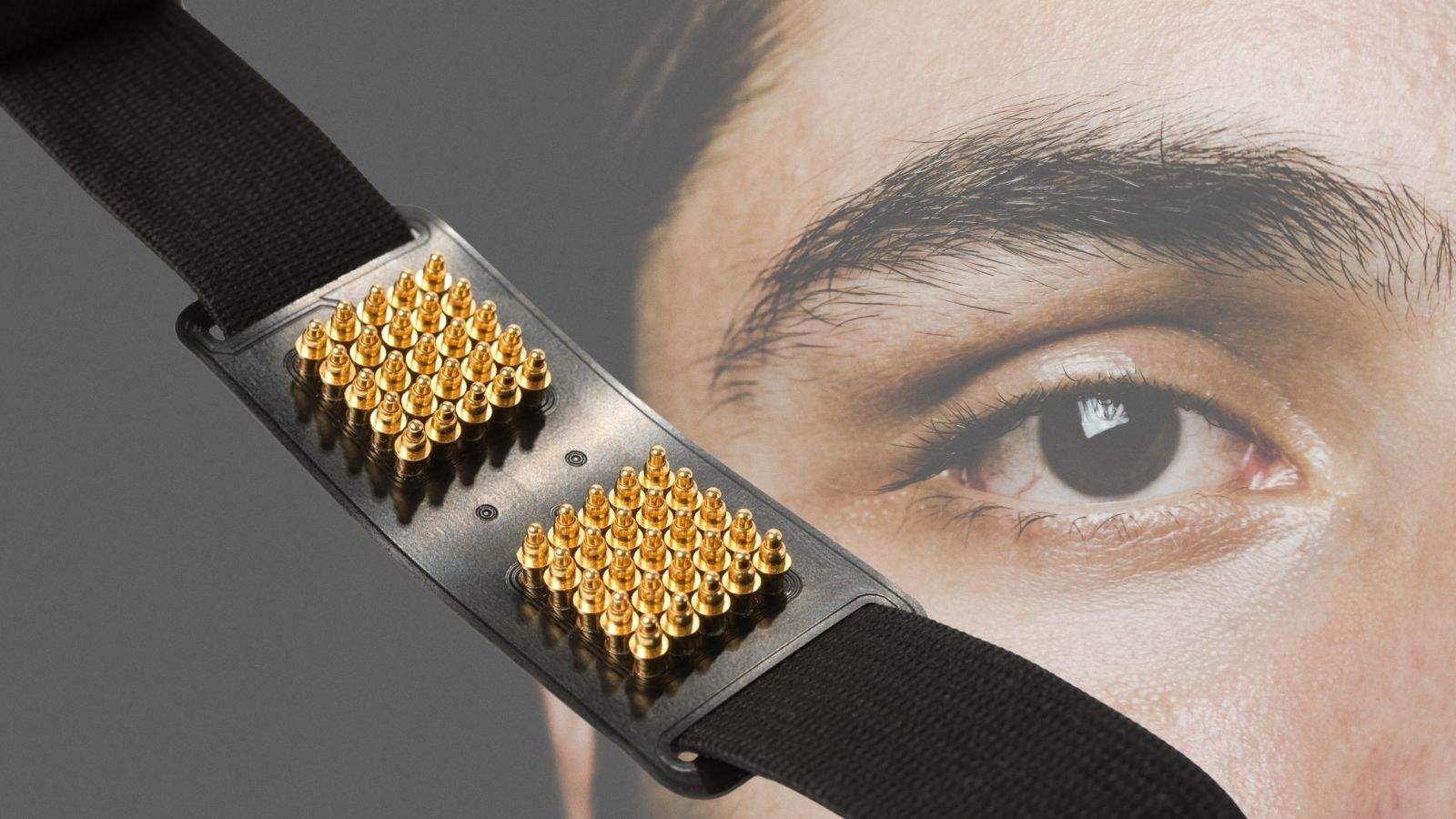
HALO isn’t a cap-and-amplifier kit, it is a fully integrated system. Electrodes, electronics, and battery are built into one lightweight, adjustable strap, with two electrodes over the forehead and two over the occipital region, plus a common reference. There’s no cap to size and no individual electrodes to place: slide it on, adjust the band, and you’re recording. One size fits all. That’s it. That simplicity is the entire point: HALO trades spatial detail for near-zero setup friction and all-day comfort.
Fast mental-state and wellness checks — relaxation, attention, mental workload
Meditation, focus-training, and neurofeedback apps built for everyday users, not lab staff
Public BCI demos, workshops, and classroom introductions to EEG
Hyperscanning across a group, since each headband is fast and cheap to fit
Wearable-product prototyping where comfort and battery life matter more than full coverage
Simple visual-response and eye-movement detection, thanks to the electrode placement
Not the right fit for: mapping activity across the scalp, source localization, or any protocol that needs to tell several brain regions apart. Four fixed electrodes can only tell you so much.
DEVICE 02
MINI Kit
Field-ready EEG in a shirt-pocket footprint.
Portability: 5/5 ⭐
Coverage: 3/5 ⭐
Comfort: 5/5 ⭐
Beginner Friendly: 4/5 ⭐
8 ch + reference
Cap + amplifier · lightest kit
~14 h battery
~3 h full charge

MINI is the lightest of the cap-based systems. It has the same building blocks as MIDI and MAXI (a wireless amplifier plus a cap of dry electrodes), scaled down to the essentials. Its connector supports custom electrode layouts, so you’re not locked into one fixed configuration; you can wire it to whichever handful of 10-20 positions your study actually needs. It also has the longest battery life in the range, which matters when a session runs all day or leaves the lab entirely.
BCI prototyping — motor imagery, SSVEP, P300 — where a handful of well-chosen sites beats whole-scalp coverage
Mobile and field EEG: sports science, outdoor cognition, naturalistic settings where participants are moving
Wearable neurotech product development
Studies focused on one cortical region rather than the whole brain
Teams starting a research program on a modest budget who still want cap-based flexibility
Not the right fit for: whole-scalp topography, source localization, or comparing activity across many regions in one recording. Eight sites cap out how much spatial pattern you can actually resolve.
DEVICE 03
MIDI Kit
The working researcher’s middle ground
Portability: 4/5 ⭐
Coverage: 4/5 ⭐
Comfort: 4/5 ⭐
Beginner Friendly: 3/5 ⭐
16 ch + reference
Cap + amplifier
~12 h battery
~3 h full charge

MIDI sits exactly where its name suggests. It has enough electrodes to see meaningful spatial patterns across the scalp — frontal versus parietal versus temporal activity, for example — while staying light and quick enough to take into the field.
Neuromarketing and consumer neuroscience — attention and engagement across regions during ad, product, or UX testing
Cognitive and ERP experiments needing moderate spatial resolution — attention, memory, decision-making tasks
Applied and field neuroscience: research-grade signal outside a shielded lab
Teams moving from prototyping into publishable or client-facing studies
Not the right fit for: dense-coverage source localization or high-resolution connectivity mapping — that’s where MAXI takes over.
DEVICE 04
MAXI Kit
Lab-grade coverage, but no gel, no wires, no hassle.
Portability: 4/5 ⭐
Coverage: 5/5 ⭐
Comfort: 3/5 ⭐
Beginner Friendly: 2/5 ⭐

32 ch + reference
Cap + amplifier · MIDI form factor
~12 h battery
~3h charge
MAXI is the density play: double MIDI’s electrode count in the same wireless, gel-free, battery-powered package. It’s built for questions that live in fine spatial detail — exactly where a signal originates, how distant brain regions communicate, whether an effect replicates across the entire scalp — while still being something you can set up in minutes rather than hours.
Academic and advanced neuroscience research requiring high spatial resolution
Source localization and connectivity or network analysis
Full-coverage ERP mapping across the whole scalp
Advanced cognitive research and non-clinical studies that need lab-comparable density without wet-gel setup
Multi-site or hyperscanning studies where per-participant detail still matters
Not the right fit for: quick demos or everyday wellness use. MAXI is the most capable device in the line-up, but it’s built for depth, not speed — if you don’t need the resolution, MINI or MIDI will serve you better for less money.
AT GLANCE
Same software, same wireless workflow, same dry-electrode philosophy. Choose the best fit based on channel count, comfort, ease of setup, budget, and application.
| Device | Channels | Form Factor | Battery Life | Starting Price* | Best For |
|---|---|---|---|---|---|
| HALO | 4 | Integrated headband | ~7 h | €400 | Wellness, quick demos, neurofeedback |
| MINI | 8 | Cap + amplifier (lightest) | ~14 h | €900 | BCI prototyping, field/mobile EEG |
| MIDI | 16 | Cap + amplifier | ~12 h | €1,600 | Neuromarketing, cognitive/ERP research |
| MAXI | 32 | Cap + amplifier (MIDI form factor) | ~9 h | €3,000 | High-density research, source localization |
Where to buy
Browse our Shop to get started.
Every kit (MINI-MIDI-MAXI) ships ready to use: device, cap and dry electrodes, Bluetooth adapter, and free access to the BrainAccess Board Desktop and Mobile app and SDK. Extra caps, electrode sets, and spare parts can be added to any kit.
Halo can be immediately added to the cart and does not require additional components.
Conclusion: which one should I get?
When purchasing a device, always consider your budget, experimental needs, required comfort, desired application, and level of experience with EEG research.
Ultimately, the decision comes down to a simple rule of thumb: buy as many channels as your questions actually need, not as many as sound impressive.
No matter what you choose, all BrainAccess options run on the same free software, the same wireless workflow, and the same dry-electrode philosophy. You’re never locked out of the rest of the family and can easily expand your options as your research demand grows.
HALO
Measure what your own brain is doing, with zero setup friction.
MINI
Prototyping a BCI or heading out into the field.
MIDI
Running research that needs moderate spatial resolution.
MAXI
Chasing fine spatial detail, source localization, or full-scalp coverage.
Still questions? Compare hardware specifications in our dedicated table, or request a demo with us. We are happy to help!