
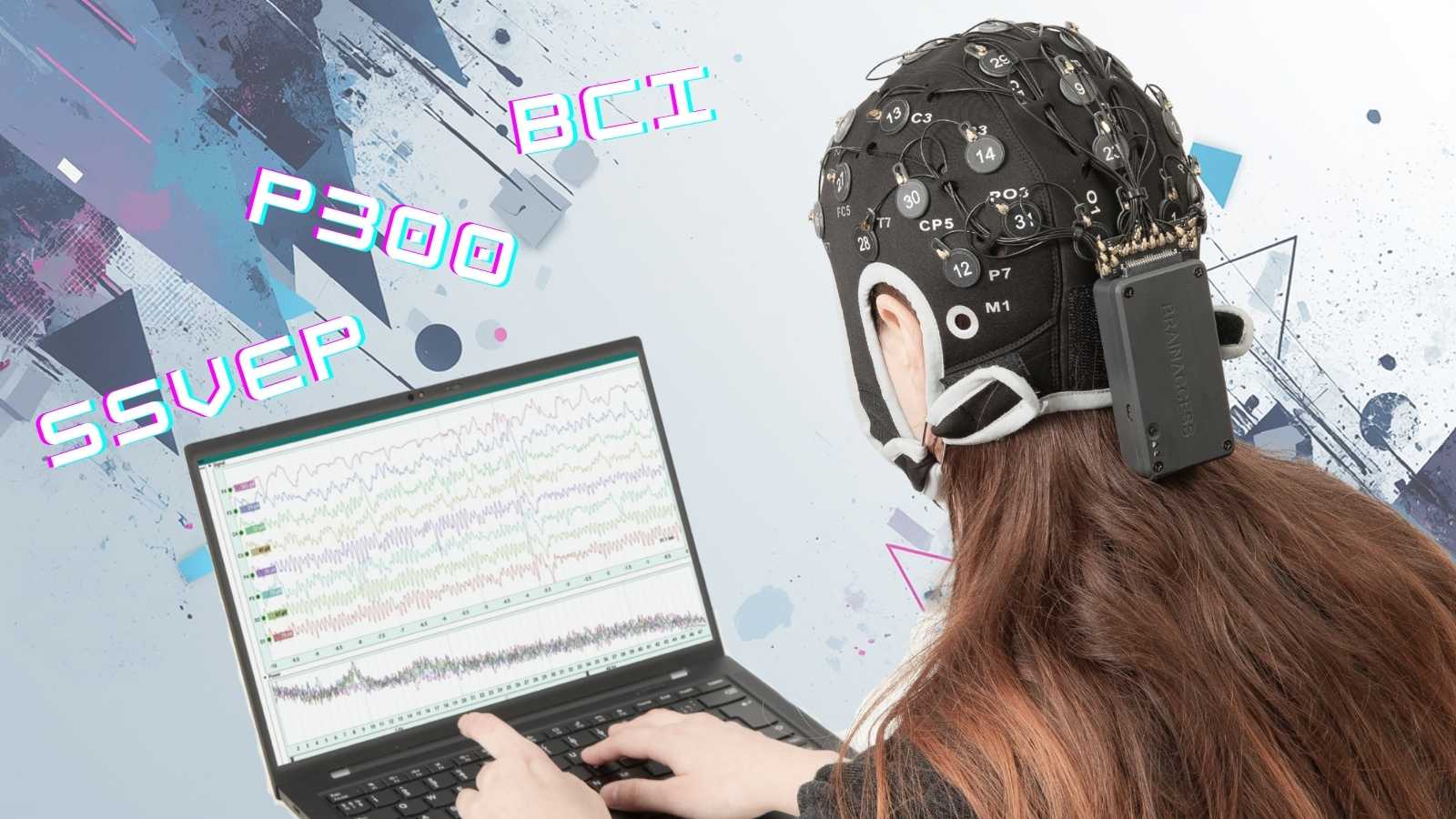
A technical survey of the three most robust EEG-based BCI paradigms: how they work, why they work, and where the field can push next.
Not all brain signals are created equal. After decades of BCI research, three paradigms have consistently cleared the bar of reproducibility, classifier generalizability, and practical deployment: P300 event-related potentials, steady-state visually evoked potentials (SSVEP), and motor imagery via sensorimotor rhythm (SMR) modulation. Each exploits a fundamentally different neuroelectric mechanism, and each comes with its own trade-off surface spanning ITR, user fatigue, calibration cost, and robustness to noise.
This post maps the signal-level mechanics of all three, situates them within the classification landscape, and outlines the engineering directions most likely to push them toward genuinely complex, real-world systems.
PARADIGM 1
P300 — Event-Related Potential
Signal Mechanism
The P300 is an endogenous ERP component, a positive deflection peaking around 300–500 ms post-stimulus over centroparietal scalp sites (Pz, Cz). It is elicited by infrequent, task-relevant stimuli within an oddball sequence — the classic Donchin speller being the canonical implementation. The underlying neural generator is distributed, involving the posterior parietal cortex, prefrontal regions, and hippocampal contributions, reflecting context-updating and target discrimination processes.
PEAK LATENCY
KEY CHANNELS
Pz, Cz, Fz
Typical ITR
20–40+ bpm
Calibration
Classification Approach
The standard pipeline involves bandpass filtering (1–20 Hz), epoch extraction, and downsampling prior to feature entry. Linear discriminant analysis (LDA) on concatenated epoch windows remains a strong baseline, but stepwise LDA (SWLDA) — which performs implicit feature selection across the epoch time-series — is the workhorse of production P300 systems. Ensemble approaches and xDAWN spatial filtering to increase the signal-to-noise ratio of the P300 component have shown consistent accuracy gains. The fundamental challenge is single-trial detection: averaging over 10–15 repetitions stabilizes the P300 but tanks ITR. Reducing the required repetitions via better spatial filters or deep learning (EEGNet, ShallowConvNet) is the core accuracy-speed trade-off.
The P300 paradigm is robust to motor impairment, making it valuable for clinical communication BCIs. Its main liability is fatigue from sustained visual attention and the latency cost of averaging.
PARADIGM 2
SSVEP — Steady-State Visually Evoked Potential
Signal Mechanism
When the visual system is driven by a flickering stimulus at a fixed frequency f, the occipital cortex phase-locks to that frequency, generating a narrowband response at f and its harmonics (2f, 3f…) measurable over O1, Oz, and O2. The response is exogenous and largely automatic, requiring minimal cognitive engagement. Stimulus frequencies in the range of 6–40 Hz are most used, with the 8–15 Hz range balancing response amplitude and flicker comfort. Higher frequencies (above ~30 Hz) reduce fatigue but attenuate signal amplitude.
Response band
KEY CHANNELS
O1, Oz, O2
Typical ITR
40–100+ bpm
Calibration
Classification Approach
Canonical Correlation Analysis (CCA) between the multichannel EEG response and a set of sinusoidal reference signals at each target frequency is the state-of-the-art calibration-free approach. It exploits both the fundamental and harmonics simultaneously. Multivariate extensions (MsetCCA, L1-regularized CCA) and filter bank CCA (FBCCA), which applies CCA across multiple sub-bands to capture harmonic energy across decomposed frequency bands, push classification accuracy higher. Subject-specific training with task-related component analysis (TRCA) provides the highest reported ITRs — studies have demonstrated over 200 bits/min in controlled settings with 40-target layouts.
The practical ceiling is stimulus engineering: screen refresh rates constrain available target frequencies, phase coding schemes expand the target set without adding more frequencies, and joint frequency-phase modulation (JFPM) is now the dominant paradigm for high-density SSVEP spellers.
SSVEP’s low calibration requirement and high ITR make it well-suited for wearable, on-device BCIs — exactly the deployment context BrainAccess devices target. The main constraint shifts to display hardware and ocular fatigue.
PARADIGM 3
Motor Imagery — SMR / ERD / ERS
Signal Mechanism
Motor imagery (MI) produces event-related desynchronization (ERD) in the alpha (mu, 8–12 Hz) and beta (18–26 Hz) bands over sensorimotor cortex contralateral to the imagined movement, followed by post-movement event-related synchronization (ERS) — the beta rebound. The topography is the key discriminator: left-hand MI drives right-hemisphere C4 suppression; right-hand MI drives C3 suppression. This cortical lateralization is the core separability structure that classifiers exploit.
Feature band
KEY CHANNELS
C3, Cz, C4
Typical ITR
Calibration
Classification Approach
Common Spatial Patterns (CSP) is the canonical spatial filter for MI: it finds linear combinations of EEG channels maximizing the variance ratio between two classes, producing features that map directly onto lateralized cortical activations. Log-variance of CSP-filtered signals fed into LDA or SVM defines the standard MI pipeline. Riemannian geometry classifiers operating on covariance matrices in the SPD manifold (e.g., MDM — Minimum Distance to Mean) have emerged as strong alternatives, especially for cross-session and cross-subject generalization, since covariance matrices carry both spatial and spectral information.
The core difficulty of MI is high inter- and intra-subject variability. Users differ substantially in their ability to generate detectable SMR patterns, and session-to-session non-stationarity is a persistent challenge. Adaptive classifiers using unsupervised domain adaptation — or more aggressively, source-free domain adaptation leveraging pre-trained models — are the active research direction.
MI is the only paradigm among the three that requires no external stimulus, making it suitable for passive and covert control scenarios. Its lower ITR is an acceptable trade-off for applications demanding naturalistic, screen-independent interaction.
Pushing the Boundaries
Each of the three paradigms has a well-characterized performance ceiling under classical assumptions. Breaking through it — or combining paradigms into systems that transcend individual limits — requires addressing the bottlenecks in both signal and system architecture. Here are the directions with the most evidence and engineering traction.
01
Hybrid BCI fusion
Combining SSVEP with P300 (or MI with SSVEP) via late-stage decision fusion or shared feature spaces lets systems exploit complementary signal structures. SSVEP provides fast exogenous selection; P300 confirms intent endogenously. Joint systems can maintain high ITR while reducing false positives.
02
Transfer Learning & Foundation Models
Pre-trained EEG encoders (BIOT, LaBraM, ZUNA) trained on large multi-dataset corpora are beginning to reduce calibration requirements substantially for MI and P300. Fine-tuning on small subject-specific datasets yields competitive accuracy with a fraction of the training data.
03
Online Adaptive Classifiers
Non-stationary EEG distributions degrade all three paradigms over time. Covariance-tracking Riemannian classifiers and continual learning approaches that update decision boundaries without labelled feedback represent the state-of-the-art in handling session drift — critical for any deployed wearable BCI.
04
Aperiodic-Aware Feature Extraction
The 1/f aperiodic component of the EEG power spectrum confounds bandpower features, particularly in MI and resting-state paradigms. Parameterizing the aperiodic slope and offset (via specparam/FOOOF) before extracting oscillatory components improves feature specificity and reduces inter-session variability.
05
Passive Mental State Monitoring
Beyond discrete command paradigms, continuous decoding of cognitive load, attention, or emotional valence opens a different application space. Spectral features from frontoparietal networks, combined with multimodal physiological signals (HRV, EDA), are the basis of composite mental state indices that can run passively in the background of any active BCI session.
06
Real-Time Closed-Loop Neurofeedback
Embedding the BCI decode loop inside a neurofeedback paradigm lets the system train the user’s neural patterns simultaneously with classification. Closed-loop alpha/SMR neurofeedback during MI training demonstrably shortens user training time and improves long-term classifier stability.
Conclusion
The three paradigms reviewed here are not competitors — they are complementary instruments in a broader BCI toolkit. SSVEP excels when speed and minimal calibration matter; P300 covers complex symbol sets and cognitively intact users; MI remains the only truly stimulus-free pathway. Mature implementations of all three are now tractable with compact, wearable EEG hardware operating at research-grade signal quality.
The frontier is systems thinking: how to fuse these paradigms intelligently, adapt to the user rather than demanding the user adapt to the system, and embed richer passive decoding alongside active control. The neurophysiology is well-characterized. What remains is the engineering.
Building something similar? At BrainAccess, we build the hardware and software layer that makes these paradigms reproducible outside the lab — from compact dry-electrode HALO, MINI, MIDI, and MAXI headsets to the open Python SDKs for real-time signal processing and feature extraction. If you are building on any of the paradigms above, we would like to hear what you are working on!

Martina Berto, PhD
Research Engineer & Neuroscientist @ Neurotechnology.
Martina Berto, PhD
Research Engineer & Neuroscientist @ Neurotechnology.