
A grounded look at where EEG-to-text research actually stands, the real progress, the very real gaps, and why the field just got a lot more honest with itself.
What EEG-to-text is actually trying to do
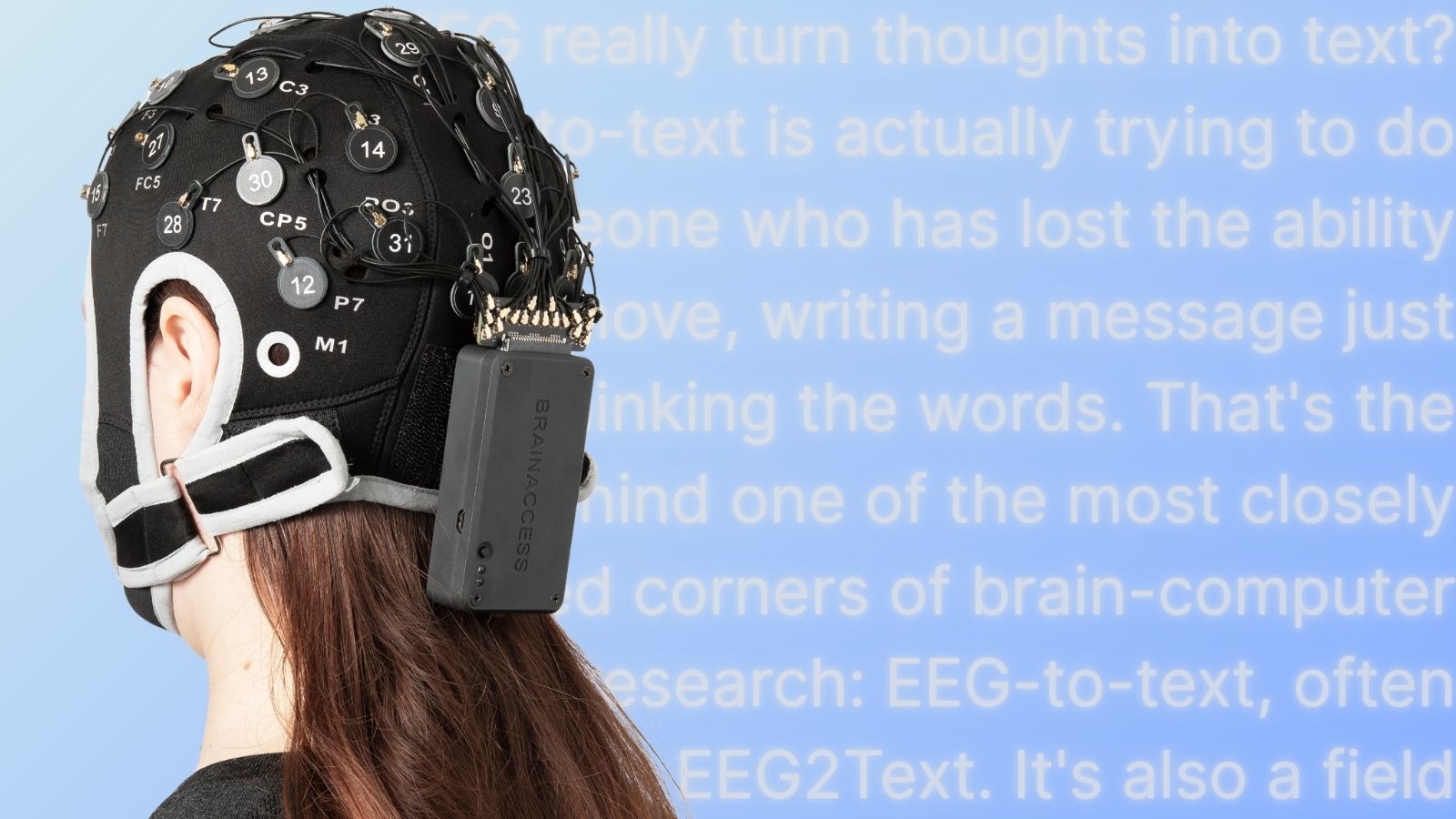
Picture someone who has lost the ability to speak or move, writing a message just by thinking the words. That’s the promise behind one of the most closely watched corners of brain-computer interface research: EEG-to-text, often shortened to EEG2Text.
It’s also a field that has recently had to ask itself an uncomfortable question: how much of what looked like “reading minds” was the brain actually talking, and how much was a very capable language model quietly filling in the blanks? Here’s where the science genuinely stands, past the headlines.
EEG-to-text is the attempt to translate electroencephalography recordings — the faint electrical activity picked up by sensors resting on the scalp — directly into open, freely composed text. Not a menu of ten preset commands to choose from, but full sentences, generated from brain activity alone.
If it works reliably, this technology could give people who are paralyzed or otherwise unable to speak a way back into conversation, without brain surgery. Compared to an implanted array, surface EEG is non-invasive, comparatively affordable, and increasingly portable.
Why this is such a hard problem
A whisper through a wall
Every EEG sensor sits on the scalp, several layers of skull and tissue away from the neurons doing the actual work. What reaches the sensor is a blurred, weakened version of the real signal, tangled together with electrical noise from blinking eyes, jaw muscles, and ordinary movement. Researchers call this a low signal-to-noise ratio. It behaves a lot like trying to follow one whispered conversation through a wall, at a party. Every EEG-to-text model is, in some sense, built to fight this.
No two brains speak the same accent
The pattern of activity that means “hello” in one person’s brain can look almost nothing like the pattern for the same word in someone else’s. Differences in skull shape, electrode placement, and individual wiring mean a model trained on one person often struggles with the next. Getting a model to generalize across many people, without hours of per-person calibration, remains one of the field’s stubborn open problems.
The memorization problem: a needed reality check
A 2025 study published in Scientific Reports ran a simple, pointed test on several published EEG-to-text decoders: swap in random, meaningless noise instead of real brain data, and see what happens. In a worrying number of cases, the models kept producing fluent, plausible sentences anyway, performing about as well on noise as on real EEG. This suggests the language-model was doing most of the work, while the brain signal itself contributed far less than the headline numbers implied.
💡 A compounding issue
Many earlier evaluations also relied on “teacher forcing”: feeding the model the correct previous word at each step, rather than letting it build a sentence unaided. One widely cited analysis found that switching to fully autonomous decoding could shrink reported translation-quality scores to roughly a third of their teacher-forced values.
None of this makes EEG-to-text a dead end. It means the field is doing something healthy: getting more rigorous about proving that decoding is real, rather than a clever illusion built on language priors. A standard noise-baseline test for every new model, and evaluation without teacher forcing as the default, are quickly becoming best practice rather than the exception.
What’s actually working
EEG2TEXT
A 2024 academic project, simply named EEG2TEXT, tackled the open-vocabulary problem directly. Rather than restricting decoding to a small fixed set of words, it combined EEG-specific pre-training with a “multi-view” transformer — one that treats signals from different regions of the scalp as separate perspectives on the same sentence, then aligns them with a language model’s sense of meaning. On standard benchmarks, it improved translation-quality scores by as much as five percentage points over earlier approaches — genuine progress, even with the memorization caveats above firmly in mind.
Brain2Qwerty
Meta AI took a cleverer angle: instead of decoding imagined or spoken words directly, Brain2Qwerty decodes what someone is typing on a physical keyboard, from brain activity recorded during the act of typing. Published in Nature Neuroscience, the study tested 35 volunteers using both EEG and magnetoencephalography (MEG) — a non-invasive method that reads magnetic rather than electrical brain activity, needs a room-sized scanner, but returns a considerably cleaner signal.
That gap is the field’s honesty check. In one direct, head-to-head comparison, it shows exactly how much signal quality EEG still gives up next to its bulkier, pricier cousin.
Lower is better. The best individual participants using MEG reached a character error rate of 18% — accurate enough to perfectly decode some sentences the model had never seen in training.
A newer version, Brain2Qwerty v2, trained on a considerably larger dataset — 22,000 typed sentences collected across nine participants — and brought the average word error rate down to 39% using MEG alone, decoded in real time. For the best participant, half of all sentences were reconstructed with at most one word wrong. Just as notably, the team found decoding accuracy kept improving log-linearly as they added more training data, with no plateau in sight yet — a hint that some of the remaining gap might close simply through more data, not only through cleverer architectures.
The honest big picture
Put together, these threads tell a fairly clear story. Non-invasive EEG-to-text is real, it is improving, and it remains meaningfully behind cleaner signals like MEG, and further still behind invasive implants placed directly on or in the brain. The gap is narrowing — through better architectures, larger datasets, and, just as importantly, through the field holding itself to tougher standards after the memorization findings. Progress here increasingly looks less like a single dramatic breakthrough and more like this: incremental gains, paired with an increasingly rigorous eye on whether those gains are real.
Where BrainAccess sees this going
We follow this field closely, and not only out of curiosity. In a few short years, EEG-to-text has moved from “sounds like science fiction” to “works, imperfectly, and keeps improving with every new dataset” and we don’t think that trajectory is anywhere near finished. Every honest gap this research surfaces, whether it’s the distance between EEG and MEG, or the one exposed by noise-baseline testing, is also a map of exactly where the next real progress will come from.
We believe we’ve only scraped the tip of the iceberg of what’s possible with EEG. Closing gaps like these takes more than a handful of well-funded labs working in isolation. It takes more researchers, more data, and easier access to solid EEG hardware in more places. That’s precisely why we build affordable, wireless, dry-electrode EEG systems in the first place: to put real research-grade tools into more hands, from university labs to independent BCI developers, so the next dataset, the next architecture, and the next round of tougher validation don’t have to wait on a handful of institutions to arrive.
🚀 We’re committed to pushing that boundary forward, one recording at a time.
Reference
[1] Jo, H., Yang, Y., Han, J., Duan, Y., Xiong, H., & Lee, W. H. (2025). Evaluating EEG-to-text models through noise-based performance analysis. Scientific Reports, 16(1), 350. https://doi.org/10.1038/s41598-025-29587-x
[2] Liu, H., Hajialigol, D., Antony, B., Han, A., & Wang, X. (2024). Eeg2text: Open vocabulary eeg-to-text decoding with eeg pre-training and multi-view transformer. arXiv preprint arXiv:2405.02165. https://doi.org/10.48550/arXiv.2405.02165
[3] Lévy, J., Zhang, M., Pinet, S., Rapin, J., Banville, H., d’Ascoli, S., & King, J. R. (2025). Brain-to-text decoding: A non-invasive approach via typing. arXiv preprint arXiv:2502.17480. https://doi.org/10.48550/arXiv.2502.17480
[4] Lévy, J., Zhang, M., Pinet, S., Rapin, J., Banville, H., d’Ascoli, S., & King, J. R. (2026). Noninvasive decoding of typed sentences from human brain activity. Nature Neuroscience, 1-7. https://doi.org/10.1038/s41593-026-02303-2