
When researchers encounter a new EEG system, one of the first numbers they look at is the channel count. More must be better, right? The answer, as with most things in neuroscience, is: it depends. The number of electrodes shapes what you can measure, where you can do it, and who will realistically wear the device. Understanding this trade-off is one of the most useful things you can do before choosing a system or interpreting data collected with one.
WHY MORE CHANNELS MATTER?
You may have heard that high-density EEG is the best solution for rigourous reserch. You were not lied to, this statement has some merit. The core advantage of a denser electrode array is spatial resolution. Each additional electrode samples a slightly different mix of underlying neural sources, and more sampling points mean you can better separate those sources from one another. This matters enormously for certain applications.
Source Localization
The clearest case is source localization — estimating where in the brain a signal originates. Independent Component Analysis (ICA), a workhorse algorithm for isolating neural sources from mixed scalp signals, produces one source estimate per electrode. More electrodes mean more independent components, which means a richer and more anatomically interpretable picture of the brain. For network-level analyses, where researchers study how different brain regions coordinate over time, maximizing electrode count is almost always the right call.
Clinical Settings
High-density systems also shine in clinical contexts. Epilepsy monitoring, pre-surgical mapping, and sleep staging all benefit from the kind of spatial granularity that 64, 128, or 256 channels provide. The same applies to rigorous cognitive neuroscience experiments where the goal is to understand the spatial organization of a neural response, not just detect its presence.
But here is the practical ceiling: at some point, adding more electrodes gives diminishing returns. The scalp acts as a spatial low-pass filter: volume conduction and skull conductance blur the signal before it ever reaches the surface. This means that electrodes placed very close together pick up largely overlapping information. Research on mobile brain imaging found that for common cognitive tasks, around 35 well-placed electrodes were sufficient to recover the two most dominant electrocortical sources with excellent fidelity (spatial and temporal R² > 0.9), and that signal quality degraded only gradually below that threshold (Lau et al., 2012).
There is no universal magic number — 64, 128, 256, or more all have their place — but the optimal count is always application-dependent.
WHEN YOU NEED HIGH COVERAGE AND WHEN YOU DON’T
Some scenarios are essentially non-negotiable when it comes to channel count. Three examples:
01
Source estimation
Requires enough electrodes to constrain the inverse problem. Fitting dipole models or distributed source analyses with too few channels produces solutions that are mathematically underdetermined and physiologically unreliable.
02
multi-paradigm studies
Simultaneous multi-paradigm recordings where you need to capture both a frontal attention effect and a posterior visual response in the same session benefit from broad scalp coverage.
03
Clinical diagnosis
Often follows regulatory and clinical standards that specify electrode placement and density. Reducing channels below those standards risks missing pathology.
On the other side of the spectrum, many real-world and applied scenarios actively work against high channel counts.
01
Mobile and field research
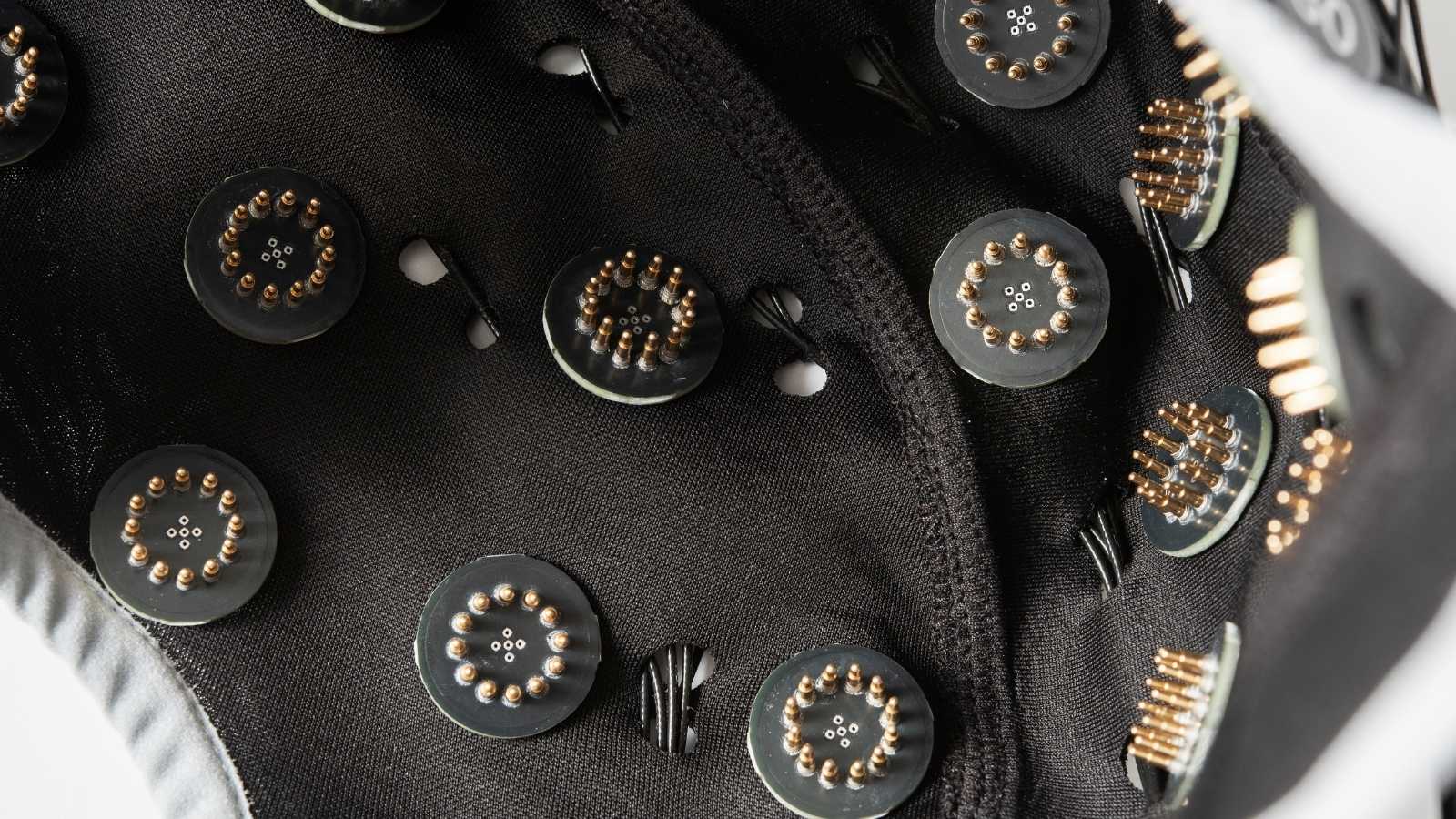
Studying the brain during walking, driving, sports, or naturalistic social interaction demands that subjects actually wear the device. A 128-channel wet-electrode cap that takes 45 minutes to prepare is simply incompatible with ecological validity.
02
Wellbeing and consumer applications
Focus monitoring, stress detection, sleep quality tracking, BCI applications operate in environments where comfort and long-term wearability are everything. Users will not tolerate gel-based systems in everyday life settings.
03
Repeated longitudinal measurements
Longitudinal studies to monitor wellbeing or treatment progress over time require the same person to be measured across many sessions. This applications favor simpler setups that minimize preparation variability and time.
Strategic electrode placement can partially substitute for density.
If your research question concerns a cognitive function with well-understood neural correlates and known electrode locations, you may not need broad coverage at all. Emotion recognition is a useful illustration: frontal electrodes, particularly F3, F4, Fp1, and Fp2, consistently emerge as the most informative channels across multiple channel-reduction strategies — data-driven, prior-knowledge-based, and commercial device comparisons alike (Apicella et al., 2022). For valence recognition specifically, studies on the DEAP dataset have found that reducing from 32 to as few as 3–6 carefully chosen frontal channels costs less than a few percent in classification accuracy. The frontal cortex’s role in emotional valence is well enough established that targeted electrode placement can do a lot of the work that density would otherwise provide.
CAN ALGORITHM COMPENSATE FOR FEWER CHANNELS?
This is where the field is rapidly moving. To a meaningful extent, yes, algorithms can help. But with important caveats.
Below, we explore the most common channel reconstruction technique as well as emerging methods.
Channels interpolation
The classical approach to filling in a missing or noisy channel is spherical-spline interpolation, available in standard packages like MNE-Python. It works by fitting a smooth spatial function across the observed channels and predicting the missing one. For high-density arrays where the missing electrode is surrounded by many neighbors, it performs quite well. But as channel density drops and the gaps between electrodes grow, spatial smoothness alone becomes an inadequate prior. The method degrades sharply in exactly the scenarios where you most need it: low-density arrays and aggressive upsampling.
EEG Foundation Models for channels reconstruction
Recent work on learned interpolation is changing this picture. ZUNA, a 380-million-parameter diffusion autoencoder developed by Zyphra, is a compelling recent example (Warner et al., 2026). The model was trained on approximately two million channel-hours of EEG data spanning 208 public datasets. Its key architectural insight is a four-dimensional rotary positional encoding over the (x, y, z) scalp coordinates of each electrode plus time — meaning the model learns to represent where each electrode sits on the head, rather than assuming a fixed montage. This allows it to reconstruct channels at arbitrary positions, including locations that were never recorded, from the information in the remaining channels.
ZUNA substantially outperforms spherical-spline interpolation across a range of datasets and dropout conditions, and the gap widens as the upsampling factor increases. At 90% channel dropout, spherical-spline interpolation degrades dramatically while ZUNA maintains considerably higher reconstruction fidelity. The model is available open-source (Apache 2.0 license) and integrates with MNE-Python via a pip package.
ZUNA
Zyphra · 2026
Apache 2.0
380M
parameters
2M+
channel-hours training
208
public datasets
256 Hz
sample rate
A masked diffusion autoencoder with 4D rotary positional encoding over (x, y, z, t) — meaning it learns where each electrode sits on the head, not just its index in a fixed montage. This enables reconstruction of arbitrary channel positions, including locations never recorded. It substantially outperforms spherical-spline interpolation, with the gap widening at higher dropout rates (up to 90% channel removal). Available as a pip package with MNE-Python integration.
⚠ Reconstructed channels are imputed data, not ground-truth measurements. Treat accordingly, especially in clinical contexts. The model also operates on 5-second windows only. Long-range temporal context is not yet leveraged.
That said, the limitations are real and worth stating clearly. ZUNA is a generative model — it produces plausible reconstructions, not ground-truth measurements. The reconstructed channels should be treated as imputed data, not as if a physical electrode had been there. For clinical decision-making, reconstructed channels should be interpreted with appropriate caution. The model is also currently trained on five-second epochs at 256 Hz, so it does not yet leverage long-range temporal context across multi-minute recordings. And while its performance generalizes impressively across datasets, it remains strongest in the scenarios it was trained on: recordings with reliable 3D electrode coordinates and standard preprocessing.
The practical upshot: algorithmic upsampling is a genuine and growing tool for extending what lower-density systems can do. It is not a free lunch, but it is increasingly a real option for preprocessing pipelines, particularly in research contexts where the goal is group-level inference rather than individual clinical interpretation.
BRAINACCESS ANGLE: WHAT CAN YOU DO WITH OUR DEVICES?
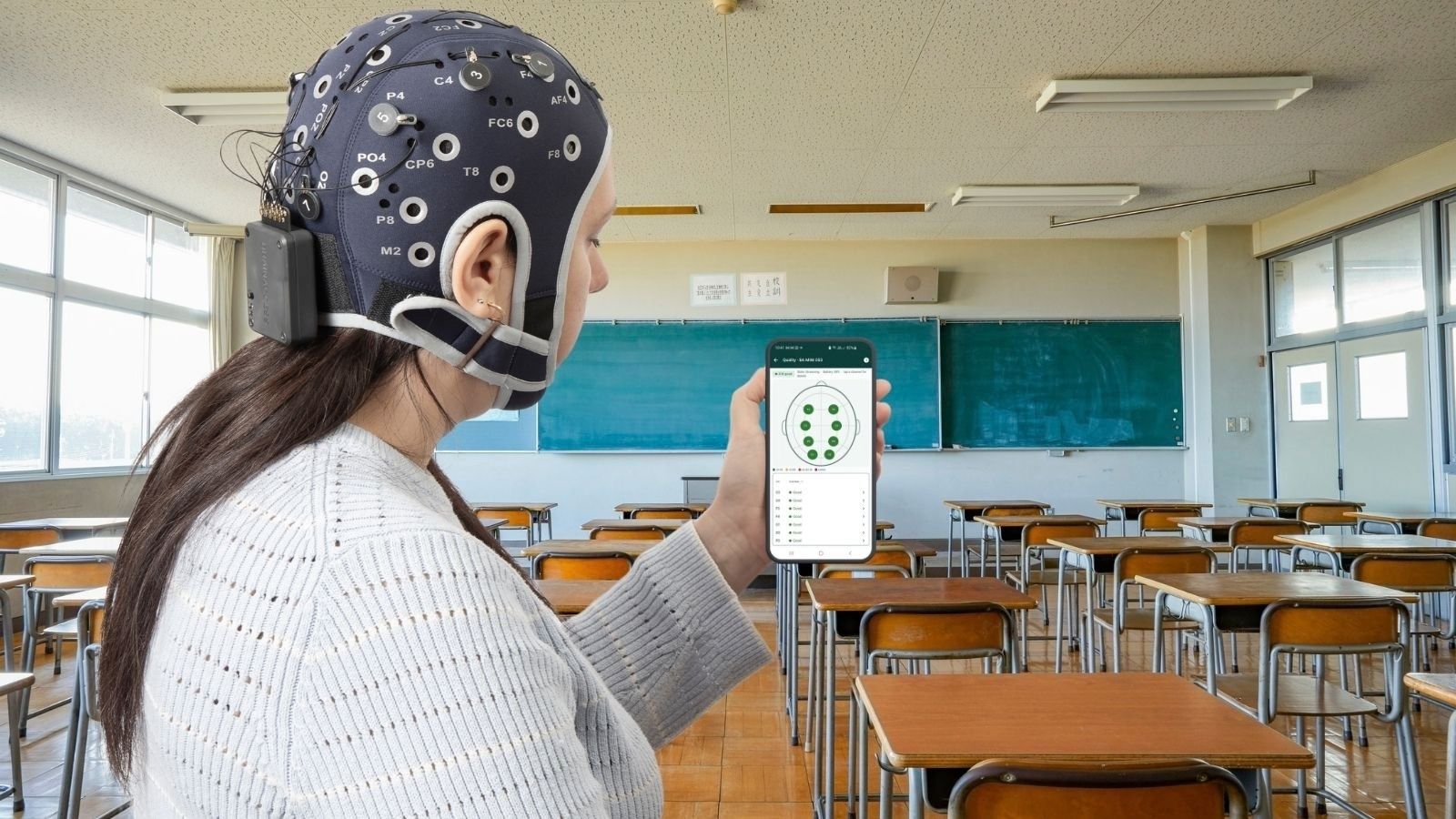
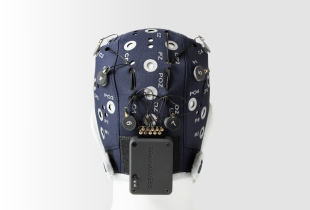
BrainAccess offers systems across a range of channel counts — from the compact HALO (4 channels) up to the MIDI and MINI configurations at 8, 16, and 32 channels. Each represents a different point on the comfort–coverage spectrum, and understanding what each enables is important before you choose.
BrainAccess HALO
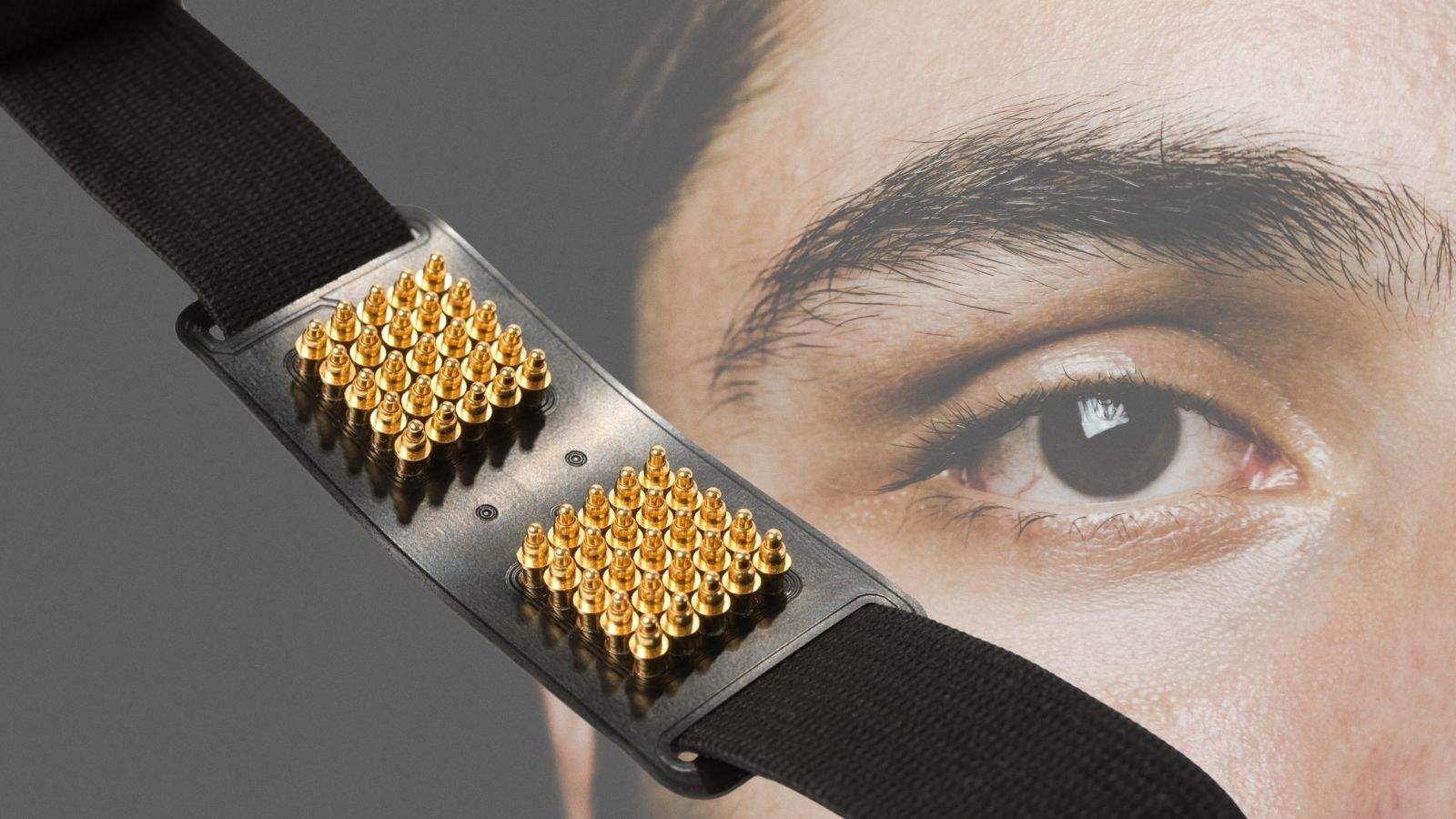
Designed for real-world deployment. With 4 electrodes positioned at frontal and occipital sites, it is well suited to applications where the signal of interest is localized and well understood. Focus and attention monitoring, fatigue detection, and basic mental state classification (think focused vs. relaxed paradigms using bandpower features) are natural fits. The frontal placement also covers the channels most informative for emotional valence. What the HALO is not suited for is source localization, broad network analyses, or paradigms that require simultaneous coverage of multiple distant scalp regions. Four channels simply cannot constrain those problems, regardless of the algorithm applied downstream
BrainAccess MINI and MIDI
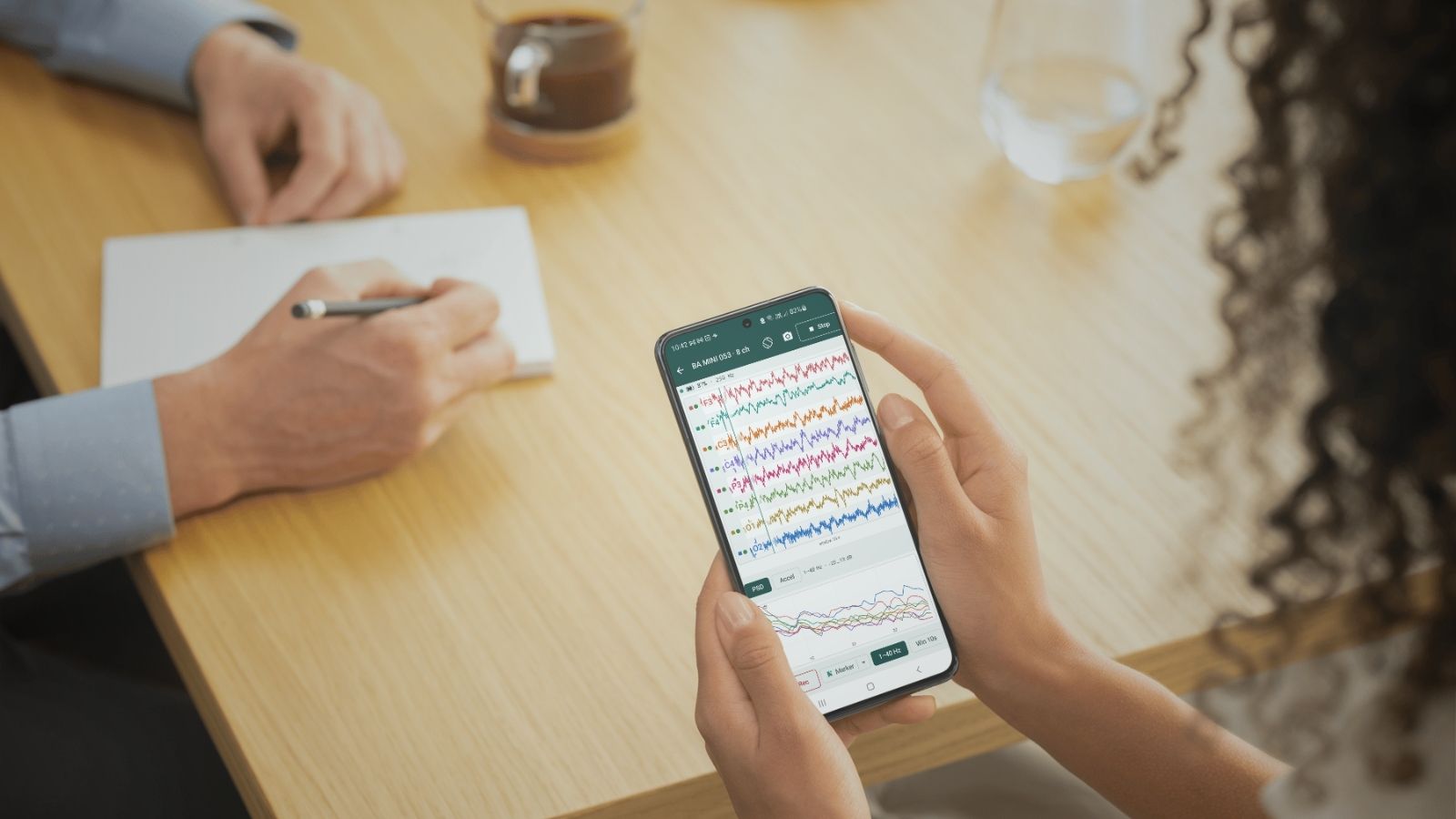
The 8–16 channel range opens up considerably more flexibility. You can cover frontal, central, and parietal regions simultaneously, enabling ERPs (P300, N200), motor imagery paradigms (using sensorimotor channels C3/C4), and SSVEP responses from occipital electrodes. This is a solid range for BCI research and applied neuroscience work that does not require full source localization.
BrainAccess MAXI
The 32-channel configuration brings you into the territory of more serious cognitive neuroscience research. You can run ICA, recover multiple independent components with reasonable fidelity, and tackle questions about spatial distribution of neural activity. It remains portable and preparation is manageable relative to clinical 64+ channel systems.
Shop our EEG solutions



THE GENERAL FRAMEWORK
Before choosing a channel count, it helps to work through a few questions:
1. What is the spatial distribution of your signal of interest?
Localized signals at known electrode positions need fewer channels. Distributed or poorly localized signals need more.
2. Where will the recording happen?
Lab recordings tolerate longer prep time and more electrodes. Field, clinical, or longitudinal studies favor simplicity.
3. Who is wearing the device?
Healthy adults in a lab can tolerate more than children, patients, or users in naturalistic settings.
4. What does your analysis pipeline require?
ICA benefits from more channels. Simple bandpower features or ERP averaging at known sites do not.
5. Can you compensate algorithmically?
If you have a well-characterized signal and access to modern imputation tools, lower-density systems can punch above their weight… but this is not a substitute for thinking carefully about the first four questions.
Have questions about which BrainAccess system fits your application?
Reach out at [email protected].
References
[1] Lau, T. M., Gwin, J. T., & Ferris, D. P. (2012). How many electrodes are really needed for EEG-based mobile brain imaging? Journal of Behavioral and Brain Science, 2(3), 387–393.
[2] Apicella, A., Arpaia, P., Isgrò, F., Mastrati, G., & Moccaldi, N. (2022). A survey on EEG-based solutions for emotion recognition with a low number of channels. IEEE Access, 10, 117411–117428.
[3] Warner, C., Mago, J., Huml, J. R., Osman, M., & Millidge, B. (2026). ZUNA: Flexible EEG superresolution with position-aware diffusion autoencoders. arXiv:2602.18478.