
What Are Brainwaves?
Brainwaves are rhythmic electrical activities produced by neurons in your brain. They’re typically categorized by their frequency (measured in Hertz, Hz):
- Delta (0.5–4 Hz): Dominant during deep sleep, essential for restorative processes.
- Theta (4–8 Hz): Linked to memory, meditation, and dreaming.
- Alpha (8–13 Hz): Associated with relaxation, eyes-closed rest, and creativity.
- Beta (13–30 Hz): Reflective of alertness, concentration, and active thinking.
- Gamma (>30 Hz): Related to high-level cognition, information integration, and consciousness.
These frequencies help us decode various states of the brain, from sleep stages to intense concentration.
Why Measure EEG Power?
EEG power represents the strength of these brainwave signals. By accurately measuring EEG power, we can understand how prominently each brainwave component is represented in the EEG signal and identify which frequencies dominate the brain’s response at any given moment. This offers valuable insights into cognitive states, emotional well-being, neurological conditions, and overall brain health, and can even help predict specific mental or physical activities a person may be engaged in.
Reliable EEG power measurements are essential for a wide range of applications, from advancing health optimization strategies to supporting scientific research and enabling the development of more accurate brain-computer interfaces (BCI).
Challenges in Measuring Real EEG Power
Measuring accurate EEG power isn’t straightforward. Several factors complicate the interpretation. For example:
- Noise and Signal Quality: External electrical interference or muscle movements can distort EEG signals.
- Interindividual differences: The frequency range and dominant peak of specific brainwaves can vary slightly between individuals, making it challenging to define universal parameters that work equally well for everyone.
- Aperiodic Activity: EEG recordings include brainwaves (or rhythmic, periodic activity) and non-rhythmic neural background activity (aperiodic activity). Discerning genuine rhythmic signals from the background aperiodic “noise” can be challenging.
Traditional EEG power analyses often neglect to differentiate clearly between genuine rhythmic oscillations and the underlying aperiodic background.
The Importance of Aperiodic Activity
Interestingly, the aperiodic background, often considered “noise,” itself provides meaningful physiological information. Its slope and shape relate to:
- Age-related cognitive decline
- Cognitive workload
- Neurotransmitter balance
- Neuropsychiatric disorders
Recognizing and analyzing this component of EEG data enhances our understanding of brain function and health.
A New Methodological Approach: Parameterizing Neural Power Spectra
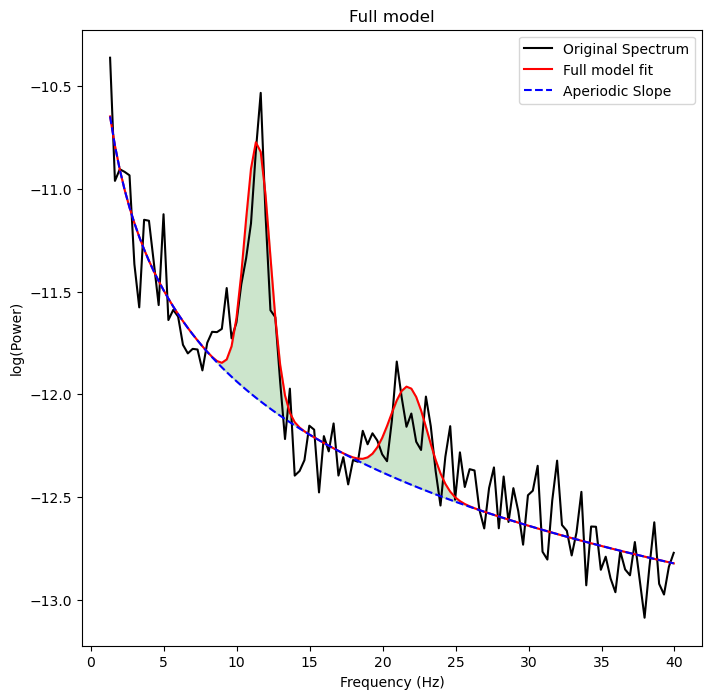
A groundbreaking approach published in Nature Neuroscience by Donoghue and colleagues (2020) provides a more sophisticated method for analyzing EEG signals. Rather than merely identifying peaks, their approach parameterizes the entire EEG spectrum into periodic and aperiodic components.
By modeling these two components together, this method has two major advantages:
- Precision: It accurately distinguishes real oscillations from the aperiodic background.
- Insight: It leverages the information contained within the aperiodic slope, often ignored in traditional analyses.
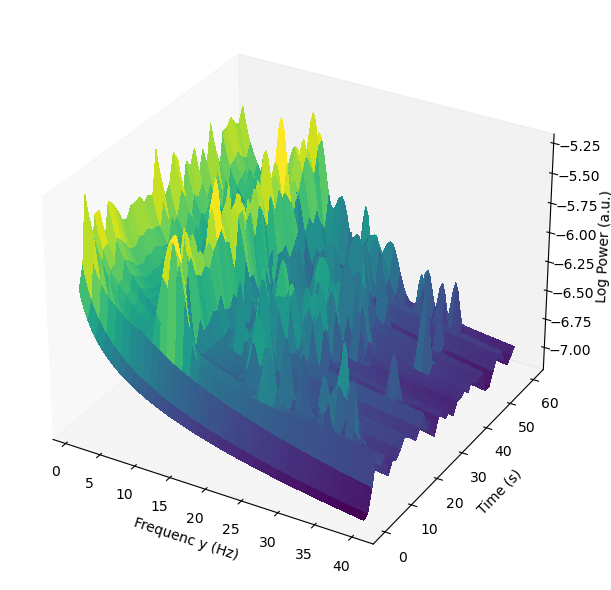
Additionally, Wilson et al. (2022) extended this work by providing a time-resolved framework for analyzing the dynamic evolution of parameterized EEG spectral components. In their approach, the spectrum is collected and parameterized approximately every second or at the desired temporal resolution. The resulting data is compiled into a spectrogram-like representation.
BrainAccess: Leading the Way
At BrainAccess, we recognize these methodological complexities and actively incorporate these robust solutions for measuring both periodic and aperiodic EEG components. By doing so, we aim to advance the clarity, accuracy, and applicability of EEG analysis in neuroscience research and practical applications.
Conclusion
Accurately understanding EEG power goes beyond merely observing brainwaves—it requires careful consideration of both periodic oscillations and underlying aperiodic dynamics. Embracing these complexities enhances our ability to harness EEG data, opening doors to improved cognitive therapies, personalized brain health strategies, and deeper insights into human cognition.
Stay tuned to BrainAccess as we continue to innovate and share more insights into the fascinating world of EEG and brain health!