
Hyperscanning means recording EEG from two or more people at once while they interact, instead of studying one brain at a time. Researchers use it to see whether people’s brain activity synchronize during things like music duets, cooperative or competitive games, and even flight simulations with pilot pairs. Running these studies is technically tricky, since it means keeping multiple devices synchronized and monitoring signal quality across everyone at once. This is exactly what platforms like BrainAccess are built to handle.
What is it, and how does it work?
Most brain research focus on one individual participant at a time. But so much of what makes us human happens between people. For example, researchers may be asking what happens when people are cooperating, competing, playing music together, or having a conversation.
Hyperscanning answer to this demand by recording brain activity from two or more people simultaneously. Electroencephalography (EEG) is a natural fit for this application because it’s fast, wireless, and captures activity down to the millisecond. The high temporal resolution is especially important for catching moments of connection between brains.
Once you have simultaneous recordings, the real question is whether the two people’s brain signals move together, a phenomenon usually called inter-brain coupling. Researchers have a surprising number of ways to measure this:
- whether the phase of an oscillation lines up between partners (useful when exact timing matters, like in duet music performance)
- whether the amplitude or “envelope” of activity rises and falls together (better suited when signals are noisy or timing is looser)
- whether one person’s brain activity actually predicts the other’s, revealing who’s leading and who’s following.
Where is it used?
Hyperscanning studies span different fields of application:
Rhythm, music, and motor synchronization
Researchers use hyperscanning to measure how musicians connect when they play together. For example, guitar duets have shown increased synchronized brain activity between players as they lock into a shared rhythm, and finger-tapping; hand-imitation studies have used similar setups to show that “leaders” and “followers” in a joint task can be told apart just from patterns of frontal brain activity.
Game-theory paradigms
Classic tasks like the Prisoner’s Dilemma have been adapted for hyperscanning, showing that cooperating pairs tend to develop denser connectivity between their brains than pairs where one person defects. However, defecting can produce stronger activity within each individual brain as well.
Computer-based tasks
Researchers can use simple joint games (i.e., cooperatively guiding a virtual ball to a target, or competitive ball-and-paddle games) to directly compare cooperative and competitive brain dynamics. These studies generally find that cooperation produces tighter synchronization than competition.
Real-life applications
Hyperscanning can be used also to simulate real life scenario. For instance, pairs of pilots and co-pilots have been hyperscanned during flight simulations, revealing spikes in inter-brain connectivity during the most demanding, closely coordinated phases like takeoff and landing. Similar setups have even been tried in workplace role-plays between managers and employees.
Joint action research more broadly
Beyond social neuroscience, hyperscanning is increasingly used to study coordinated action itself: how two musicians, dancers, or collaborators align not just their behavior but the underlying neural processes, and whether that alignment reflects something shared (like a joint goal) or is just a byproduct of both people hearing or seeing the same thing.
Challenges of hyperscanning
Hyperscanning comes with some challenges that make it complex from scientific and logistic perspective.
Firstly, one of the trickier parts of designing a good hyperscanning study is choosing the right measurement. Whether you record phase, amplitude, or predictive measures can change the outcome of your experiment and what you can expect.
Moreover, figuring out whether any coupling you find is a meaningful social effect is not trivial. Sometimes, effects can emerge from just two people reacting separately to the same sound or image. A real “connection” study requires a strong experimental design and stimuli formulation.
Another challenge is in the practical synchronization. Running a hyperscanning study can be a genuine logistical challenge: multiple EEG systems need to record at once, stay tightly synchronized in time, and give the researcher a way to monitor everyone’s signal quality without juggling several separate setups.
But fear not! At BrainAccess, we can help with that!
Why BrainAccess is well suited for hyperscanning
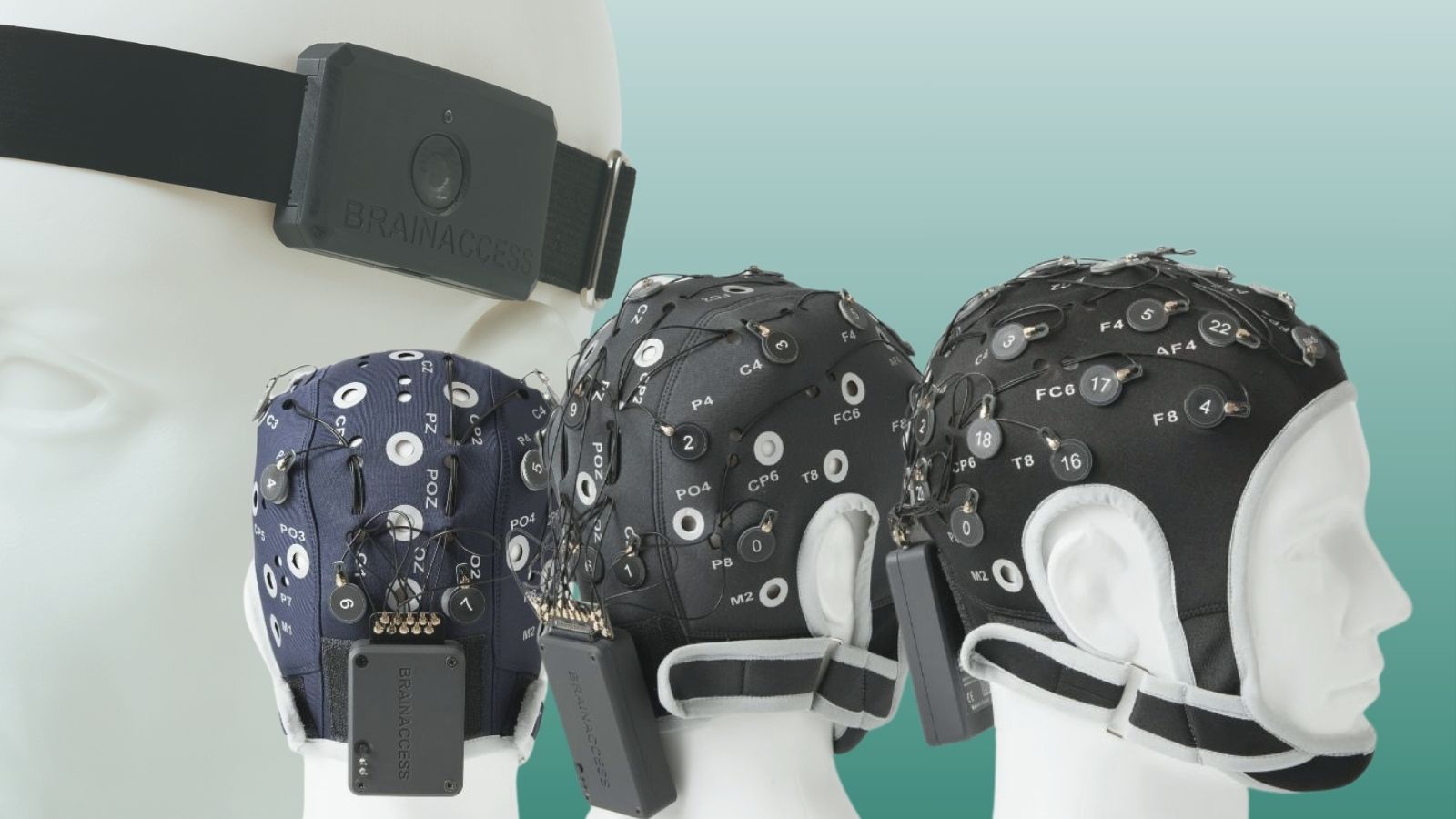
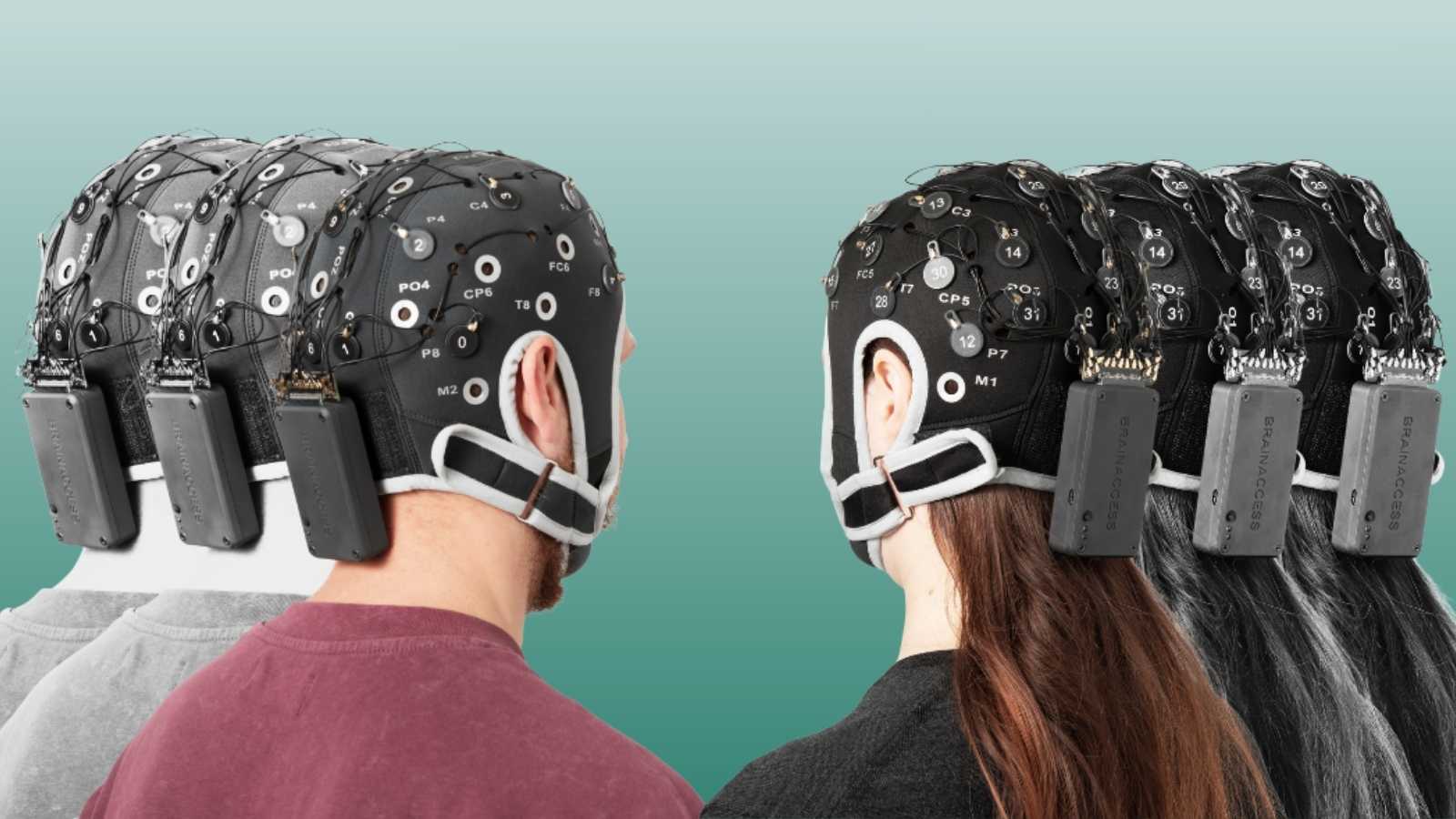
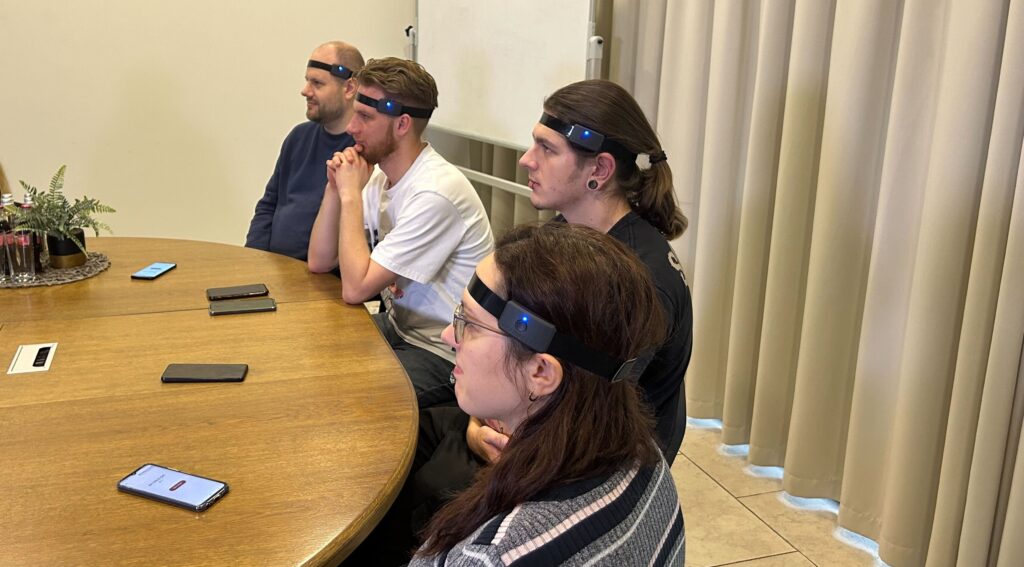
BrainAccess supports multiple devices connected at the same time, allowing EEG signals from different participants to be streamed, monitored, and recorded in parallel.
BrainAccess Board makes it possible to check the status of each device, monitor signal quality across participants, visualize the EEG data, and manage recordings from a single interface.
A few things make this work in practice. BrainAccess relies on the Lab Streaming Layer (LSL) protocol to keep data from different devices synchronized in time. This is extremely important, since even small timing misalignments can distort measures like phase synchrony.
The devices themselves are wireless and portable, so a research team isn’t stuck cabling several participants together in a fixed lab setup. This is useful if a study wants to move toward more naturalistic, real-world conditions, like the pilot and workplace studies mentioned above.
Because BrainAccess offers free SDKs (Python, C, C++, Kotlin), researchers can build custom analysis or stimulus-presentation pipelines on top of the core system when a study calls for something more specific.
Practically, this means a two-, three-, or multi-person hyperscanning session can be set up and monitored from one screen, rather than stitching together multiple independent recording systems by hand.
Finally, when many devices are connected at the same time, checking their status and data quality in real-time can easily become a headache. That is why, the new version of BrainAccess Board, will include Jena, a powerful AI assistant, that can monitor all your active streams (even when 10+ devices are connected together), troubleshoot problems, and flag EEG quality issues.
Stay tuned for Jena’s upcoming release!
Conclusion
Hyperscanning is a reminder that some of the most interesting things happening in the brain aren’t happening in just one brain, they’re happening between brains, in the split-second give-and-take of cooperating, competing, or simply coordinating with someone else.
As the tools for multi-person EEG recording become easier to set up and manage, expect hyperscanning to keep moving beyond specialized neuroscience labs and into more everyday questions about how people connect.
Reference
[1] Balconi M and Vanutelli ME (2017) Cooperation and Competition with Hyperscanning Methods: Review and Future Application to Emotion Domain. Front. Comput. Neurosci. 11:86. doi: 10.3389/fncom.2017.00086
[2] Zamm, A., Loehr, J. D., Vesper, C., Konvalinka, I., Kappel, S. L., Heggli, O. A., … & Keller, P. E. (2024). A practical guide to EEG hyperscanning in joint action research: from motivation to implementation. Social cognitive and affective neuroscience, 19(1), nsae026.